
Cable Chest Exercises
Isolate and develop upper, mid, and lower pectoral fibers with movements like the cable crossover and cable chest press. Cables maintain high adduction tension across the midline that dumbbells cannot replicate.
Unlike free weights whose resistance is constrained to the vertical downward vector of gravity, cable machines exert continuous mechanical tension directly along the line of the wire. By adjusting the pulley carriage height, you can align the resistance curve to match muscular strength profiles across every angle of movement.
From staple multi-joint pulls like the lat pulldown and seated cable row to precision isolation lifts like the face pull, cable crossover, and tricep pushdown, cables eliminate biomechanical dead zones and load muscles under continuous stretch. Explore our full library categorized by muscle group below, or jump directly to our starter full-body workout routine.
To browse other training implements in our collection, return to our guide on exercises by equipment.
Explore foundational cable movements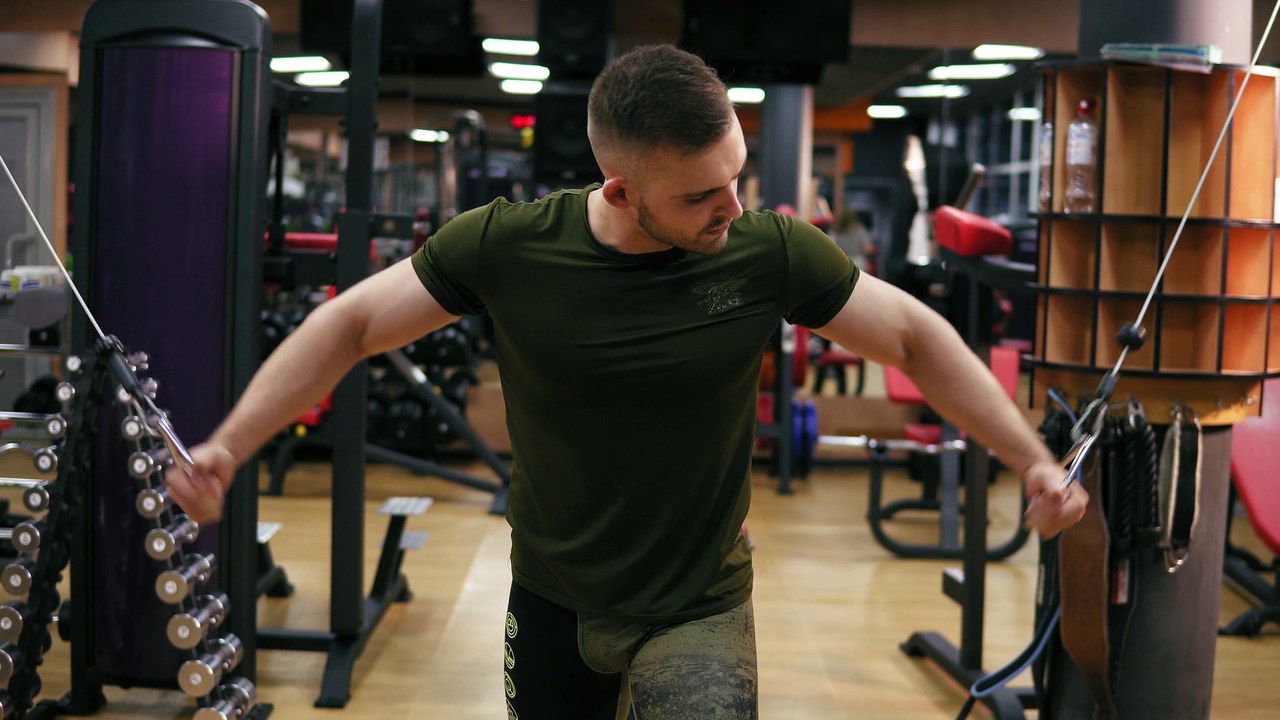
Cable exercises excel where barbells and dumbbells suffer from mechanical drop-offs. In free weight movements, the resistance torque depends entirely on the horizontal distance between the joint and the weight path. With cables, the resistance vector originates at the pulley, ensuring constant mechanical tension throughout both eccentric and concentric phases.
| Exercise | Movement Family | Primary Muscles | Key Mechanical Focus |
|---|---|---|---|
| Face pull | Horizontal pull + rotation | Rear deltoids, rhomboids, infraspinatus, middle traps | Set pulley at eye height. Pull rope attachment toward face while externally rotating thumbs backward, counteracting postural internal rotation. [1] |
| Seated cable row | Horizontal pull | Latissimus dorsi, middle trapezius, rhomboids, biceps | Maintain an upright neutral torso without excessive lumbar rocking; drive elbows back past the ribcage to achieve full scapular retraction. |
| Tricep pushdown | Elbow extension | Triceps brachii (lateral, medial, and long heads) | Pin elbows firmly to the sides of the torso; extend elbows to full contraction and flare rope outward at the bottom to maximize peak tension. |
| Lat pulldown | Vertical pull | Latissimus dorsi, teres major, lower traps, biceps | Depress and retract the scapulae before initiating elbow flexion; pull bar to upper chest without swinging torso excessively backward. |
| Cable curl | Elbow flexion | Biceps brachii, brachialis, brachioradialis | Continuous tension at full elbow extension where dumbbells go slack; keep upper arms motionless and curl against the constant cable line. |
| Cable crossover | Horizontal adduction | Pectoralis major (sternal and clavicular fibers), anterior delts | Maintain a subtle bend in the elbows; bring hands together in front of the sternum to achieve peak chest contraction without shoulder impingement. |
| Cable lateral raise | Shoulder abduction | Lateral deltoid, supraspinatus | Set pulley at knee height and pull across the body; produces intense tension at the bottom of the raise where dumbbells provide zero torque. |
| Cable crunch | Spinal flexion | Rectus abdominis, obliques | Kneel facing or away from high pulley; curl the ribcage down toward the pelvis through active spinal flexion without hinging at the hips. |
| Pull through | Hip hinge | Gluteus maximus, hamstrings, adductors | Straddle low pulley cable; hinge hips deep backward toward the stack, then drive hips forward into full extension, loading the glutes in stretch. |
| Pallof press | Anti-rotation core | Transverse abdominis, internal and external obliques, glutes | Stand perpendicular to mid-pulley; press D-handle straight out from chest, resisting the rotational moment arm that attempts to twist your torso. |
In classical free-weight movements such as the dumbbell lateral raise or chest fly, the resistance torque drops to zero when the weight hangs directly beneath the joint axis. By contrast, a cable pulley redirects the resistance vector perpendicular to the limb at the start of the movement. Research by Maeo et al. (2023) demonstrates that training muscles under high mechanical tension while in their lengthened (stretched) positions produces superior fascicle lengthening and hypertrophic adaptations compared to training solely in shortened states. Cables allow trainees to fine-tune the starting angle, providing heavy resistance right where muscle sarcomeres undergo maximum active lengthening.
Because cable carriages adjust to any height between the floor and ceiling, you can target specific muscular heads with surgical precision. Explore our dedicated equipment guides for every major muscle group across the body:
Isolate and develop upper, mid, and lower pectoral fibers with movements like the cable crossover and cable chest press. Cables maintain high adduction tension across the midline that dumbbells cannot replicate.
Build back width and thickness with the seated cable row, lat pulldown, and straight arm pulldown. Cables allow unrestricted elbow trajectories that spare the lower back.
Target all three deltoid heads with the cable lateral raise, cable front raise, and cable upright row, ensuring continuous tension from the very beginning of the range of motion.
Maximize arm development with stable resistance curves for both pushing and pulling patterns. Balance elbow flexion and extension with continuous cable resistance.
Overload the lateral, medial, and long heads with the tricep pushdown and overhead cable extensions. Adjust pulley height to emphasize peak stretch or peak contraction.
Eliminate slack at the bottom of the curl with the cable curl and cable reverse curl. Constant tension stimulates deep muscle fibers throughout the entire arc.
Isolate the latissimus dorsi through both vertical and horizontal planes using the lat pulldown and close grip lat pulldown, optimizing the line of pull along lat fibers.
Strengthen the rhomboids, middle traps, and teres major with targeted rows and face pulls, building scapular retractors and athletic posture.
Target the posterior deltoid with the face pull and rear delt cable flys, removing shoulder impingement risk common with heavy free weights.
Broaden the shoulders by keeping the lateral deltoid loaded right from hip level using the cable lateral raise, dramatically improving the stimulus-to-fatigue ratio.
Load the anterior shoulder head through smooth flexion paths using the cable front raise and high-angle cable presses.
Load the upper, middle, and lower trapezius with the cable shrug and cable upright row, benefiting from diagonal pull lines that follow muscle striations.
Rehabilitate and stabilize the glenohumeral joint using the cable external rotation and internal rotation, maintaining exact 90-degree tension vectors throughout.
Progressively overload the rectus abdominis with real resistance using the cable crunch, moving beyond high-rep bodyweight sit-ups.
Strengthen rotational power and anti-rotational core stability using the pallof press and cable woodchoppers across diagonal planes.
Target the gluteus maximus and medius with the pull through and cable hip abduction, delivering high glute tension in both stretched and contracted positions.
Overload the posterior chain hip hinge with the pull through and single-leg cable Romanian deadlifts, sparing the lower back from heavy barbell compressive forces.
Complement squats with targeted hip abduction, adduction, and lunges using the cable hip abduction and cable hip adduction for complete hip stability.
A cable machine—often configured as a dual adjustable pulley (DAP), functional trainer, or multi-station cable crossover—is a resistance training apparatus that transmits force from a selectorized weight stack to the trainee through a system of flexible aircraft-grade steel cables, nylon pulleys, and adjustable vertical carriages.
Adjustable carriages slide vertically along chrome guide columns with pin-lock mechanisms. The pulley swivels 180 degrees horizontally, permitting natural arc paths and multi-planar movements without cable binding.
Machined cast iron or steel weight plates glide smoothly along two vertical guide rods. Trainees select the load instantly using a magnetic selector pin, allowing rapid drop sets and precise 2.5 to 5-pound micro-adjustments.
High-tensile steel wire core coated in protective nylon or polyurethane ensures frictionless travel through ball-bearing pulleys, dampening vibrations and eliminating jerky momentum changes.
Standardized steel carabiners clip onto the terminal eyelet of the cable, enabling trainees to swap handles, ropes, bars, and ankle cuffs in seconds to match the biomechanical demands of each exercise.
Understanding the mechanical ratio of your cable machine is essential for accurate load tracking. Different pulley configurations alter both the effective resistance you lift and the distance of cable travel.
| Pulley Ratio | Effective Load at 100 lb Stack | Cable Travel Distance | Common Applications |
|---|---|---|---|
| 1:1 Ratio (Single Pulley) | 100 lbs (100% of stack) | Equal to stack displacement | Lat pulldown stations, dedicated seated cable rows, heavy tricep pushdown stations. Delivers maximum direct loading for heavy compound pulling. |
| 2:1 Ratio (Dual Adjustable Pulley) | 50 lbs (50% of stack) | Twice the stack displacement | Functional trainers, dual cable crossovers. Smooth travel allows explosive athletic movements, crossovers, and long-range lunges without the weight stack bottoming out. |
| 4:1 Ratio (High Velocity) | 25 lbs (25% of stack) | Four times the stack displacement | Rehabilitation units and athletic sprint stations. Enables ultra-high-speed multi-directional agility drills without weight stack inertia throwing the trainee off balance. |
This full-body cable workout routine is designed for complete muscular development, balance, and joint longevity. Performing a full-body routine on a cable station provides continuous mechanical tension with minimal joint shear, making it exceptionally effective for beginners through advanced lifters.
| Exercise | Target Muscle Group | Sets & Reps | Rest | Coaching Cue |
|---|---|---|---|---|
| 1. Cable chest press | Chest, anterior delts, triceps | 3 × 8–10 reps | 90 sec | Set pulleys at mid-chest height. Step into a staggered stance, brace core, and press forward with hands converging slightly at peak lockout. |
| 2. Seated cable row | Lats, rhomboids, mid-traps | 3 × 10–12 reps | 90 sec | Sit with knees slightly bent. Drive elbows straight back along your ribcage, squeezing shoulder blades together without swinging torso backward. |
| 3. Lat pulldown | Latissimus dorsi, teres major | 3 × 10–12 reps | 90 sec | Grip bar slightly wider than shoulder-width. Pull down to the collarbone while driving elbows downward and outward; control the 3-second negative. |
| 4. Pull through | Glutes, hamstrings | 3 × 12–15 reps | 75 sec | Set pulley at lowest setting with rope attachment. Face away, reach between legs, push hips back into a deep hinge, and snap hips forward to finish tall. |
| 5. Cable lateral raise | Lateral deltoid (side shoulders) | 3 × 12–15 reps | 60 sec | Set pulley at knee height. Pull cable diagonally across the body up to shoulder height, leading with the elbow and maintaining continuous tension. |
| 6. Face pull | Rear delts, external rotators, upper traps | 3 × 15 reps | 60 sec | Set pulley at eye level with rope. Pull towards forehead while rotating hands back so thumbs point behind you; hold peak contraction for 1 second. |
| 7. Superset: Tricep pushdown + Cable curl | Triceps and biceps brachii | 2–3 × 12–15 reps each | 60 sec after pair | Keep upper arms anchored firmly to your torso. Lock out triceps fully with a slight rope flare, then curl smoothly against the constant cable line. |
| 8. Pallof press | Transverse abdominis, obliques (core) | 2–3 × 10–12 reps per side | 45 sec | Stand athletic stance perpendicular to pulley. Press D-handle straight out from sternum; hold 2 seconds against rotational pull before returning. |
If you are new to cable machines, start by checking the pulley ratio of the station (marked on the pulley carriage or manufacturer plate). When stepping out to initiate an exercise, always set your foot stance and core brace before pulling against the cable. Control the eccentric return—never let the weight stack crash against the base. Because cables supply unbroken tension, begin with modest loads (12 to 15 controllable repetitions) to master movement paths before escalating resistance.
Browse our complete index of cable exercises with detailed movement classifications, primary muscle targets, and technique summaries:
Primary Target: Rear Deltoids, Rotator Cuff, Upper Traps
The ultimate posture and shoulder health exercise. Pulling a high rope toward the forehead with external rotation balances out anterior pressing volume.
Primary Target: Latissimus Dorsi, Rhomboids, Middle Traps
Foundational horizontal pull delivering continuous tension through full scapular retraction without loading the lumbar spine in axial compression.
Primary Target: Triceps Brachii (Lateral & Medial Heads)
The definitive tricep isolation lift. Pinning elbows to the ribs and flaring the rope at the bottom creates intense peak terminal contraction.
Primary Target: Latissimus Dorsi, Teres Major
Essential vertical pull for back width and v-taper development. Adjusting grip width and torso angle alters lat fiber recruitment.
Primary Target: Biceps Brachii, Brachialis
Unlike barbell curls where tension drops at the bottom, cable curls keep the biceps under constant tension across the entire elbow flexion arc.
Primary Target: Rectus Abdominis
Enables progressive overload for the abdominal wall. Curling the ribcage toward the pelvis against a high pulley loads the abs under genuine resistance.
Primary Target: Pectoralis Major (Sternal & Clavicular Fibers)
Standing horizontal adduction exercise that maintains full chest tension across the midline, far surpassing the dumbbell fly resistance profile.
Primary Target: Upper Trapezius
Setting low pulleys slightly wider than shoulder width allows an upward and inward pull line that matches the diagonal fiber orientation of the upper traps.
Primary Target: Lateral Deltoids, Upper Trapezius
Smooth vertical pull with continuous tension that avoids the rigid wrist binding typical of straight barbell upright rows.
Primary Target: Lateral Deltoid
Setting the pulley at knee height provides heavy tension at the start of abduction, stimulating superior lateral shoulder growth compared to dumbbells.
Primary Target: Gluteus Maximus, Hamstrings
Posterior chain hip hinge performed facing away from a low pulley. Teaches clean hip extension mechanics with minimal lower back shear stress.
Primary Target: Latissimus Dorsi, Teres Major
Pure lat isolation movement that removes biceps involvement entirely, loading the lats through shoulder extension in a lengthened arc.
Primary Target: Lower Latissimus Dorsi, Biceps
Using a V-handle or close neutral attachment increases elbow adduction travel, providing a deep stretch and powerful lower lat activation.
Primary Target: Pectoralis Major, Anterior Deltoids, Triceps
Standing or seated press on adjustable pulleys. Demands multi-planar core stability while allowing the pressing path to converge naturally inward.
Primary Target: Infraspinatus, Teres Minor (Rotator Cuff)
Gold-standard shoulder stability exercise. Pinning elbow to side and rotating outward against horizontal resistance protects against impingement.
Primary Target: Anterior Deltoid
Low pulley front shoulder raise that delivers constant tension right from thigh level, overloading anterior deltoid fibers smoothly.
Primary Target: Transverse Abdominis, Obliques
Premier anti-rotation core builder. Extending hands outward from the chest magnifies the rotational lever arm, training the torso to resist twisting.
Primary Target: Gluteus Medius, Gluteus Minimus, Tensor Fasciae Latae
Ankle-cuff exercise loading the outer hip against continuous lateral resistance, strengthening pelvic stability during single-leg stance.
Primary Target: Adductor Longus, Adductor Magnus, Gracilis
Ankle-cuff pull crossing the midline of the body, building inner thigh strength and protecting against groin strains during cutting sports.
Primary Target: Brachioradialis, Forearm Extensors, Brachialis
Overhand pronated curl targeting the outer forearm and brachialis with smooth resistance that spares the wrist joints.
Clear, biomechanically grounded answers to common questions regarding cable training, exercise selection, and workout programming:
When coaches discuss "the only 5 exercises you'll ever need," they refer to the five foundational human movement patterns: a squat (knee flexion), a hinge (hip extension), a horizontal or vertical push, a horizontal or vertical pull, and a core brace or carry. On a cable machine, these five patterns can be comprehensively trained using the cable front squat or pull through (squat/hinge), the cable chest press (push), the seated cable row or lat pulldown (pull), and the Pallof press (core brace). While no single apparatus replaces all training modalities, cables can fulfill every essential pattern with continuous joint-friendly tension.
The 3-3-3 rule is a popular workout programming framework designed to maintain consistency without mental overload. It typically consists of training 3 days per week, performing 3 primary exercises per workout session, and completing 3 sets per exercise (often between 8 to 12 repetitions). For cable training, a 3-3-3 full-body session might combine a cable chest press (3 sets), a seated cable row (3 sets), and a cable pull through (3 sets). This minimalist structure ensures sufficient stimulus for hypertrophy and strength retention while leaving ample recovery time for busy trainees.
Yes, cable workouts are exceptionally effective for both hypertrophy and athletic rehabilitation. Unlike barbells and dumbbells, cables eliminate dead zones where tension dissipates, subjecting muscle fibers to uninterrupted mechanical loading throughout both eccentric and concentric phases. Furthermore, because resistance is redirected through pulleys rather than bearing straight down into the spine, cables generate far lower joint compressive forces, making them ideal for high-volume hypertrophy training, tendon recovery, and shoulder or lower-back longevity.
Unilateral (single-arm) cable exercises are exceptional for identifying and fixing muscular imbalances, expanding active range of motion, and demanding anti-rotational core stabilization. Outstanding single-arm cable exercises include: (1) Single-arm cable lateral raise (delivering isolated tension to each side delt), (2) Single-arm neutral cable row (allowing deep lat stretch and personalized elbow paths), (3) Single-arm cable chest press (combining unilateral pressing power with heavy contralateral core stabilization), and (4) Single-arm cable tricep kickback or pushdown (eliminating dominant arm compensation).
The mechanical principles, anatomical classifications, and workout routines presented above are editorial guidance for healthy adults. Trainees with pre-existing joint or spinal conditions should seek personalized medical clearance before initiating heavy resistance training.