
“I want a more regular routine.”
Explore consistency, motivation, goal-setting and the kind of support you want around training.
Find routine topicsChoose the problem in front of you: fitting activity into the week, repeating a routine or getting started again after time away. A useful first step is to decide what you will do, when it fits and what could get in the way. This collection helps you find the topic that matches that decision.
The detailed guides below are in preparation. Meanwhile, use the planning prompts and research notes on this page to make your next step more specific.
A question about a missed appointment needs a different starting point from a question about a changing work schedule.
Explore consistency, motivation, goal-setting and the kind of support you want around training.
Find routine topicsLook at the constraint: available time, travel, cost, weather or a different time of day.
Find schedule topicsSeparate one missed session from a longer interruption, then choose the topic for your situation.
Find return topicsIn Lally and colleagues' real-world study, volunteers repeated a self-chosen eating, drinking or activity behavior in a consistent daily context and reported how automatic it felt. The researchers modeled changes in that automaticity and found substantial individual variation. This was not a study of how quickly someone regained strength after a training break. [1]
A 2024 review of health-related habit interventions also reported substantial variation in formation times. Most included studies had a high risk-of-bias rating, and only a subset directly reported time to habit formation. Those findings do not establish a fixed-day deadline for making your workout routine automatic. [2]
These detailed guides are in preparation. Their titles become clickable as the pages are added.
Start here for regular training, motivation, goals, a workout partner or all-or-nothing thinking around fitness. Choose the question you need to work through first.
CDC organizes common barriers around issues such as time, social support, cost and weather. Its suggestions include looking for workable activity times and having options that fit the facilities available. [4]
For a missed session, start by reviewing what interrupted the planned time and when the next opportunity is. A longer break raises additional questions about the activity you are returning to; a habit score or a streak cannot answer those for you.
Choose an activity, a time or cue, and an option for an obstacle you can anticipate. NIDDK suggests starting with small changes, making a plan and thinking ahead about roadblocks. [3]
Name the activity and what you need for it. Keep the choice specific enough to put on the calendar.
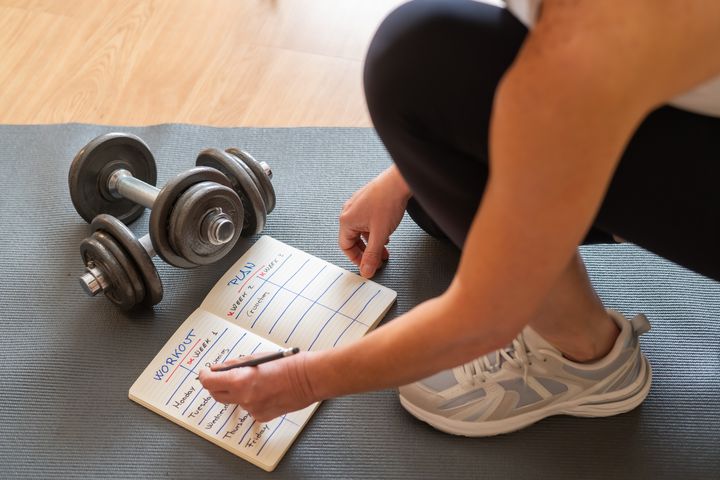
Choose an opportunity in your actual week. CDC recommends scheduling activity and writing it on your calendar. [4]
Think of the obstacle you expect—such as weather or a changed work time—and write down an alternative you can use.
If you need movement instructions now, explore the exercise library. For other training subjects, return to the guide directory.
Written and editorially reviewed with AI assistance by the Fitness Instructor AI Editorial Team. Habit research does not establish a personal training-readiness assessment or a guaranteed timetable. Read our editorial policy.