
Kettlebell Leg Exercises
Develop lower body force with squats, lunges, deadlifts, and hip thrusts. The off-center load increases stabilizer demands through the ankle, knee, and hip joints.
Unlike barbells or dumbbells whose center of mass sits directly inside your grip, a kettlebell positions its weighted sphere several inches outside your palm. This displaced center of mass creates rotational torque, requiring rapid neuromuscular stabilization through your core, shoulders, and hips.
Whether performing explosive ballistics like the kettlebell swing or deliberate grinds like the Turkish get up, kettlebells develop posterior chain power, grip endurance, and 360-degree rotational stability. Explore the full exercise library categorized by muscle group below, or jump to our starter full-body workout routine.
To browse other training implements, return to our guide on exercises by equipment.
Explore foundational kettlebell movements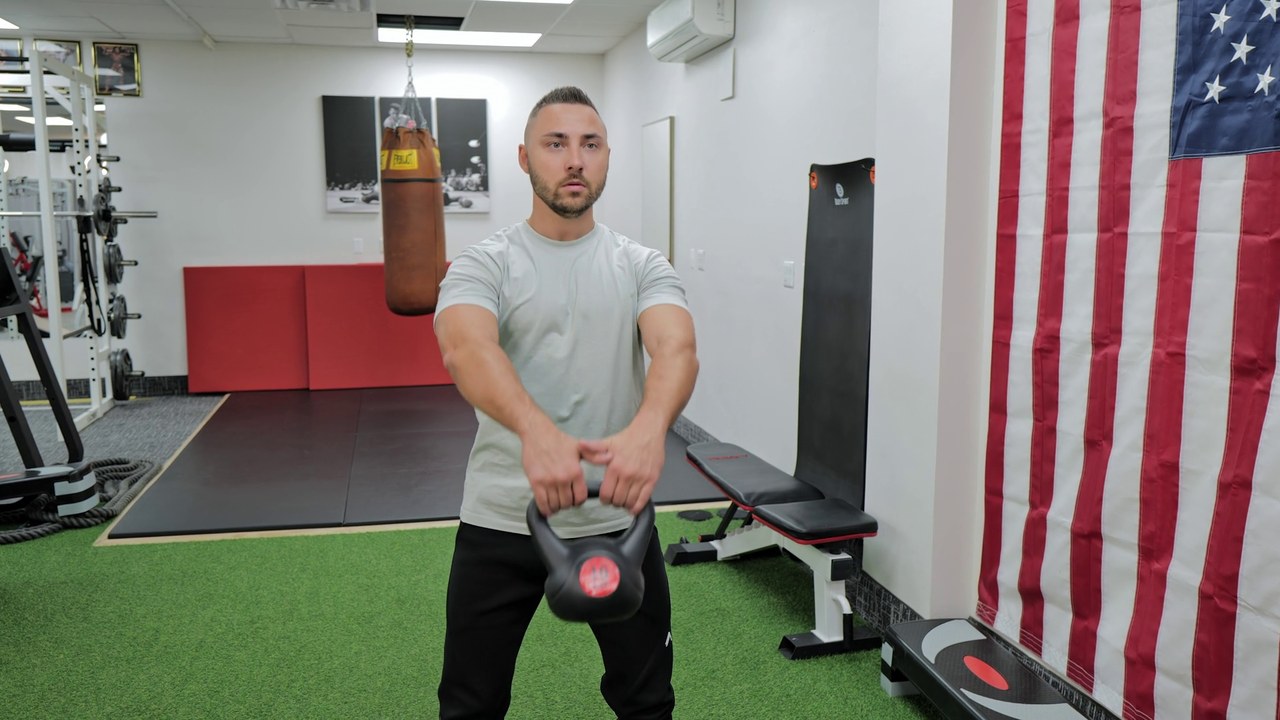
Kettlebell movements divide biomechanically into two distinct families: ballistics (explosive, velocity-based hip hinge cycles with rapid contraction and relaxation) and grinds (slow, deliberate resistance movements demanding continuous high intramuscular tension). Choosing the right combination ensures comprehensive athletic development.
| Exercise | Movement Family | Primary Muscles | Key Mechanical Focus |
|---|---|---|---|
| Kettlebell swing | Ballistic hinge | Glutes, hamstrings, spinal erectors, lats | Snap hips into full extension without hyperextending lumbar spine. Arms act as loose ropes while posterior chain drives velocity. [1] |
| Kettlebell clean | Ballistic transition | Glutes, hamstrings, upper back, forearms | Tame the arc of the bell close to the ribcage, catching it softly in the rack position without bruising the forearm. |
| Kettlebell snatch | Ballistic overhead | Posterior chain, deltoids, trapezius, core | Continuous explosive vertical power from floor to overhead lockout; punch through handle at apex to prevent bell banging wrist. |
| Kettlebell front squat | Grind squat | Quadriceps, glutes, upper back, anterior core | Anterior rack loading forces upright torso posture, recruiting thoracic extensors and deep abdominal wall during knee flexion. |
| Turkish get up | Grind multi-planar | Rotator cuff, deltoids, obliques, glutes | Move through seven distinct transition postures under a continuous vertical isometric lockout, cultivating glenohumeral stability. |
| Kettlebell floor press | Grind press | Pectoralis major, anterior deltoid, triceps | Floor limits humeral extension at 90 degrees, protecting the anterior shoulder capsule while unilateral bell challenges anti-rotation. |
| Gorilla row | Grind pull | Latissimus dorsi, rhomboids, rear delts, core | Hinge over two bells on floor; alternate rowing one while bracing downward pressure through the stationary bell to lock pelvis. |
| Windmill exercise | Grind lateral hinge | Obliques, hamstrings, gluteus medius, deltoids | Hinge laterally into the rear hip while pressing an overhead bell toward the ceiling; builds thoracic rotation and lateral hamstring length. |
Biomechanical research by McGill & Marshall (2012) demonstrated that explosive kettlebell swings generate rapid pulses of muscle activation (~80% MVIC in gluteal muscles and rectus abdominis) followed immediately by complete muscular relaxation during the swing float. Crucially, the swing produces substantial posterior shear loading on the lumbar spine rather than compressive crushing force. When performed with a sharp hip hinge rather than a knee squat, swings train high-rate power transfer while sparing spinal discs from harmful end-range lumbar flexion.
Because the kettlebell is held unilaterally, in the rack position, or by the horns, it offers distinct mechanical advantages across every major muscular compartment. Explore our specialized guides for each body area:
Develop lower body force with squats, lunges, deadlifts, and hip thrusts. The off-center load increases stabilizer demands through the ankle, knee, and hip joints.
Anterior rack squats, goblet squats, and walking lunges place the center of mass in front of the hips, maximizing upright knee flexion and quadriceps recruitment.
Romanian deadlifts, single-leg deadlifts, and explosive swings load the hamstrings at long muscle lengths, enhancing eccentric strength and athletic durability.
Dynamic hip hinge swings, heavy kettlebell hip thrusts, and lateral lunges generate intense peak gluteal contraction at full terminal hip extension.
Single-leg and double-leg heel raises holding kettlebells train gastrocnemius plantarflexion, while ballistic triple extension builds Achilles tendon stiffness.
Offset loads and pendulum momentum challenge anti-extension, anti-lateral flexion, and anti-rotation throughout the entire abdominal canister.
Windmills, side bends, suitcase carries, and rotational chops force the internal and external obliques to resist lateral collapsing and control rotational torque.
Single-arm rows, alternating rows, and gorilla rows allow full scapular protraction and retraction with neutral wrist grips, relieving elbow strain.
Floor presses, push-ups gripping the kettlebell horns, and incline presses offer shoulder-friendly horizontal pushing patterns with deep stabilizer co-contraction.
Overhead presses, bottoms-up presses, halos, and snatches train the deltoid heads while demanding precise rotator cuff centering in the glenoid fossa.
Integrate biceps and triceps training using offset bell dynamics that overload the elbow flexors and extensors through varied grip variations.
Bicep curls gripping the bell horns or ball invert the resistance curve, challenging the elbow flexors at peak contraction.
Overhead tricep extensions and close-grip floor presses leverage the hanging bell weight to sustain tricep tension throughout the movement arc.
Complex movements like the Turkish get up, clean and press, and thruster link lower body power to upper body pressing in continuous kinetic chains.
A kettlebell is a cast iron or steel cannonball-shaped weight with a flat base and a contoured loop handle on top. Understanding its anatomy and physics explains why lifting a kettlebell feels fundamentally different from lifting a dumbbell or barbell.
Unlike a dumbbell where the center of mass rests directly inside the palm between the weighted ends, a kettlebell's center of mass hangs 15 to 20 cm below or beyond the gripping hand. As the bell swings or rotates, this lever arm generates substantial angular momentum and rotational torque. Your neuromuscular system must constantly fire stabilizing co-contractions through the wrist flexors, rotator cuff, and transverse abdominis to control the trajectory.
The kettlebell consists of four key parts: the handle (where the primary grip occurs), the horns (the curved transition portions connecting the handle to the sphere, used for goblet grips), the corners (the curved upper junctions where the wrist rests in the rack position), and the ball or body (the main weighted sphere that rests against the forearm during overhead or rack holds).
Cast iron kettlebells increase in physical dimensions (ball diameter, handle thickness, and window clearance) as weight increases. A 12 kg bell is noticeably smaller than a 32 kg bell. Competition (Girevoy sport) bells maintain identical external dimensions (200 mm ball diameter, 35 mm handle diameter) across all weights from 8 kg to 48 kg, ensuring that technique, wrist contact points, and motor patterns remain perfectly consistent as you progress.
This balanced full-body session pairs primary movement patterns—hip hinge, knee flexion, horizontal push, horizontal pull, and multi-planar core stability—into an efficient, joint-friendly workout. Perform 2 to 3 times weekly with at least 48 hours of recovery between sessions.
| Exercise | Movement Pattern | Sets & Reps | Rest | Key Execution Cue |
|---|---|---|---|---|
| Halo | Shoulder & core warmup | 2 sets × 8 reps each direction | 45s | Hold bell upside down by horns; circle close around head without swaying ribs or arching low back. |
| Kettlebell deadlift | Hip hinge primer | 3 sets × 8–10 reps | 60s | Stand over bell between feet; hinge hips back with neutral spine and push floor away to stand tall. |
| Kettlebell swing | Ballistic posterior chain | 4 sets × 12–15 reps | 75s | Drive bell forward with rapid glute snap; do not lift with shoulders. Lock knees and glutes at apex. |
| Kettlebell front squat | Anterior-loaded knee flexion | 3 sets × 8–10 reps | 75s | Rack bell at chest height; keep elbows tucked, descend between knees, and keep chest proud. |
| Kettlebell floor press | Horizontal pressing | 3 sets × 8–10 reps per arm | 60s | Lie supine on floor, press bell upward until elbow locks; lower under control until tricep brushes ground. |
| Gorilla row | Horizontal pulling | 3 sets × 8 reps per arm | 60s | Maintain firm hip hinge; pull one bell to ribcage while actively pressing the other into floor to brace hips. |
| Turkish get up | Multi-planar stabilization | 2 sets × 2–3 reps per arm | 90s | Keep eyes on the raised bell at all times; pause at roll to elbow, hand press, hip bridge, and lunge. |
For individuals comparing kettlebell training to barbell work, explore our in-depth analysis on Conventional Deadlift vs Kettlebell Swing: Which to Choose.
Kettlebells enjoy immense popularity across fitness discussions. Here is what exercise physiology actually demonstrates regarding specific targets and training demographics:
Unlike traditional crunches that focus solely on lumbar flexion of the rectus abdominis, kettlebell training treats the abdominal wall as a 360-degree stabilizing cylinder. Movements like the windmill exercise, halo, and single-arm suitcase carries demand simultaneous anti-extension, anti-lateral flexion, and anti-rotation. Research demonstrates that unilateral kettlebell loading induces higher core electromyographic activity than bilateral barbell lifting because the body must actively resist asymmetric rotational torque.
Beginners should master stationary grinds before progressing to dynamic ballistics. Start with the kettlebell deadlift and kettlebell box squat to ingrain proper hip hinge and knee tracking mechanics without velocity. Once hinge mechanics are reflexive, progress to the two-handed kettlebell swing before attempting unilateral lifts like the one arm kettlebell swing, kettlebell clean, or kettlebell snatch.
From a biomechanical and physiological standpoint, muscular recruitment and progressive overload principles are identical across sexes. However, kettlebell training is particularly beneficial for female trainees seeking to build gluteal hypertrophy, posterior chain strength, and bone mineral density without excessive axial spinal loading. Lifts like the kettlebell hip thrust, kettlebell walking lunge, and kettlebell single leg deadlift deliver high localized metabolic stress to the gluteus maximus and hamstrings.
A prevalent internet myth claims specific kettlebell exercises target and burn belly fat. In clinical exercise science, spot reduction of adipose tissue is physiologically impossible. When you perform high-intensity kettlebell circuits, fatty acids are mobilized systemically from subcutaneous and visceral fat depots throughout the entire body via catecholamine release and lipolysis—not selectively from the working abdominal muscles. While ballistic kettlebell intervals produce elevated caloric expenditure and post-exercise oxygen consumption (EPOC), reduction of abdominal fat depends entirely on sustaining an overall caloric deficit through consistent energy balance and nutritional adherence over time.
While kettlebells excel at posterior chain training, upper body pushing and pulling can be trained effectively with floor presses, horn push-ups, and row variations. Single-arm rows and kettlebell alternating rows allow your wrist to rotate naturally from pronation to neutral, reducing shoulder impingement risk during horizontal pulling compared to fixed straight-bar implements.
Explore detailed guides for individual kettlebell movements across all fundamental movement patterns:
The foundational ballistic hip hinge: explosive posterior chain power, glute drive, and cardiovascular conditioning.
Unilateral swing variation that introduces intense anti-rotational forces through the trunk and shoulders.
Heavy bilateral hinge requiring wider stance, extreme hip drive, and upper back lat engagement.
Ballistic lift moving the bell from between the knees to the racked position against the chest and forearm.
The pinnacle ballistic movement: overhead trajectory in one fluid, explosive hip extension pull.
Seven-step sequential floor-to-standing movement maintaining an overhead isometric lockout throughout.
Lateral hip hinge with overhead lockout, training thoracic mobility, hamstring flexibility, and oblique strength.
Controlled circular rotation of the bell around the head, improving shoulder mobility and core bracing.
Squat with single or double bells racked at chest height, prioritizing quadriceps and thoracic posture.
Controlled squat to a box or bench, teaching hip sit-back and eliminating reactive bounce.
Foundational floor hip hinge: teaches proper lat engagement, hip sit-back, and neutral spine mechanics.
Top-down eccentric hinge targeting hamstring and glute elongation under controlled tension.
Unilateral balance and hamstring loading: challenges ankle stability, pelvic levelness, and hip rotators.
Dynamic unilateral leg exercise holding kettlebells at sides or in rack position for quad and glute development.
Bench-supported hip extension with kettlebell resting on pelvis for direct gluteus maximus overload.
Supine horizontal press on floor: joint-friendly pressing pattern limiting shoulder hyperextension.
Compound fluid transition from a deep front squat directly into an explosive overhead press.
Bent-over pulling movement targeting lats and rhomboids with neutral, wrist-friendly grip geometry.
Dual kettlebell row alternating arms from dead stop on floor with counter-brace stabilization.
Continuous rhythmic alternating single-arm row building endurance in back extensors and lats.
The consensus top 5 kettlebell exercises for general physical preparation are the kettlebell swing (posterior chain power and conditioning), Turkish get up (shoulder stability and multi-planar mobility), goblet / front squat (quadriceps and core strength), clean and press (total-body pulling and pressing power), and single-arm row (scapular retractors and lat development). Together, these five cover every major functional movement pattern.
In traditional kettlebell methodologies, the "Big Six" foundational lifts are: 1) Swing (explosive hinge), 2) Clean (floor-to-rack transition), 3) Snatch (overhead power), 4) Press (overhead grind), 5) Front Squat (anterior-loaded squat), and 6) Turkish Get-Up (multi-planar stabilization). Mastering these six movements provides a complete, lifelong training foundation.
Yes. Clinical trials confirm that kettlebell training elicits substantial improvements in VO2 max, maximal explosive strength, and muscular hypertrophy. Research by Lake & Lauder (2012) demonstrated that six weeks of kettlebell swing training produced meaningful transfers to vertical jump height and maximal back squat strength. While barbell training remains superior for absolute 1RM powerlifting strength due to limitless micro-loading, kettlebells provide complete cardiovascular and functional hypertrophy conditioning in minimal space.
Kettlebells are an exceptionally potent tool for fat loss due to the high metabolic rate and caloric burn generated by full-body ballistic complexes. However, kettlebell exercises cannot selectively burn fat from the belly or waistline. Adipose reduction occurs systemically across the entire body when an energy deficit is sustained. Combine consistent kettlebell training with balanced, nutrient-dense nutrition for best results.
The exercise demonstrations, mechanical analyses, and training programs provided on this page are for educational reference. Consult a qualified physician or certified strength and conditioning specialist before beginning any high-intensity ballistic kettlebell program.