
Machine Leg Exercises
Complete lower body development utilizing 45° leg presses, hack squats, and pendulum platforms. Build quad mass and glute power while eliminating spinal axial loading.
Resistance machines provide fixed-axis guidance, external stability, and variable resistance cams that match the human strength curve. By removing multi-planar joint stabilization demands, machines allow near 100% of neural drive to be directed toward the prime movers, making it safe to train close to true concentric failure without a spotter.
From premier lower-body builders like the leg press, hack squat, seated leg curl, and leg extension to upper-body staples like the chest press, pec deck, and machine row, modern gym machines isolate target tissues while minimizing lumbar spinal shear forces. Browse our full library by muscle group below, or jump directly to our complete 3-day machine-only workout plan.
To compare machines with other strength implements such as barbells, dumbbells, and cables, browse all exercises by equipment.
Explore foundational machine movements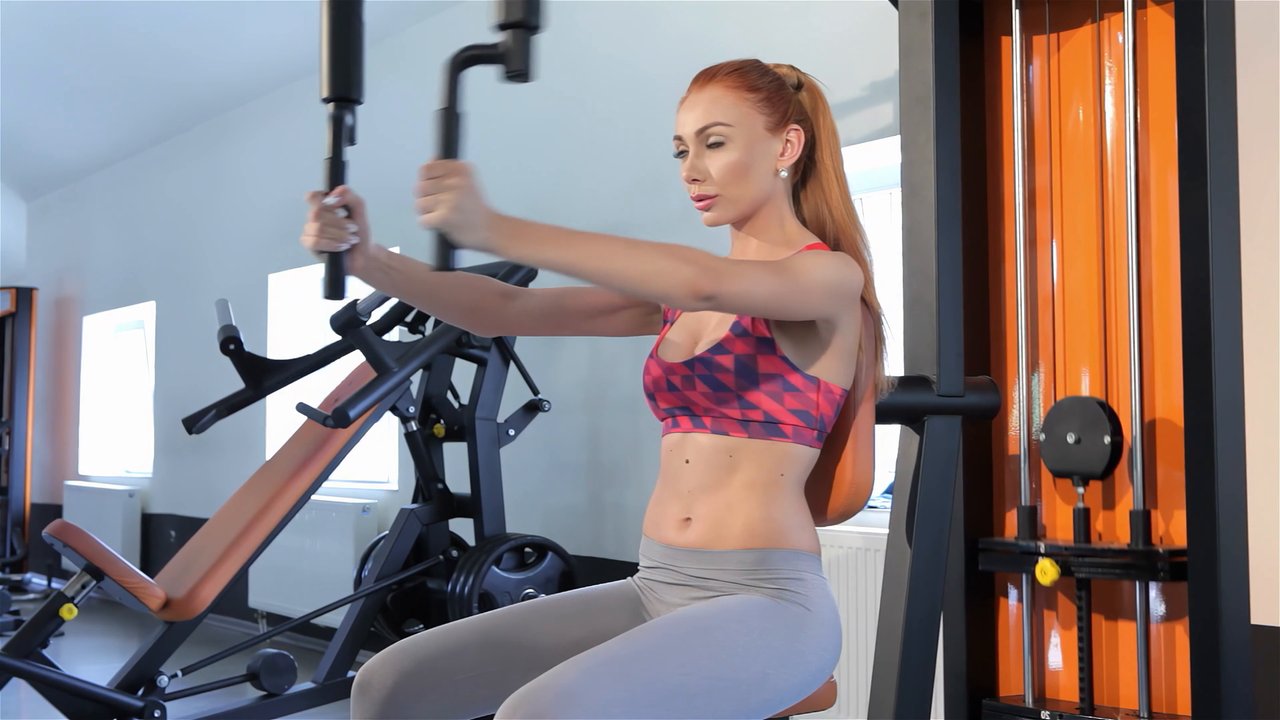
Resistance machines excel by eliminating the balance constraints of free weights. In multi-joint barbell or dumbbell exercises, balance fatigue or core failure often terminates a set before the target muscles reach full fatigue. Fixed-track machines guide the load along a pre-determined mechanical vector, allowing lifters to achieve high levels of mechanical tension in complete safety.
| Exercise | Movement Family | Primary Muscles | Biomechanical Advantage |
|---|---|---|---|
| Leg press | Lower body compound push | Quadriceps, gluteus maximus, adductor magnus | Back pad supports the lumbar spine at 45°, eliminating axial compressive loads on the vertebrae while allowing heavy quad loading. [1] |
| Chest press | Upper body compound push | Pectoralis major, anterior deltoid, triceps brachii | Converging lever arms match natural humeral adduction, maintaining peak chest contraction without shoulder hyperextension. [2] |
| Hack squat | Quad-dominant compound squat | Vastus lateralis, vastus medialis, vastus intermedius, rectus femoris | Fixed angled sled stabilizes the torso, allowing deeper knee flexion angles that maximize mechanical tension on the quadriceps. [4] |
| Seated leg curl | Knee flexion isolation | Biceps femoris, semitendinosus, semimembranosus | Seated position flexes the hip to approximately 90°, placing hamstrings under stretch for superior lengthened-state hypertrophy over lying curls. [3] |
| Leg extension | Knee extension isolation | Rectus femoris, vastus lateralis, vastus medialis | Elliptical cam profile maintains constant torque through 90° of knee extension, isolating the rectus femoris which is under-stimulated in squats. [5] |
| Pec deck | Horizontal adduction isolation | Pectoralis major (sternal & clavicular heads) | Delivers constant rotational torque into full humeral adduction, unlike dumbbell flyes where tension falls to zero at the top. [6] |
| Machine row | Horizontal compound pull | Latissimus dorsi, rhomboids, middle trapezius, posterior deltoid | Chest-supported pad stabilizes the anterior torso, preventing spinal erector fatigue and eliminating torso momentum. |
| Assisted pull up | Vertical compound pull | Latissimus dorsi, teres major, biceps brachii | Counterbalance weight pad allows precise volume accumulation across full range of motion for lifters unable to complete unassisted reps. |
| Machine shoulder press | Vertical compound push | Anterior deltoid, lateral deltoid, triceps brachii | Converging overhead track keeps resistance centered over the glenohumeral joint, avoiding backward spinal hyperextension. |
| Hip adduction machine | Hip adduction isolation | Adductor magnus, adductor longus, adductor brevis, gracilis | Directly loads the inner thigh through its full transverse excursion, building adductor hypertrophy and groin strain resilience. |
In free-weight lifts such as the barbell back squat or dumbbell overhead press, a substantial portion of motor unit discharge is consumed by stabilizing synergists—such as the rotator cuff, quadratus lumborum, and pelvic rotators—to maintain multi-planar balance. When muscular fatigue sets in, subtle breakdowns in balance typically terminate the set before prime movers reach true failure.
Research by Schwanbeck et al. (2009) and Fisher et al. (2011) confirms that fixed-track resistance machines relieve the nervous system of stabilization tasks. This allows lifters to direct higher voluntary neural drive to prime movers, train within 0–1 Reps in Reserve (RIR) safely, and stimulate muscle hypertrophy without risking catastrophic loss of balance.
Whether you train in a commercial fitness center or an equipped home gym, machines provide dedicated biomechanical setups for every major muscle group. Explore the dedicated equipment hubs below for detailed technique guides, setup parameters, and progression cues.
Complete lower body development utilizing 45° leg presses, hack squats, and pendulum platforms. Build quad mass and glute power while eliminating spinal axial loading.
Vertical and horizontal pulling stations including selectorized lat pulldowns, seated chest-supported rows, and assisted pull up frames that isolate the lats and mid-back.
Target the upper, middle, and lower pectorals with seated chest presses, converging incline lever machines, and dual-arm pec deck flyes without shoulder strain.
Wide-grip chest-supported rows, high rows, and reverse pec deck stations engineered to overload the rhomboids, rear deltoids, and middle trapezius.
Isolate the vastus group and rectus femoris with hack squats, sissy squat benches, leg extensions, and vertical sleds through deep knee flexion.
Develop both calf heads with seated calf machines (isolating the soleus) and standing or donkey calf stations (overloading the gastrocnemius under stretch).
Guided vertical press stations, machine lateral raise units, and reverse fly machines that eliminate body sway and isolate each deltoid head.
Preacher curl benches with rotating cams and seated tricep extension or dip machines that enforce strict elbow hinge mechanics.
Seated and lying leg curl machines, 45° back extensions, and glute ham developer (GHD) units that target both knee flexion and hip extension functions.
Hip abduction machines, plate-loaded glute drive thrust platforms, and kickback stations engineered to load the gluteus maximus and medius through peak contraction.
Selectorized abdominal crunches, seated rotary torso machines, and hanging leg raise towers that overload spinal flexion and rotational bracing with measurable resistance.
Gym machines are precision mechanical tools. Understanding how cams and lever arms alter mechanical advantage helps you select the right machine for your anatomical structure.
Human joints exhibit dynamic strength curves (ascending, descending, or bell-shaped). In a free-weight curl or extension, resistance torque varies with gravity. Modern resistance machines utilize elliptical, kidney-shaped cams where the radius of the cam changes as you move through the range of motion. This matches the mechanical resistance directly to your muscular capability, maintaining optimal tension at both shortened and lengthened joint angles.
Emerging hypertrophy literature (Maeo et al., 2021; Pedrosa et al., 2022) demonstrates that training muscles at long muscle lengths elicits superior muscle protein synthesis. Machines like the seated leg curl and hack squat place hamstrings and quadriceps into deep stretch under high mechanical tension without requiring spinal stabilization.
Barbell squats and deadlifts transmit immense compressive and shearing forces through the lumbar vertebrae. The 45° leg press and chest-supported machine row brace the pelvis and ribcage against rigid high-density foam pads, allowing maximal leg and upper back hypertrophy while completely sparing the spine.
Free weights carry severe injury risk when attempting concentric failure. Resistance machines feature mechanical lockout levers, adjustable safety pins, and pin-loaded weight stacks. A lifter can perform instant drop sets or push to absolute failure without fear of being pinned under a heavy barbell.
Not all machines operate the same way. Understanding selectorized stacks, plate-loaded leverage arms, and cardiovascular machines ensures you program each equipment type effectively.
Selectorized machines feature weight plates moving along precision-ground solid steel guide rods, connected via aircraft-grade nylon-coated cables or Kevlar belts. Resistance is selected instantly with a magnetic pin. Guide rod friction provides slight eccentric braking, making selectorized machines ideal for fast transitions, super-sets, and beginners learning movement pathways.
Plate-loaded machines (such as Hammer Strength or leverage stations) utilize standard Olympic 45 lb iron or bumper plates on independent lever arms. Because each side moves independently, they prevent bilateral strength deficits and accommodate converging or diverging natural joint arcs that closely mimic free-weight biomechanics.
In addition to resistance training, gym machines encompass low-impact cardiovascular ergometers. Stations like the stationary bike and elliptical trainer provide non-impact aerobic conditioning, active muscular recovery, and metabolic conditioning without joint impact.
Counterbalance stations, such as the assisted pull up and assisted chin up, invert the resistance paradigm: the selected pin weight offsets bodyweight, allowing lifters to train multi-joint vertical pulls through full range of motion until unassisted strength is achieved.
You can build substantial strength and muscle mass using gym machines exclusively. This 3-day split balances compound multi-joint movements and targeted isolation exercises while distributing weekly volume across all major muscle groups.
This routine is structured across three non-consecutive training days (e.g., Monday, Wednesday, Friday). It covers horizontal pushing, horizontal pulling, vertical pushing, vertical pulling, quad-dominant knee extension, hip-dominant knee flexion, and calf development.
For progression, apply the double progression model: select a weight where you can achieve the lower rep target with 1–2 Reps in Reserve (RIR). Work up to the top of the rep range across all sets before increasing the weight by the smallest pin increment (typically 2.5 to 5 kg).
| Exercise | Target Muscle | Sets & Reps | Rest | Key Coaching Cue |
|---|---|---|---|---|
| Chest press | Pectoralis major, triceps | 3–4 sets × 8–10 reps | 2 min | Adjust seat so handles align with mid-chest. Retract shoulder blades firmly into the pad. |
| Machine row | Latissimus dorsi, rhomboids | 3–4 sets × 8–10 reps | 2 min | Chest pressed flat against support pad. Pull elbows toward your hips, pausing for 1 second at full contraction. |
| Incline chest press | Clavicular upper chest | 3 sets × 10–12 reps | 90 sec | Drive arms upward along converging track without letting shoulders shrug upward. |
| Assisted pull up | Lats, upper back, biceps | 3 sets × 8–10 reps | 90 sec | Keep core braced and pull elbows down into your ribs until your chin clears the bar. |
| Machine shoulder press | Anterior & lateral delts | 3 sets × 10–12 reps | 90 sec | Keep elbows slightly in front of the coronal plane. Press overhead without arching the lower back. |
| Pec deck | Sternal pectoralis major | 2–3 sets × 12–15 reps | 60 sec | Maintain a soft bend in the elbows. Squeeze inner chest pads together and hold for a 1-second contraction. |
| Machine preacher curl | Biceps brachii, brachialis | 3 sets × 10–12 reps | 60 sec | Align elbow joint with the rotating cam pivot. Control the eccentric phase for 3 full seconds. |
| Exercise | Target Muscle | Sets & Reps | Rest | Key Coaching Cue |
|---|---|---|---|---|
| Leg press | Quadriceps, glutes | 4 sets × 8–12 reps | 2–3 min | Place feet shoulder-width in middle of sled. Lower until knees reach 90° without letting tailbone peel off the pad. |
| Seated leg curl | Hamstrings | 3–4 sets × 10–12 reps | 90 sec | Lock thigh pad securely down to prevent hips rising. Pull heels under seat and control the return stretch. |
| Hack squat | Quadriceps | 3 sets × 8–10 reps | 2 min | Keep upper back and hips pressed against carriage. Descend under control to deep knee flexion. |
| Hip adduction machine | Inner thigh adductors | 3 sets × 12–15 reps | 60 sec | Smoothly close knees together, pausing for 1 second at peak adduction. Avoid jerky rebounds. |
| Machine hip abduction | Gluteus medius & minimus | 3 sets × 12–15 reps | 60 sec | Sit tall with back against support. Push outward through the lateral thigh pads to full abduction. |
| Seated calf raise | Soleus | 4 sets × 12–15 reps | 60 sec | Lower heels into deep dorsiflexion, hold the stretch for 2 seconds, then drive onto balls of feet. |
| Exercise | Target Muscle | Sets & Reps | Rest | Key Coaching Cue |
|---|---|---|---|---|
| Glute ham raise | Hamstrings, glutes, spinal erectors | 3 sets × 6–10 reps | 90 sec | Lock ankles in rollers with knees just behind pad. Lower torso forward and pull back up with active hamstring knee flexion. |
| Leg extension | Rectus femoris & vastus group | 3 sets × 12–15 reps | 60 sec | Align knee joint with machine axis. Extend legs fully, pause for 1 second, and resist on the way down. |
| Assisted chin up | Lats, biceps, lower traps | 3 sets × 8–10 reps | 90 sec | Use supinated (underhand) grip. Pull chest toward the handles, emphasizing full elbow flexion. |
| Chest press | Pectoralis major, anterior delts | 3 sets × 10–12 reps | 90 sec | Focus on rhythmic tempo (2 seconds down, 1 second pause, 1 second explosive concentric). |
| Donkey calf raise | Gastrocnemius | 3 sets × 15–20 reps | 60 sec | Hips flexed at 90° with weight applied over sacrum. Emphasize deep stretch at the bottom of each rep. |
| Stationary bike | Cardiovascular system, active recovery | 15–20 minutes | N/A | Maintain steady cadence (80–90 RPM) at moderate zone 2 aerobic intensity. |
Explore the full index of gym machine movements, complete with links to individual technical guides, form breakdown videos, and setup instructions.
The premier lower-body compound machine. Loads the quads and glutes with heavy mechanical tension while sparing the spine.
Open kinetic chain knee extension. Directly isolates all four quadriceps heads, particularly the rectus femoris.
Premier hamstring hypertrophy lift. Trains the knee flexors under lengthened hip flexion for superior muscle growth.
Seated horizontal pressing station with fixed or converging guide arms that overloads the pectorals safely.
Rotational fly machine that delivers continuous resistance through full transverse humeral adduction.
Angled sled squat providing immense quad overload with torso stabilization and knee-friendly mechanics.
Prone knee flexion station that isolates the hamstrings through a neutral hip posture.
Seated inner thigh machine targeting the adductor magnus and longus for pelvic stability and groin resilience.
Bodyweight and plate-loadable leverage station delivering intense eccentric hamstring overload.
Bent-knee calf station that bypasses the gastrocnemius to isolate the deep soleus muscle.
Overhead pressing machine providing fixed-track stability to build deltoid size without balance breakdowns.
Isolated bicep station featuring an inclined arm pad that eliminates shoulder assistance.
Counterbalanced vertical pull station allowing progressive overload toward bodyweight pull ups.
Seated outer hip station targeting the gluteus medius and minimus for pelvic stability and hip shape.
Ergometer conditioning station providing low-impact cardiovascular training and active leg recovery.
Zero-impact full-body cardiovascular trainer synchronizing upper and lower body movement.
Angled pressing machine targeting the clavicular head of the pectoralis major and anterior deltoid.
Supinated counterbalance station building upper back and bicep pulling strength safely.
Chest-supported horizontal pulling machine targeting the lats and mid-back without spinal erector fatigue.
Hip-hinged calf station placing the gastrocnemius under extreme stretch for maximal lower leg hypertrophy.
Choosing between machines and free weights depends on your training phase, injury history, and target muscle goals. Compare our in-depth biomechanical breakdowns:
The most effective exercise machine depends on your primary fitness objective, but multi-joint compound machines generally provide the highest return on investment. For lower-body strength and muscle mass, the 45° leg press and hack squat are exceptionally effective because they allow heavy loading without spinal axial compression. For upper-body development, a seated chest-supported machine row and converging chest press recruit massive motor unit pools safely. For isolation, the seated leg curl is widely considered one of the single most effective hamstring builders due to its lengthened-state mechanics.
The six foundational movement patterns in resistance training are: 1. Squat: represented by the barbell back squat, goblet squat, or hack squat. 2. Hinge: represented by deadlifts or the glute ham raise. 3. Horizontal Push: represented by the barbell bench press, push up, or chest press. 4. Horizontal Pull: represented by the bent-over barbell row or machine row. 5. Vertical Push: represented by the overhead barbell press or machine shoulder press. 6. Vertical Pull: represented by pull ups, assisted pull ups, or lat pulldowns.
A well-rounded top 10 exercise program combines free-weight staples with guided machine movements to optimize hypertrophy, joint longevity, and functional strength: 1. Leg Press (Lower body compound push) 2. Barbell Romanian Deadlift (Posterior chain hinge) 3. Chest Press (Horizontal upper push) 4. Machine Row (Chest-supported horizontal pull) 5. Hack Squat (Quad-dominant knee flexion) 6. Assisted Pull Up or Lat Pulldown (Vertical pull) 7. Seated Leg Curl (Lengthened hamstring isolation) 8. Machine Shoulder Press (Overhead vertical press) 9. Pec Deck or Cable Crossover (Transverse chest isolation) 10. Seated or Standing Calf Raise (Lower leg development)
The 3-3-3 rule is a popular training framework designed to build consistency and progressive overload for beginners and intermediate lifters: - 3 Days per Week: Training on three non-consecutive days (such as Monday, Wednesday, and Friday) to allow 48 hours of recovery between sessions. - 3 Key Exercises per Session: Focusing on three core compound movements per workout rather than getting lost in excessive volume. - 3 Working Sets per Exercise: Performing three challenging working sets per movement in the 8–12 repetition range with 1–2 Reps in Reserve (RIR).
The coaching cues, workout splits, and machine mechanics presented in this guide are editorial educational aids. Always consult manufacturer instructional placards and adjust seat heights, pads, and range-of-motion limiters to your individual body dimensions before loading resistance machines.