
Medicine Ball Core Exercises
Overload rotational power, anti-rotation, and trunk flexion with Russian twists, woodchoppers, and dead bugs. Essential for developing an athletic midsection and transverse torque.
Medicine balls deliver unmatched ballistic power, high-velocity triple extension, and multi-planar rotational strength. Unlike traditional barbells and dumbbells where the athlete must decelerate the implement during the final 25% to 40% of the concentric stroke to protect joints, medicine balls permit complete acceleration straight through release. This uninhibited follow-through maximizes the rate of force development (RFD) and kinetic power output across all athletic planes.
From explosive whole-body power movements like the medicine ball slam, med ball clean and press, and med ball thruster to targeted rotational core drills like the med ball russian twist, medicine ball dead bug, and medicine ball push up, medicine balls bridge pure strength with functional athletic agility. Browse our complete exercise library organized by muscle group below, or follow our complete full-body athletic conditioning routine.
To compare medicine ball training with other implements such as barbells, dumbbells, kettlebells, cables, resistance bands, and machines, browse all exercises by equipment.
Explore foundational medicine ball movements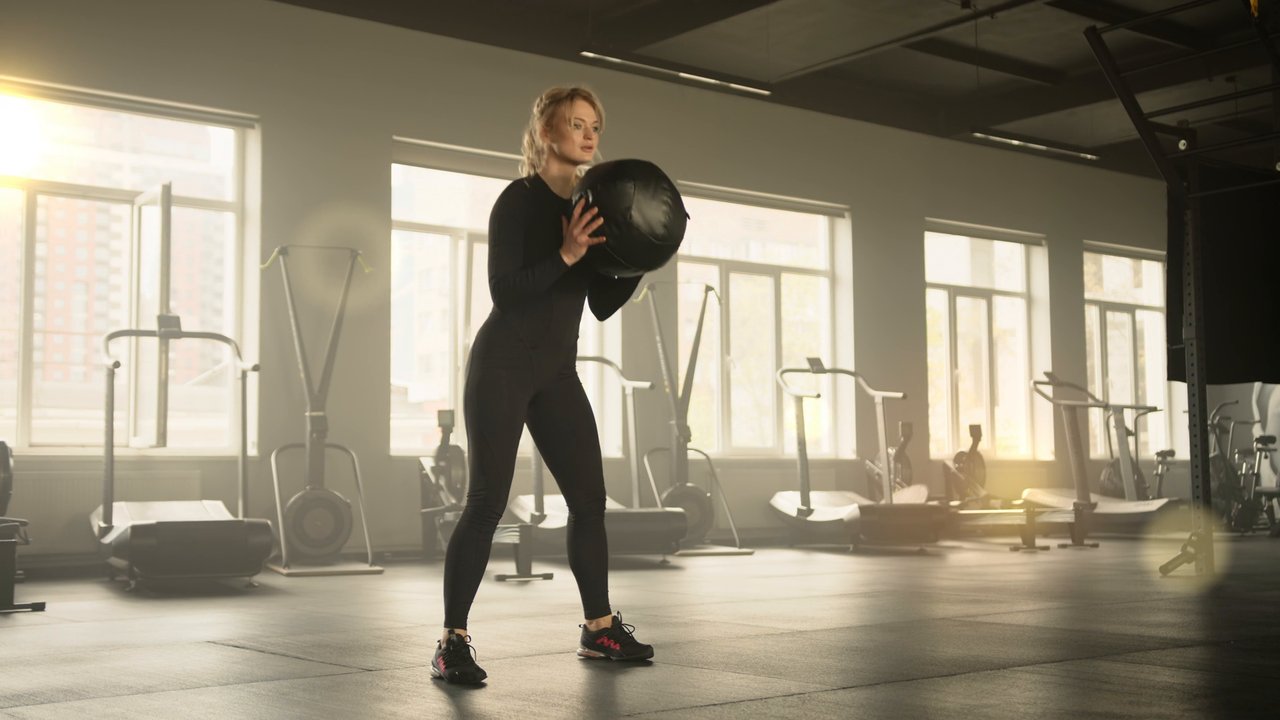
Medicine balls enable dynamic ballistic acceleration that cannot be replicated with conventional heavy iron. By releasing the ball at the apex of the movement, muscles fire at maximal velocity through terminal extension without inhibitory joint deceleration reflexes.
| Exercise | Movement Family | Primary Muscles | Biomechanical Advantage |
|---|---|---|---|
| Medicine ball slam | Ballistic vertical pulling & trunk flexion | Latissimus dorsi, rectus abdominis, triceps, calves | Requires rapid forceful trunk flexion and humeral adduction against ground impact without eccentric joint shock, training high-velocity power. [1] |
| Med ball russian twist | Transverse rotational core torque | Internal obliques, external obliques, rectus abdominis | Overloads anterior and posterior oblique slings with isometric hip flexor stabilization, producing transverse rotational torque essential for sports. [2] |
| Medicine ball overhead throw | Posterior chain hip hinge & vertical power | Glutes, hamstrings, erector spinae, deltoids | Demands explosive triple extension of ankles, knees, and hips followed by shoulder flexion, maximizing total-body vertical force generation. |
| Medicine ball push up | Unilateral elevation & horizontal press | Pectoralis major, anterior deltoids, triceps, serratus anterior | Elevating one hand on an unstable spherical surface increases muscle activation in scapular stabilizers and core rotators while deepening unilateral range of motion. |
| Med ball clean and press | Multi-joint Olympic lift adaptation | Quadriceps, glutes, trapezius, deltoids, triceps | Combines ground-up hip drive, rapid turnover under the ball, and overhead lockout without the wrist and collarbone impact of rigid barbells. |
| Medicine ball dead bug | Anti-extension anterior core brace | Transverse abdominis, rectus abdominis, hip flexors | Squeezing the ball diagonally between contralateral knee and hand forces active transverse abdominis bracing and neutral lumbar spine stabilization. |
| Med ball box jump | Loaded plyometric vertical jump | Quadriceps, gastrocnemius, soleus, gluteus maximus | Holding a medicine ball at the chest increases system mass during takeoff, overloading stretch-shortening cycle (SSC) dynamics. |
| Med ball thruster | Compound squat-to-overhead press | Quadriceps, glutes, anterior deltoids, triceps | Seamlessly transfers ground kinetic energy generated by the lower body squat directly into overhead pressing velocity with high cardiovascular output. |
Explore specialized medicine ball exercise collections categorized by target anatomy. Each section highlights multi-planar movement patterns, anchoring cues, and load recommendations.
Overload rotational power, anti-rotation, and trunk flexion with Russian twists, woodchoppers, and dead bugs. Essential for developing an athletic midsection and transverse torque.
Build pectoral mass and pushing velocity with explosive chest pass throws, push-up crossovers, and alternating single-arm medicine ball presses.
Engage the entire kinetic chain with cleans, thrusters, overhead throws, and ball slams that combine lower-body triple extension with upper-body drive.
Train quads, glutes, and hamstrings with goblet squats, walking lunges with rotation, and explosive medicine ball box jumps.
Develop 3D deltoids and scapular stability with kneeling overhead presses, single-arm push presses, and dynamic wall throws.
Target the latissimus dorsi and posterior chain through overhead slam variations, reverse throws, and bent-over med ball rows.
Medicine balls occupy a unique biomechanical category distinct from standard free weights. Understanding the mechanics of ballistic acceleration and kinetic torque allows athletes to program them for peak rate of force development.
In conventional resistance training with barbells or dumbbells, the musculoskeletal system is constrained by safety braking mechanics. During the final 25% to 40% of a traditional bench press or squat, antagonist muscles fire eccentrically to decelerate the heavy bar and prevent joint hyperextension or dislocation (Newton et al., 1996, PMID 8979603). Consequently, mean force and velocity plummet during the critical terminal phase of the movement.
Ballistic medicine ball training eliminates this deceleration constraint completely. Because the athlete releases the implement into the air or slams it into the floor, the agonist muscles accelerate continuously across 100% of the concentric stroke. This enables full motor unit recruitment and maximizes the rate of force development (RFD).
Rotational athletic power ($P$) is the product of applied torque ($\tau$) and angular velocity ($\omega$). Torque represents rotational force generated through the hips, pelvis, and core around the longitudinal axis, while angular velocity reflects how rapidly that rotational twist occurs.
Medicine ball throws, Russian twists, and rotational slams train the anterior and posterior oblique slings (external oblique, contralateral internal oblique, and opposite gluteal and adductor complex). Ground reaction force generated by the back foot drives hip rotation, which winds the elastic connective tissues of the abdominal wall and fascial sheets before snapping through the shoulder girdle and arms into the ball release.
Dating back more than 3,000 years to ancient Persia and later utilized by Hippocrates with weighted sandbags for post-injury restoration, the term “medicine ball” originated from its health-building and restorative qualities. Today, three distinct ball designs serve specific training objectives.
Constructed from thick textured rubber with high rebound properties. Ranges from 2 to 30 lbs. Ideal for wall passes, partner chest tosses, floor bounce drills, and rotational rebound exercises where maintaining rhythmic tempo is primary.
Encased in a heavy-duty vinyl or thick rubber shell filled with iron sand. Designed to absorb kinetic impact with zero rebound. Essential for high-power overhead floor slams, chest slams, and drop catches without rebound facial injury risks.
Large 14-inch standardized diameter padded sphere with double-stitched vinyl casing. Absorbent and gentle on hands and torso upon catch. Specifically designed for wall ball shots, deep squat-to-overhead wall targets, and close-quarters partner throws.
Features molded ergonomic side handles. Combines the circular weight profile of a ball with dumbbell-style grips. Excellent for rotational chops, steering wheel core drills, Romanian deadlifts, and upright rows.
The most common error in medicine ball training is choosing an implement that is too heavy. Heavy balls slow movement velocity below the threshold required for ballistic adaptation ($>2.0\text{ m/s}$). Use these evidence-based weight brackets:
Medicine ball exercises can be precisely adapted to beginner athletes, rotational sport competitors (golf and baseball), older adults, and clinical demographics.
Traditional crunches only train sagittal spinal flexion. Incorporating medicine balls into movements like the med ball russian twist, half kneeling med ball lumberjack, and medicine ball dead bug strengthens the deep transverse abdominis, rectus abdominis, and internal/external obliques against rotational and anti-extension stress.
Beginners should master stationary, grounded medicine ball movements with light 4 to 6 lb balls before attempting high-velocity throws. Starting with the med ball clean and press, goblet squats, and kneeling chest presses establishes sound hip hinge mechanics and kinetic transfer without spinal shear.
Rotational sports require explosive kinetic sequencing: power begins in the lower body, transfers through the pelvic girdle and torso, and culminates in arm velocity (the kinematic chain). Research by Szymanski et al. (2007, PMID 17685695) demonstrated that medicine ball rotational training significantly increased baseball bat swing velocity and golf clubhead speed by expanding the “X-Factor” (hip-shoulder separation angle).
Older adults lose muscular power (rate of force development) nearly twice as rapidly as they lose static muscular strength. The 2026 American College of Sports Medicine (ACSM) healthy aging guidelines recommend low-load, high-velocity power drills for fall prevention. Seated chest tosses, standing medicine ball halo circles, and gentle rotational handoffs preserve balance, bone mineral density, and reactive reflexes (Currier et al., 2026, PMID 41843416).
Clarifying the “Medicine Ball to Induce Labor” Misconception: A prevalent online search query asks about using medicine balls to induce labor. Medical authorities urge extreme clarity: obstetricians and midwives recommend large, inflatable birthing or stability balls (soft, air-filled vinyl spheres 55 to 65 cm in diameter) for gentle pelvic rocking, wide-legged bouncing, and easing contractions during late pregnancy. In contrast, weighted medicine balls or slam balls must never be used for pelvic bouncing and should never be dropped or swung near the pregnant abdomen.
During pregnancy, elevated levels of the hormone relaxin loosen ligamentous structures, increasing joint laxity and vulnerability to sacroiliac or lumbar strain. High-velocity rotational throws and heavy overhead slams are contraindicated. Always obtain explicit clearance from your obstetrician or midwife before performing any resistance or core routines during pregnancy or postpartum recovery.
This evidence-based, 6-exercise full-body athletic conditioning routine develops explosive power, cardiovascular endurance, and rotational core strength in approximately 35 minutes. Perform 2 to 3 times per week with at least 48 hours between intense sessions.
Frequency: 2 to 3 days per week • Warm-up: 5 minutes of dynamic joint mobility, torso twists, bodyweight air squats, and inchworms • Equipment Needed: One 8 to 14 lb non-bouncing slam ball and one 6 to 10 lb bouncing medicine ball • Progression: Focus first on maximal explosive velocity and perfect form. Advance by shortening rest intervals or adding 2 to 4 lbs to the ball weight once velocity is maintained across all sets.
| Exercise | Target Muscle | Sets & Reps | Rest | Key Coaching Cue |
|---|---|---|---|---|
| Medicine ball slam | Lats, core, triceps, calves | 4 sets × 8–10 reps | 60 sec | Rise onto toes with ball overhead in full triple extension. Hinge hips violently and slam the ball straight down into the floor as hard as possible. Catch on bounce or scoop. |
| Med ball thruster | Quadriceps, glutes, shoulders, triceps | 3 sets × 12 reps | 75 sec | Hold ball at sternum. Descend into a deep parallel squat. Drive up through heels explosively, launching the ball overhead into a full lockout press in one fluid movement. |
| Alternating medicine ball push up | Pectoralis major, deltoids, triceps, core | 3 sets × 6 reps / side | 60 sec | Place one hand on the ball and one on the floor. Perform a strict push-up, press up, and roll the ball across to the opposite hand for the next rep while bracing the core. |
| Half kneeling med ball lumberjack | Internal/external obliques, transverse abdominis | 3 sets × 8 reps / side | 45 sec | In a half-kneeling position, start with the ball at the back hip. Chop the ball diagonally up and across the body past the front shoulder with controlled rotational torque. |
| Med ball russian twist | Obliques, rectus abdominis, hip flexors | 3 sets × 15 reps / side | 45 sec | Sit in a V-sit posture with heels slightly elevated or hovering. Rotate the ball from hip to hip, keeping the chest open and avoiding rounded lumbar posture. |
| Medicine ball dead bug | Transverse abdominis, deep pelvic stabilizers | 3 sets × 10 reps / side | 45 sec | Lie supine with arms and legs raised. Press the ball between right hand and left knee while extending left arm and right leg toward floor. Keep lower back pinned to the mat. |
Browse our catalog of 20 high-demand medicine ball exercises. Each guide details setup mechanics, target muscles, common execution errors, and progression strategies.
Primary Muscles: Latissimus dorsi, rectus abdominis, triceps
The premier explosive power movement in medicine ball training. Stand tall, extend overhead onto the balls of your feet, and violently slam a dead-weight ball into the floor using full abdominal and lat contraction.
Primary Muscles: Transverse abdominis, rectus abdominis
A premier anti-extension and cross-body stabilization exercise. Squeezing the ball between opposite hand and knee activates the deep anterior core sling while extending the opposite limbs.
Primary Muscles: Pectoralis major, anterior deltoid, triceps
Performing push-ups with one or both hands perched on a medicine ball challenges shoulder joint stability, activates the serratus anterior, and deepens pectoral stretch.
Primary Muscles: Quadriceps, glutes, gastrocnemius
Holding a medicine ball at the chest increases system mass during takeoff and landing, demanding greater stretch-shortening cycle power and absorbing deceleration force.
Primary Muscles: Posterior chain, deltoids, quadriceps, triceps
An Olympic weightlifting variation that trains triple extension, rapid turnover under the ball, and an explosive overhead press without heavy wrist strain.
Primary Muscles: Internal obliques, external obliques, rectus abdominis
Seated in a balanced V-up position, rotate the ball side to side to touch the floor adjacent to each hip. Builds rotational endurance and firm oblique definition.
Primary Muscles: Quadriceps, gluteus maximus, deltoids, triceps
Combines a full front squat with an overhead press in one continuous motion. Exceptional for metabolic conditioning, high-calorie burn, and leg-to-shoulder force transfer.
Primary Muscles: Pectoralis major, triceps, anterior core
An advanced unilateral pushing drill. One hand balances on the elevated sphere while the primary pushing arm works near the floor, heavily overloading pressing strength.
Primary Muscles: Hamstrings, gluteus maximus, erector spinae, deltoids
An athletic combine staple. Hinge backward at the hips with the ball between knees, then explode upward in triple extension to launch the ball backward or vertically.
Primary Muscles: Rectus abdominis, hip flexors
Performing sit-ups seated atop an inflatable stability ball while pressing a medicine ball overhead enables hyperextension of the spine, stretching and contracting the abdominals through a complete arc.
Primary Muscles: Pectoralis major, anterior deltoids, triceps
After completing a push-up with one hand on the ball, roll the ball dynamically across the floor to the opposite hand and repeat. Builds dynamic shoulder stabilization and core anti-rotation.
Primary Muscles: Latissimus dorsi, core, shoulders
A classic high-intensity conditioning movement focusing on rapid, continuous repetitions to drive heart rate and muscular endurance without joint impact.
Primary Muscles: Upper and lower rectus abdominis
Positioning the lumbar spine over the curved dome of a Bosu ball provides abdominal pre-stretch while holding a medicine ball at the chest increases resistance.
Primary Muscles: Rectus abdominis, obliques
Combines unstable surface core recruitment with weighted resistance, strengthening the abdominal wall while minimizing lumbar compression.
Primary Muscles: Pectoralis major, triceps, anterior core
Push the ball horizontally and downward into the floor with maximum force. Overloads horizontal pressing power and immediate core bracing.
Primary Muscles: Pectoralis major, anterior deltoids, triceps
A ballistic partner or wall drill. Step forward and launch the medicine ball from chest height with explosive extension, mimicking a basketball chest pass or football block.
Primary Muscles: Full body (legs, core, shoulders, lats)
A triple-combination athletic power movement: clean the ball from floor to shoulders, press overhead, and violently slam into the mat in one unbroken cycle.
Primary Muscles: Quadriceps, glutes, traps, deltoids, triceps
A full-depth squat clean combined with a strict overhead push press. Excellent for testing full-body work capacity and Olympic lifting movement patterns.
Primary Muscles: Biceps brachii, anterior deltoids, glutes, core
The half-kneeling posture eliminates spinal compensation and forces gluteus medius and core stabilization while curling and pressing the ball overhead.
Primary Muscles: Internal obliques, external obliques, transverse abdominis
A diagonal rotational chop moving from the back hip across the front knee. Trains the oblique sling systems and pelvic stability required in rotational sports.
Understanding how medicine ball training compares to traditional iron, cables, and bodyweight movements helps optimize exercise selection for specific athletic goals.
While barbell cleans produce higher absolute peak force due to heavier loading potential, medicine ball slams generate superior triple-extension velocity and rate of force development ($>2.5\text{ m/s}$) with zero wrist, elbow, or cervical spine impact. Ball slams also train eccentric deceleration through the ground without catching heavy iron.
Cable woodchoppers provide constant tension across a fixed pulley vector, making them ideal for steady progressive resistance. However, medicine ball Russian twists and rotational throws allow free-range ballistic release and train rapid anti-rotation deceleration during the catch phase, closely mirroring athletic game situations.
Placing hands on a rounded medicine ball forces the pectoralis major and serratus anterior to contract against both vertical bodyweight and inward adduction forces. The unstable surface recruits up to 35% greater shoulder stabilizer muscle activation compared to stable floor push-ups.
Clear, evidence-based answers to the most common questions regarding medicine ball workouts, safety, and programming.
Yes. Medicine ball training provides an exceptional full-body workout that combines explosive power development, rotational core strength, and high-intensity cardiovascular conditioning. Because medicine ball movements frequently involve multi-joint compound patterns (such as thrusters, slams, and clean-and-presses), they recruit large muscle masses simultaneously, elevating metabolic rate and caloric expenditure while enhancing athletic coordination.
Medicine balls are uniquely effective for developing rate of force development (RFD), rotational power, and core stability. Unlike free weights that force an athlete to decelerate the weight before joint lockout, medicine balls can be released with 100% acceleration through full movement completion. This makes them the gold standard for throwing athletes, golfers, martial artists, and anyone seeking functional athletic agility.
The primary limitation of medicine ball training is that it cannot easily provide the high mechanical tension necessary for maximal absolute strength development (1-rep max strength) or pure hypertrophy compared to heavy barbells and selectorized machines. Additionally, ballistic throws require dedicated gym space, concrete or reinforced walls, and impact-absorbing flooring. Practicing throws with an improper bounce ball can also pose facial rebound injury risks if done without correct form.
For most adults, the ideal medicine ball weight depends on the training objective. For explosive throws, wall tosses, and rotational velocity, a 4 to 10 lb (2 to 5 kg) ball is optimal to ensure movement speed remains high. For loaded strength exercises like squats, lunges, and controlled push-ups, an 12 to 20 lb (6 to 10 kg) ball provides appropriate mechanical resistance. Beginners should always start lighter (4 to 8 lbs) to master movement mechanics before increasing load.
Every biomechanical assertion, physiological mechanism, and exercise recommendation on this page is grounded in published peer-reviewed research and official exercise science standards.
Biomechanical analyses and coaching guidelines are prepared for educational reference. Consult a qualified physician before undertaking high-intensity ballistic exercise, especially if rehabilitating previous musculoskeletal injuries.