
Band Leg Exercises
Overload the quadriceps, hamstrings, and calves using loop and 41-inch monster bands with banded squats, Bulgarian split squats, and calf raises.
Elastic resistance bands provide variable ascending resistance governed by elastomeric elongation. Unlike constant gravitational free weights where torque depends entirely on lever arms, bands generate minimal tension at deep, vulnerable joint angles and peak mechanical overload at full muscular contraction. This unique resistance profile mirrors the human musculoskeletal ascending strength curve while eliminating high-impact starting inertia.
From fundamental compound strength movements like the band squat, band chest press, and band row to corrective and postural essentials like the band pull apart, band face pull, and band shoulder press, elastic bands deliver proven muscle hypertrophy and functional strength at home, in the gym, or during travel. Browse our comprehensive exercise library categorized by muscle group below, or jump directly to our complete full-body resistance band workout routine.
To compare resistance bands with other training implements such as barbells, dumbbells, kettlebells, cables, and machines, browse all exercises by equipment.
Explore foundational band movements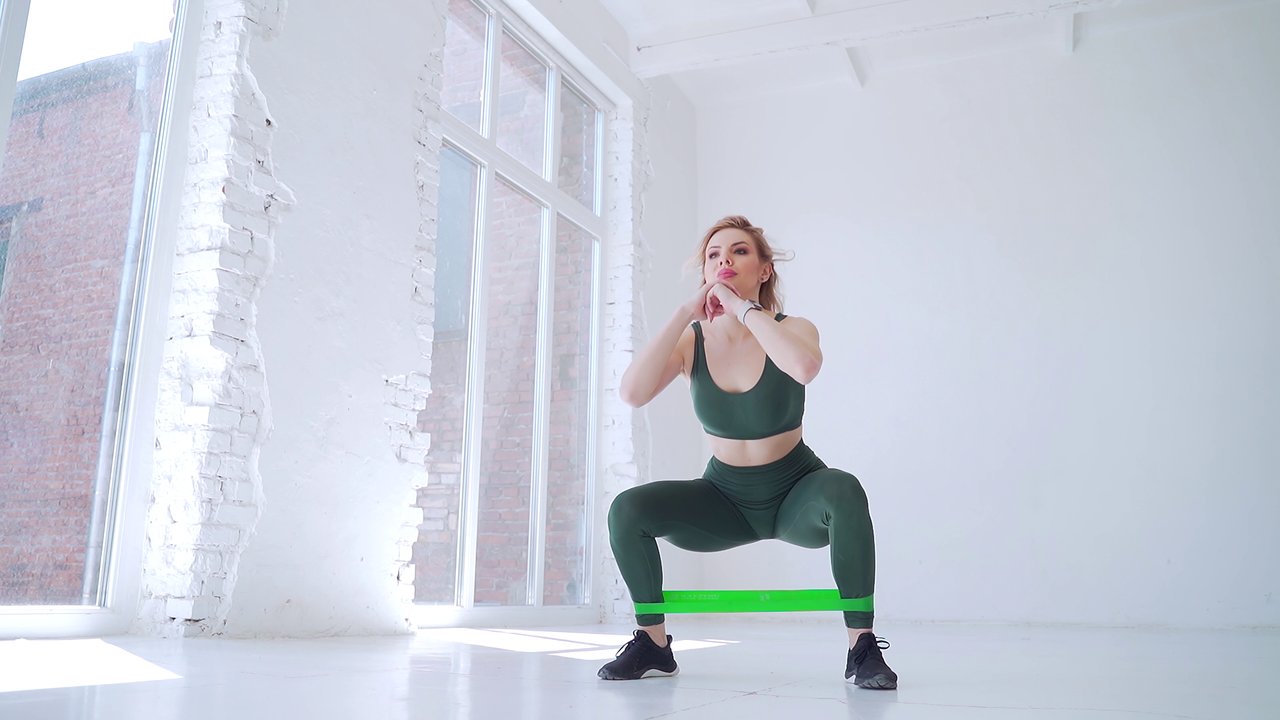
Elastic bands enable comprehensive multi-joint compound pushing, pulling, and squatting without requiring bulky iron plates or fixed gym stations. Because tension increases continuously as the band stretches, muscles experience maximal mechanical recruitment through the terminal completion of each repetition.
| Exercise | Movement Family | Primary Muscles | Biomechanical Advantage |
|---|---|---|---|
| Band squat | Lower body compound push | Quadriceps, gluteus maximus, adductors | Minimal tension at the bottom of the squat protects the patellofemoral joint; peak tension occurs at full hip and knee lockout where mechanical leverage is strongest. [1] |
| Band chest press | Upper body horizontal push | Pectoralis major, anterior deltoids, triceps brachii | Accommodates the natural pressing strength curve; low tension in deep shoulder horizontal abduction prevents anterior capsule strain while overloading terminal triceps extension. |
| Band row | Upper body horizontal pull | Latissimus dorsi, rhomboids, middle trapezius, biceps | Provides peak horizontal tension at full scapular retraction, ensuring complete motor unit recruitment of the mid-back musculature without spinal momentum. |
| Band pull apart | Upper back scapular retraction | Posterior deltoids, rhomboids, lower trapezius | High-frequency postural drill that directly counteracts upper crossed syndrome (rounded shoulders) by strengthening the scapular retractors and external rotators. |
| Band shoulder press | Upper body vertical push | Anterior deltoids, lateral deltoids, triceps brachii | Standing on the loop eliminates lumbar hyperextension risks common with heavy barbells while requiring active core and pelvic stabilization throughout the press. |
| Band glute bridge | Lower body hip extension | Gluteus maximus, gluteus medius, hamstrings | Placing a mini-loop above the knees combines pure sagittal hip extension with active hip abduction, simultaneously activating all three gluteal heads. |
| Band lat pulldown | Upper body vertical pull | Latissimus dorsi, teres major, biceps brachii | Overhead door anchor setup enables vertical humeral adduction for back width development without requiring a high-cost cable tower. |
| Band good morning | Posterior chain hip hinge | Hamstrings, gluteus maximus, erector spinae | Overloads the posterior chain hip hinge with zero barbell spinal loading across the cervical spine, training powerful glute and hamstring extension. |
Explore specialized resistance band guides tailored to every major anatomical region. Each hub features targeted anatomy breakdowns, band anchoring configurations, and muscle-specific programming guidelines.
Overload the quadriceps, hamstrings, and calves using loop and 41-inch monster bands with banded squats, Bulgarian split squats, and calf raises.
Develop 3D deltoids with overhead presses, banded lateral raises, front raises, and face pulls that protect the delicate rotator cuff complex.
Build back thickness and width with seated rows, bent-over rows, single-arm lat pulldowns, and deadlift variations using heavy elastic bands.
Challenge anti-rotation, spinal flexion, and abdominal bracing with Pallof presses, banded crunches, and woodchoppers.
Isolate the biceps and triceps with standing curls, hammer curls, overhead triceps extensions, and pushdowns with continuous accommodating resistance.
Target the vastus lateralis, vastus medialis, and rectus femoris through banded sissy squats, terminal knee extensions (TKEs), and front squats.
Overload elbow flexion with supinated curls, reverse curls, and drag curls, achieving peak bicep peak contraction as the band reaches maximal stretch.
Train horizontal adduction and pectoral hypertrophy with standing chest presses, incline presses, and banded push-ups.
Sculpt the gluteus maximus and medius with monster walks, banded hip thrusts, frog pumps, and standing kickbacks.
Overload horizontal shoulder abduction with band pull aparts, face pulls, and reverse flies to build rear shoulder cap fullness and shoulder stability.
Strengthen the internal and external obliques with kneeling Pallof holds, standing oblique rotations, and side bends.
Isolate both knee flexion and hip extension functions with lying leg curls, seated banded curls, and Romanian deadlifts.
Strengthen the hip abductors and tensor fasciae latae with seated band abductions, clamshells, and lateral band walks to prevent knee valgus collapse.
Blast all three triceps heads with band pushdowns, kickbacks, and overhead extensions with intense terminal lockout tension.
To maximize training outcomes with resistance bands, athletes must understand the biomechanical and physical principles governing elastic tension and muscular adaptations.
In classical physics, Hooke's law states that restoring force is linearly proportional to displacement: F = -kx, where k is the spring constant and x is elongation distance. However, natural and synthetic latex resistance bands are non-linear elastomers. At modest stretch (50% to 150% elongation), bands behave near linearly. When stretched beyond 200% of their resting length, polymer chains align and the elastic modulus increases sharply, creating exponential resistance that demands explosive deceleration or forceful concentric drive.
Human multi-joint movements (such as squats, bench presses, and shoulder presses) exhibit ascending strength curves: lifters produce their lowest force output at deep joint flexion (e.g., bottom of a squat) and their highest force output near terminal extension (e.g., top of a squat). Constant gravitational free weights limit the load to what you can lift at your weakest mechanical point. Resistance bands match this ascending curve perfectly, applying low joint stress at the bottom and maximum mechanical resistance at lockout.
A rigorous systematic review and meta-analysis conducted by Lopes et al. (2019, PMID 30886725) compared elastic resistance training directly to conventional resistance training (dumbbells, barbells, and machines). The researchers concluded that resistance band training elicits statistically equivalent gains in muscular strength and muscle hypertrophy across diverse populations, provided sets are performed with adequate intensity close to momentary muscular failure (0–2 Repetitions in Reserve).
Free weights generate momentum (mass times acceleration). Accelerating a heavy barbell or dumbbell creates sudden spikes in joint shear force at turnaround points. Resistance bands possess virtually zero inertia, eliminating abrupt joint deceleration forces. This makes elastic bands exceptionally safe for rotator cuff rehabilitation, degenerative joint management, and high-frequency training.
Understanding which band style to deploy for specific exercises ensures safety, comfort, and appropriate loading parameters.
Continuous flat elastic loops made of latex or fabric-encased elastic. Primarily placed around the thighs, calves, or wrists. Ideal for glute bridges, lateral monster walks, clamshells, and activating the hip abductors during squats. Fabric mini-bands resist rolling and pinching on bare skin.
Continuous 41-inch layered latex loops varying in width from 0.5 inches to 4 inches. Used for heavy compound lifts: banded squats, good mornings, deadlifts, and assisted pull-ups or dips. Can be looped around power racks to create accommodating resistance curves on barbells.
Hollow extruded latex tubes fitted with metal carabiners that attach to cushioned handles, ankle cuffs, and door anchors. Enable quick adjustments in tension by clipping multiple tubes onto a single handle. Perfect for chest presses, lat pulldowns, seated rows, and arm curls.
Thin, non-loop flat latex or thermoplastic elastomer (TPE) ribbons (5 to 7 feet long). Highly flexible and easily gripped by hand. Used extensively by physical therapists for rotator cuff internal/external rotation, ankle rehabilitation, and gentle isometric stretching.
While manufacturers vary slightly, most high-grade elastic resistance band systems follow standardized color coding and tension ranges:
Elastic bands offer unique adaptability for specific demographics and targeted fitness objectives, including arm firming, senior longevity, and seated mobility.
A common fitness goal is eliminating looseness in the posterior upper arm. Physiologically, localized fat removal (spot-reduction) is impossible; fat loss occurs systemically when a consistent caloric deficit is maintained. However, building and firming the underlying triceps brachii muscle tightens the upper arm, creating defined athletic contours. Combining high-repetition band tricep kickbacks, band overhead tricep extensions, and band tricep extensions with standing curls creates complete arm development with zero elbow tendinopathy.
Sedentary lifestyles frequently lead to glute amnesia, where the gluteus maximus fails to fire properly during daily movements. Elastic mini-bands provide immediate tactile feedback. Performing banded squats, monster walks, and band glute bridges recruits the gluteus medius to resist medial knee collapse (valgus), building firm, powerful glutes while protecting knee cartilage and lower back integrity.
Age-related muscle loss (sarcopenia) and bone mineral density decline (osteopenia) can be effectively halted with resistance training. The updated 2026 American College of Sports Medicine (ACSM) guidelines specifically highlight elastic bands as a safe, highly effective modality for older adults (Currier et al., 2026, PMID 41843416). Bands eliminate the risk of dropping heavy iron weights on feet, reduce spinal axial compression, and improve balance and functional independence.
For individuals recovering from knee or hip surgery, wheelchair users, or desk-bound professionals seeking circulation, seated band drills provide safe resistance without weight-bearing joint stress. Seated knee extensions (looping the band around the chair leg and ankle), seated hamstring curls, and seated ankle dorsiflexion activate the lower body musculature, prevent venous blood pooling, and preserve joint range of motion.
While resistance bands offer exceptional safety, individuals over 50 or those managing chronic health conditions should adhere to the following medical precautions:
This evidence-based, 7-exercise full-body resistance band routine targets every major muscle group in under 45 minutes. It can be performed 3 times per week with 48 hours of rest between sessions.
Frequency: 3 days per week (e.g., Monday, Wednesday, Friday) • Warm-up: 5 minutes of arm circles, bodyweight hip hinges, and light band pull aparts • Progression: When you can complete the maximum target reps on all sets with strict tempo, choke up on the band to increase tension or advance to the next color resistance level.
| Exercise | Target Muscle | Sets & Reps | Rest | Key Coaching Cue |
|---|---|---|---|---|
| Band squat | Quadriceps, glutes | 3 sets × 12–15 reps | 90 sec | Stand inside 41-inch loop with feet shoulder-width. Rack the top of the band across anterior deltoids. Squat deep and press up explosively against peak lockout tension. |
| Band row | Lats, rhomboids, biceps | 3 sets × 10–12 reps | 75 sec | Anchor band around midfoot or door anchor at chest height. Hinge hips at 45°, keep chest proud, and pull elbows back past the ribcage with a 1-second squeeze. |
| Band chest press | Pectorals, triceps | 3 sets × 12–15 reps | 75 sec | Loop band behind upper back or anchor at mid-chest height. Press handles forward, bringing hands together at full extension to maximize inner pectoral contraction. |
| Band good morning | Hamstrings, glutes, lower back | 3 sets × 12–15 reps | 90 sec | Stand on loop, loop opposite end behind neck across upper traps. Hinge hips backward with soft knees until torso is near parallel to floor, feeling a deep hamstring stretch. |
| Band shoulder press | Deltoids, triceps | 3 sets × 10–12 reps | 60 sec | Stand on band with one or both feet. Start with handles at collarbone level. Press directly overhead to full lockout without hyperextending your lumbar spine. |
| Band lat pulldown | Latissimus dorsi | 3 sets × 12–15 reps | 60 sec | Anchor band high on a door or overhead bar. Kneel or sit tall. Grasp handles and pull elbows down toward hips, leading with your back rather than your biceps. |
| Band pull apart | Rear delts, rhomboids | 3 sets × 15–20 reps | 45 sec | Hold light band at chest height with straight arms. Pull band horizontally apart until it touches your sternum. Control the return over 2 seconds. |
Browse detailed biomechanical profiles and setup protocols for the 20 most popular resistance band exercises.
Primary Muscles: Pectoralis major, anterior deltoids, triceps brachii
A premier horizontal push. The band is anchored behind the shoulder blades or to a door anchor. Resistance ramps up as the elbows extend, producing intense pectoral peak contraction without straining the vulnerable front shoulder capsule in deep flexion.
Primary Muscles: Posterior deltoids, rhomboids, middle trapezius
An essential corrective and postural staple. Gripping a light band with arms extended at shoulder level, you pull horizontally outward until the band contacts your sternum, activating the scapular retractors and rear shoulder caps.
Primary Muscles: Anterior deltoid, lateral deltoid, triceps brachii
A vertical pressing movement performed by standing on a loop or handled band and pressing overhead. Peak mechanical tension coincides with full overhead extension, challenging deltoid motor unit recruitment while sparing the lower back.
Primary Muscles: Quadriceps, gluteus maximus, adductor magnus
Stand on a heavy 41-inch loop band with feet shoulder-width apart and rack the band across the front of your shoulders. The ascending tension curve matches your natural strength curve, delivering massive quad loading at lockout.
Primary Muscles: Lateral deltoids
Stand on a light tube or flat band and abduct the arms to shoulder height. Unlike dumbbells where tension is zero at the bottom, bands maintain active resistance throughout the arc, building capped side shoulders.
Primary Muscles: Subscapularis, pectoralis major
Anchored at elbow height, this rotational drill isolates the subscapularis muscle of the rotator cuff. Essential for throwing athletes, swimmers, and general shoulder joint stabilization.
Primary Muscles: Infraspinatus, teres minor
Performed with the elbow tucked against the ribcage at 90 degrees, rotating the forearm outward against band tension. Rebuilds infraspinatus strength and resolves anterior shoulder impingement.
Primary Muscles: Latissimus dorsi, rhomboids, middle trapezius
Looped around the feet or a mid-height anchor, this horizontal pulling pattern trains mid-back thickness and scapular retraction. Peak tension occurs right at the contraction point, forcing complete back engagement.
Primary Muscles: Lateral deltoids, upper trapezius
Standing on a loop band and pulling handles up along the torso to chest height. The variable compliance of elastic bands permits natural wrist and shoulder rotation, avoiding the subacromial impingement common with rigid barbells.
Primary Muscles: Posterior deltoids, infraspinatus, middle/lower trapezius
Anchored at eye level, pull the band toward the bridge of the nose while externally rotating the hands outward. This dual movement simultaneously strengthens the rear delts, external rotators, and scapular stabilizers.
Primary Muscles: Anterior deltoid, upper pectoralis
Step on the band and raise straight arms forward to eye level. Provides smooth ascending resistance to overload the anterior deltoid head with minimal joint strain.
Primary Muscles: Hamstrings, gluteus maximus, erector spinae
Step on the loop band and drape the top over the shoulders and neck. Hinge backward at the hips with a flat spine, loading the hamstrings under full stretch without vertical spinal compression.
Primary Muscles: Posterior deltoids, rhomboids
In a hinged standing or seated position, abduct the arms horizontally against band tension. Isolates the posterior deltoid head to improve posture and shoulder 3D fullness.
Primary Muscles: Gastrocnemius, soleus
Place balls of feet on an elevated step with band looped under feet and over shoulders or held in hands. Overloads ankle plantarflexion through full range of motion.
Primary Muscles: Triceps brachii (lateral and long heads)
In a hinged forward posture, extend the forearm backward until the elbow is locked out. Because band resistance peaks at full elbow extension, kickbacks produce maximum tricep peak contraction.
Primary Muscles: Gluteus maximus, gluteus medius
Lie supine with a mini-band above knees and drive hips toward ceiling. Combines sagittal hip extension with lateral abduction force, creating deep metabolic fatigue in all three gluteal heads.
Primary Muscles: Latissimus dorsi, teres major
Anchored overhead to a door or beam, pull the band down to clavicle height with wide elbows. Replicates the vertical pulling mechanics of a gym cable tower for back width development.
Primary Muscles: Quadriceps, core, trapezius, deltoids
Press the band overhead with wide snatch grip and perform a deep squat. Demands total-body mobility, thoracic spine extension, and shoulder stabilizer endurance.
Primary Muscles: Triceps brachii (long head focus)
Anchor band under heels or low door anchor and extend arms overhead. By placing the shoulder into flexion, this drill maximally stretches and hypertrophies the triceps long head.
Primary Muscles: Triceps brachii (medial and lateral heads)
Anchored overhead, push down handles until elbows are locked out at sides. Provides continuous variable tension that eliminates joint stress at the elbow turnaround point.
Evaluate the biomechanical strengths and trade-offs of resistance bands versus free weights, cables, and machines.
Free weights exert constant gravitational force directed purely downward ($F = mg$). Resistance bands generate variable force along the line of pull regardless of gravity ($F = k \cdot x$). Free weights provide high mechanical tension in the stretched position, which is potent for muscle growth but carries higher joint injury risk. Bands provide ascending tension that peaks at contraction, sparing joints and allowing safe training to muscular failure without a spotter. A hybrid approach utilizing bands alongside free weights provides optimal development.
Both tools deliver continuous variable resistance and allow multidirectional movement paths. Cable machines provide constant load resistance across the entire range of motion via weight stacks and pulleys, whereas bands provide ascending resistance that increases as the movement progresses. However, resistance bands weigh less than two pounds, require zero electricity or bulky frames, and cost a fraction of commercial cable systems.
For detailed comparisons between specific movements, read our comprehensive guides:
Evidence-based answers to the most common questions regarding elastic band training effectiveness, fat loss, and exercise selection.
Yes. A comprehensive 2019 systematic review and meta-analysis published in SAGE Open Medicine (Lopes et al., 2019, PMID 30886725) examined multiple randomized trials comparing elastic resistance to conventional resistance training (dumbbells, barbells, and machines). The study found that resistance bands produced comparable muscle activation (EMG) and equivalent gains in both muscular strength and muscle hypertrophy. Muscle fibers do not recognize whether mechanical tension originates from an iron plate or an elastic polymer; they respond to mechanical tension, motor unit recruitment, and proximity to fatigue (0–2 Repetitions in Reserve).
Resistance bands contribute significantly to fat loss by burning calories during workouts and stimulating muscle protein synthesis, which elevates your resting metabolic rate (RMR). However, spot-reduction—the concept of losing fat from a specific body region like the abdomen by performing targeted ab exercises—is physiologically impossible. Body fat is reduced systemically across the entire body when you maintain a consistent caloric deficit through nutrition and regular physical activity.
The single best exercise depends on your primary goal, but multi-joint compound exercises deliver the greatest return on investment. For the lower body, the band squat is supreme because it loads the quadriceps, glutes, and adductors while sparing the lumbar spine. For the upper body, the band row and band chest press recruit large motor unit pools across the back and chest. For postural correction and shoulder longevity, the band pull apart is unmatched.
According to the 2026 American College of Sports Medicine (ACSM) resistance training guidelines (Currier et al., 2026, PMID 41843416), healthy adults should perform resistance training 2 to 4 days per week. Performing our 7-exercise full-body band routine 3 days per week (e.g., Monday, Wednesday, Friday) with 48 hours of recovery between sessions optimizes muscle recovery, protein synthesis, and joint adaptation.
This resource is grounded in peer-reviewed biomechanics research, sports medicine literature, and clinical exercise guidelines.