
Trap Bar Exercises
The trap bar—often referred to as the hex bar—is a breakthrough specialty implement engineered to optimize the mechanics of heavy lifting. Patented in 1985 by powerlifter Al Gerard to circumvent severe lower-back stress, the trap bar surrounds the lifter inside an open or closed hexagonal frame. By positioning the load in-line with the body's vertical center of mass rather than in front of the shins, the trap bar virtually eliminates the harmful horizontal moment arm on the lumbar spine that makes conventional straight-bar deadlifting difficult for many trainees.
From primary strength builders like the trap bar deadlift, trap bar shrug, and trap bar squat to athletic staples including the trap bar jump squat, trap bar farmers carry, and trap bar romanian deadlift, this implement bridges the gap between the hinge and the squat. It allows lifters to produce higher peak power and velocity with significantly lower lumbar shear forces. Explore our 20-exercise directory categorized by muscle group below, or jump directly into our complete athletic strength routine.
To compare trap bar training with conventional barbells, dumbbells, and cables, review our comprehensive collection of exercises by equipment.
Explore foundational trap bar movements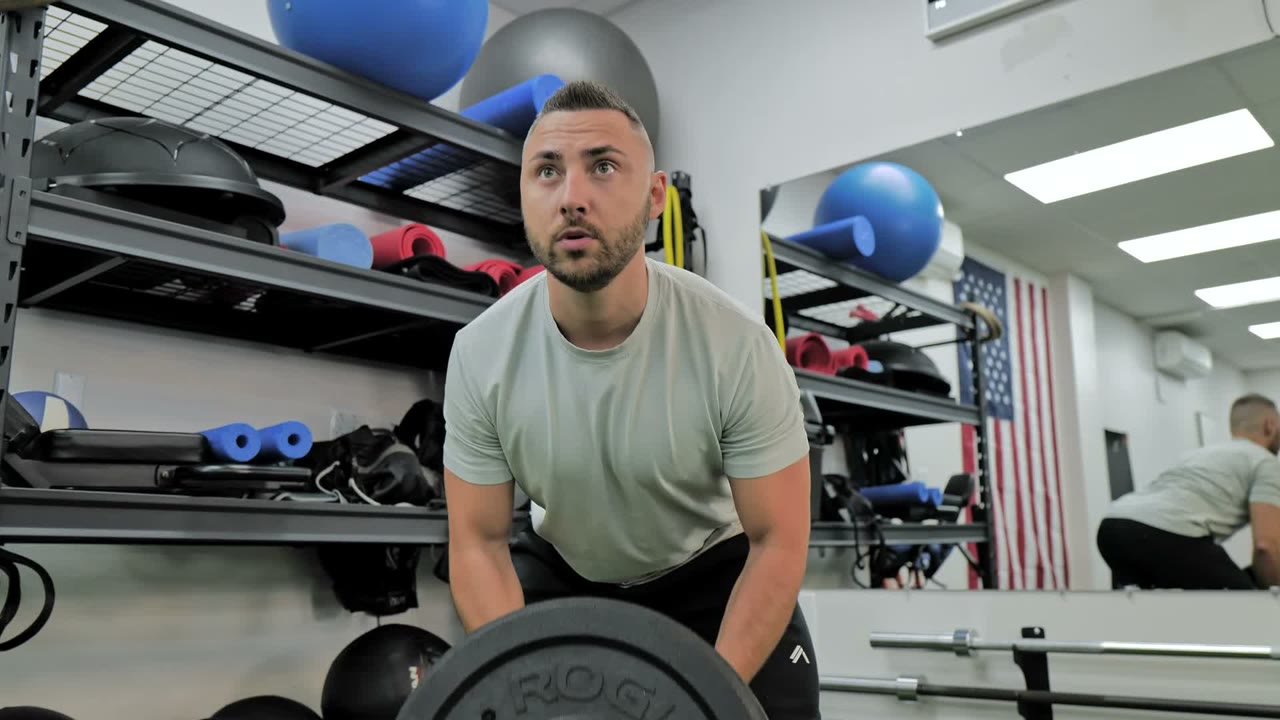
Key Trap Bar Exercises to Anchor Your Training
The trap bar provides exceptional versatility, serving as a primary tool for explosive athletic development, posterior chain hypertrophy, and heavy loaded carries. Below are eight core exercises that define effective hex bar programming.
| Exercise | Movement Family | Primary Muscles | Biomechanical Advantage |
|---|---|---|---|
| Trap bar deadlift | Hybrid hip-hinge / knee extension | Glutes, quadriceps, hamstrings, erector spinae | Centers load directly over ankles, reducing lumbar flexion moment by 20% to 30% while generating higher peak velocity than a straight bar. [1] |
| Trap bar shrug | Scapular elevation | Upper and middle trapezius, levator scapulae | Bilateral neutral grip allows straight vertical scapular travel without the bar scraping across the thighs or forcing anterior shoulder rolling. |
| Trap bar squat | Knee-dominant lower body press | Quadriceps (vastus lateralis), gluteus maximus | High-handle setup allows deeper knee flexion with a vertical torso angle, reducing axial spinal compression compared to barbell back squats. [2] |
| Trap bar romanian deadlift | Hip-dominant posterior chain hinge | Hamstrings, gluteus maximus, lower back | Neutral grip keeps the shoulders back and latissimus dorsi engaged, providing continuous eccentric tension across the hamstring origin. |
| Trap bar farmers carry | Loaded unilateral / bilateral locomotion | Forearms, grip, trapezius, core stabilizers | Rigid unified frame prevents dumbbells from swinging against the legs, allowing lifters to handle substantially heavier loads safely. |
| Trap bar bent over row | Horizontal upper body pull | Latissimus dorsi, rhomboids, posterior deltoids | Neutral hand positioning aligns with natural glenohumeral mechanics, reducing anterior shoulder impingement during heavy rowing sets. |
| Trap bar jump squat | Ballistic triple-extension power | Quadriceps, glutes, gastrocnemius, soleus | Maintains center-of-gravity alignment during takeoff and landing, generating superior peak power and rate of force development without bar whip. [3] |
| Trap bar split squat | Unilateral staggered-stance knee press | Quadriceps, gluteus medius, adductors | Encloses the front leg while lowering the center of gravity, challenging unilateral pelvic stability without balance limitations. |
Trap Bar Definition & Biomechanical Evolution
The trap bar (hex bar) was invented in 1985 by North Carolina powerlifter Al Gerard and officially patented in 1986 under US Patent #4,618,144. Gerard designed the apparatus after suffering recurrent, debilitating lower-back injuries while training with conventional straight barbells. Recognizing that straight barbells force the load to travel in front of the knees and shins, Gerard conceived an enclosed hexagonal rhomboid frame that would allow the lifter to stand directly inside the perimeter of the weight plates.
The Physics of Spinal Moment Arm Elimination
In a conventional barbell deadlift, the bar must clear the patella and anterior tibial spine. This anatomical requirement positions the load approximately 15 to 20 centimeters anterior to the transverse axis of the hips. As a consequence of this horizontal distance, the barbell creates a prolonged external resistance moment arm acting upon the L5/S1 intervertebral disc. The lumbar erector spinae must generate massive internal tension to counteract this rotational shear force.
In contrast, the trap bar aligns the hand grips directly with the lifter's midfoot and lateral hip axis. By eliminating the anterior bar offset, the horizontal moment arm acting on the lumbar spine is reduced by 20% to 30%. Peer-reviewed biomechanical analyses published by Swinton et al. (2011) and Camara et al. (2016) demonstrate that the trap bar significantly decreases peak lumbar flexion moments and decreases lumbar spinal shear forces, while simultaneously allowing athletes to lift heavier absolute loads with greater mechanical efficiency.
Most modern trap bars feature dual-handle configurations: low handles flush with the plane of the sleeves (identical to standard barbell height of 22.8 cm above the floor with 450 mm plates) and raised high handles elevated by approximately 7.5 to 10 cm. The high handles decrease required hip and ankle mobility, allowing taller athletes, beginners, and individuals with restricted lumbar-pelvic rhythm to pull heavy loads with pristine spinal alignment.
Four Biomechanical Pillars of the Hex Bar
Electromyographic (EMG) studies by Camara et al. (2016) confirm that the trap bar elicits significantly higher vastus lateralis (quadriceps) activation during the concentric phase than a straight barbell, while maintaining comparable peak gluteus maximus recruitment. The conventional straight bar shows modestly higher biceps femoris (hamstring) and spinal erector activity solely because the lifter must lean further forward to avoid the shins.
Trap Bar Exercises by Muscle Group
Because the trap bar allows seamless variation between knee-dominant squat mechanics and hip-dominant hinge mechanics, it can be programmed to target specific muscle groups across the lower and upper body.
Quadriceps & Leg Drive
Because the shins are free to translate forward without striking a horizontal bar, the trap bar enables deep knee flexion. Variations like the trap bar squat, trap bar deficit deadlift, and trap bar split squat place exceptional tension on the vastus lateralis, vastus medialis, and rectus femoris.
Hamstrings & Posterior Chain
By initiating the movement with an intentional hip hinge and keeping the shins vertical, the trap bar becomes a powerful posterior chain tool. Utilizing trap bar hamstring exercises like the trap bar romanian deadlift and trap bar single leg deadlift builds resilient posterior chain strength and hamstring hypertrophy.
Glutes & Hip Extension
The trap bar allows lifters to achieve complete hip extension against maximal loads without hyperextending the lumbar spine. Heavy lockouts in the trap bar deadlift, trap bar lunge, and trap bar reverse lunge produce intense gluteus maximus mechanical tension.
Upper Back & Trapezius
The neutral grip of the trap bar enables pure vertical scapular elevation. The trap bar shrug, trap bar bent over row, and trap bar row heavily overload the upper, middle, and lower trapezius along with the rhomboids and lats.
Core & Spinal Stabilizers
Carrying heavy loads requires intense isometric bracing from the rectus abdominis, obliques, and quadratus lumborum. Loaded carries like the trap bar farmers carry and trap bar farmers walk develop unbreakable midline stiffness.
Forearms & Grip Strength
Holding thick steel handles under hundreds of pounds builds crushing grip strength and forearm muscularity. High-volume holds, pause pulls like the trap bar pause deadlift, and carries build forearm flexor endurance without wrist strain.
Top 20 Trap Bar Exercises by Search Demand & Training Tier
Browse our complete catalog of 20 verified trap bar exercises. Each movement card details the primary muscular focus, mechanical advantages, and technical execution notes.
Trap Bar Deadlift
The definitive multi-joint lower body movement. Combines high quad recruitment with immense glute drive while sparing the lower back from excessive shear.
Trap Bar Shrug
The gold standard for upper trapezius hypertrophy. Neutral grips keep arms at your sides, allowing pure scapular elevation without friction on the thighs.
Trap Bar Squat
A knee-dominant variation performed with an upright torso and deep knee bend, delivering pure quad overload without spinal bar compression.
Trap Bar Deficit Deadlift
Standing on a 2-to-4-inch platform increases the range of motion, forcing deeper hip and knee flexion to build immense strength off the floor.
Trap Bar Overhead Press
Performed with an open-ended hex bar or standard frame. Neutral handles reduce shoulder impingement and encourage natural upward scapular rotation.
Trap Bar Romanian Deadlift
A pure hip-hinge movement that places massive eccentric stretch across the hamstrings and glutes while keeping the load centered over the midfoot.
Trap Bar Jump Squat
The elite athletic tool for vertical jump development and rate of force development (RFD), loaded at 10% to 20% of 1RM for maximum peak power output.
Banded Trap Bar Deficit
Combines deficit range of motion with accommodating band tension, building explosive starting strength off the platform and fierce terminal lockout power.
Trap Bar Bent Over Row
Hinging inside the bar provides stable spinal support, allowing heavy horizontal pulling with neutral wrists to target the lats and rhomboids.
Trap Bar Deadlift Against Chains
Progressive chain de-loading matches the human strength curve: lighter off the floor where leverage is lowest, heavier at lockout where hips are strongest.
Trap Bar Farmers Carry
A static grip and core hold performed for distance or time. Trains dynamic postural control, trap endurance, and unbreakable work capacity.
Trap Bar Farmers Walk
Active walking stride under heavy load, forcing the gluteus medius, obliques, and foot stabilizers to manage ground reaction forces unilaterally.
Trap Bar Lunge
A walking or stationary forward lunge that places direct vertical load onto the lead quadriceps and glute while eliminating upper body dumbbell sway.
Trap Bar Overhead Carry
Carrying the bar locked out overhead builds bulletproof serratus anterior stability, thoracic extension, and shoulder rotator cuff endurance.
Trap Bar Pause Deadlift
Pausing for 2 seconds 2 inches off the floor eliminates stretch reflex and builds immense isometric bracing strength at the weakest mechanical point.
Trap Bar Rack Pull
Elevating the bar onto pins or blocks emphasizes the top half of the pull, heavily overloading the upper back, traps, and hip lockout.
Trap Bar Reverse Lunge
Stepping backwards preserves a vertical lead tibia, shifting maximum tension to the gluteus maximus while minimizing patellofemoral shear stress.
Trap Bar Row
A classic horizontal row variation allowing lifters to pull to the lower ribcage with optimal glenohumeral alignment and latissimus activation.
Trap Bar Single Leg Deadlift
A unilateral hinge movement that challenges hamstring flexibility, ankle proprioception, and gluteus medius pelvic stabilization.
Trap Bar Split Squat
A static split stance knee flexion exercise that builds massive quad volume and corrects left-to-right lower limb strength imbalances.
Programming the Trap Bar for Specific Goals
Trap Bar Exercises for Legs
When training the legs with a trap bar, manipulating torso angle and knee displacement allows you to shift emphasis between the anterior and posterior compartments. For quadriceps development, keep your torso more upright and allow the knees to travel forward over the toes (using the low handles or standing on a slight heel elevation). For hamstring and posterior chain development, perform the Romanian deadlift variation by keeping the shins vertical, pushing the hips backward, and initiating the pull entirely from the glutes and hamstrings.
Trap Bar Exercises for Back
The trap bar is one of the most underrated back-building tools in the gym. Because you stand inside the resistance, bent-over rows can be executed with a flatter, more supported torso without the bar colliding with the knees. The neutral grip places the lats in their strongest line of pull, while the high-load capacity of rack pulls and shrugs forces thick development throughout the rhomboids, middle trapezius, and upper back musculature.
Trap Bar Exercises for Glutes
The gluteus maximus is the primary engine of hip extension. The trap bar allows lifters to achieve maximal glute activation at lockout without the hyperlordosis (lower-back arching) often seen in straight-bar deadlifts. Exercises like the trap bar reverse lunge, Bulgarian split squat inside the hex frame, and heavy trap bar deadlifts provide deep stretch under load and intense contraction at the top of the movement.
Trap Bar Exercises for Athletes
Strength and conditioning coaches for collegiate and professional sports rely heavily on the trap bar because it provides superior transfer to field performance. Research in the Journal of Strength and Conditioning Research demonstrates that athletes produce higher peak force, peak velocity, and peak power during trap bar jumps and pulls compared to traditional straight-bar movements. The reduced technical learning curve and lower spinal strain allow team sport athletes to build game speed and vertical jump power without risking lumbar fatigue before competition.
Trap Bar Exercises for Beginners
For novice lifters, learning the hip hinge on a straight barbell can be intimidating and technically demanding due to shin scraping and forward tipping. The trap bar provides an immediate, intuitive movement groove. The lifter simply stands inside, grips the handles, braces the core, and stands up. Beginners can rapidly build foundational strength, develop grip capacity, and learn proper abdominal bracing without fighting difficult balance mechanics.
Trap Bar Exercises at Home
For home and garage gym lifters, a trap bar is an exceptionally space-efficient investment. A single hex bar can replace multiple bulky machines by functioning as your primary deadlift bar, squat apparatus, shrug station, rowing handle, and farmer's walk implement. For tighter home gym spaces, open-ended trap bars provide even greater versatility, allowing lunges, step-ups, and split squats without frame interference.
Full-Body Trap Bar Athletic Strength Routine
This evidence-based routine combines heavy compound lifting, explosive power work, posterior chain hypertrophy, and functional carry conditioning in a single balanced session.
Weekly Session Architecture
Perform this session 1 to 2 times per week with at least 48 to 72 hours of recovery between workouts. Ensure you warm up thoroughly with dynamic hip mobility, ankle dorsiflexion drills, and progressive empty-bar warm-up sets.
| Exercise | Target Muscles | Sets & Reps | Rest | Tempo | Training Intent |
|---|---|---|---|---|---|
| Trap bar jump squat | Quads, glutes, calves | 4 sets × 3–5 reps | 120 sec | Explosive | Peak rate of force development (RFD); use 15–20% of 1RM with maximal jump height. [3] |
| Trap bar deadlift | Glutes, quads, hamstrings, back | 4 sets × 5–6 reps | 180 sec | 2-0-1-0 | Primary progressive overload; drive through midfoot with neutral spine and aggressive hip lockout. |
| Trap bar bent over row | Lats, rhomboids, rear delts | 3 sets × 8–10 reps | 90 sec | 2-1-1-0 | Horizontal pull; pull elbows back toward hips, pausing 1 second at full scapular retraction. |
| Trap bar romanian deadlift | Hamstrings, gluteus maximus | 3 sets × 8–10 reps | 90 sec | 3-1-1-0 | Hamstring hypertrophy; initiate by driving hips back with soft knees, feeling deep stretch. |
| Trap bar split squat | Quadriceps, gluteus medius | 3 sets × 8 reps/leg | 75 sec | 2-1-1-0 | Unilateral leg strength; maintain upright chest and steady front-foot heel contact. |
| Trap bar farmers carry | Grip, traps, obliques, core | 3 sets × 30–40 meters | 90 sec | Controlled | Work capacity and grip endurance; walk with short, controlled heel-to-toe strides and braced core. |
Progressive Overload Strategy
To ensure continuous progress without plateauing or overtraining, implement a double-progression model. When you can complete all prescribed sets at the top of the repetition range with clean form, increase the load by 2.5 kg to 5 kg for the subsequent workout. If lower back fatigue accumulates, transition temporarily to the high handles to reduce hip flexion demands while maintaining heavy loading on the leg musculature.
How the Trap Bar Compares to Other Implements
Choosing the Right Tool for Your Biomechanical Needs
- Trap Bar vs. Straight Barbell: The straight barbell requires the lifter to navigate the bar around the knees, producing greater forward trunk lean and higher lumbar spine shear forces. The straight barbell elicits higher erector spinae and hamstring EMG activity. Conversely, the trap bar permits higher peak power output, faster bar speed, and greater quadriceps activation with substantially reduced spinal strain.
- Trap Bar vs. Dumbbells: Dumbbells allow natural hand positioning and unilateral freedom, but loading is severely limited by hand grip and awkward balance once loads exceed 40–50 kg per hand. The unified rigid frame of the trap bar accommodates hundreds of pounds on Olympic sleeves, allowing heavy progressive overload that dumbbells cannot replicate.
- Trap Bar vs. Cable Machine: Cables provide continuous resistance through constant tension curves and multi-directional angles. However, cable stacks lack the ground reaction force, explosive triple extension, and maximum bone density stimulus provided by heavy free-weight trap bar pulls and jumps.
Clinical Safety: Protecting the Lower Back and Knees
While the trap bar is significantly gentler on the lumbar spine than a conventional barbell, poor execution can still induce injury. Avoid hyperextending the lumbar spine at lockout; finish the lift by squeezing the glutes firmly forward rather than leaning backward through the lower back. Maintain continuous intra-abdominal pressure via the Valsalva maneuver throughout the rep. Ensure your knees track in-line with your second and third toes to prevent valgus knee collapse during the initial floor drive.
Frequently Asked Questions About Trap Bar Training
What is the 3-3-3 rule in the gym?
The 3-3-3 rule is a foundational training guideline commonly recommended for balanced strength and longevity. It typically refers to structuring workouts around three compound multi-joint movements (such as a squat or trap bar deadlift, a press, and a pull), performing three challenging working sets per exercise, and resting for three full minutes between heavy strength efforts. This protocol ensures adequate central nervous system recovery and high motor unit recruitment without excessive metabolic fatigue.
Is it worth getting a trap bar?
Yes. For most lifters, athletes, and home gym owners, a trap bar is one of the highest-value equipment investments available. It allows individuals with lower-back stiffness or past disc injuries to deadlift heavy loads safely. It eliminates the need for expensive dedicated shrug and farmer's walk equipment, and scientific research consistently demonstrates that it produces equal or superior athletic power and muscle hypertrophy compared to standard straight barbells.
What is a trap bar good for?
A trap bar is primarily good for developing explosive lower-body power, building quadriceps and glute strength, packing mass onto the upper back and trapezius, and building crushing grip strength. Its unique hexagonal geometry places the load in line with your center of gravity, making it the safest implement for heavy pulls, loaded carries, and ballistic jump squats.
What are the 3 best exercises for building traps?
The three most effective exercises for building dense, powerful trapezius muscles are the heavy trap bar shrug (which provides vertical scapular elevation without thigh friction), the heavy trap bar farmer's carry (which subjects the entire shoulder girdle to prolonged isometric eccentric stretch under massive loads), and the chest-supported or cable row with an emphasis on scapular retraction to target the middle and lower trapezius fibers.
Evidence & References
- Swinton PA, Stewart A, Agouris I, Keogh JW, Lloyd R. (2011). A biomechanical analysis of straight and hexagonal barbell deadlifts using submaximal loads. Journal of Strength and Conditioning Research, 25(7):2000-2009. PMID: 21659894.
- Camara KD, Coburn JW, Dunnick DD, Brown LE, Galpin AJ, Stockton ME. (2016). An Examination of Muscle Activation and Power Characteristics While Performing the Deadlift With Straight and Hexagonal Barbells. Journal of Strength and Conditioning Research, 30(5):1183-1188. PMID: 26840440.
- Lockie RG, Moreno MR, Lazar A, Orjalo AJ, Davis DL, Risso FG, Liu TM, Stage AA, Birmingham-Babauta SA, Stokes JJ, Heidle HA, Peters RR, Dawes JJ. (2018). The 1 Repetition Maximum Mechanics of a High-Handle Hexagonal Bar Deadlift Compared With a Conventional Barbell Deadlift as Measured by Linear Position Transducers. Journal of Strength and Conditioning Research, 32(1):150-161. PMID: 28557876.
- Gerard A. (1986). Weightlifting Bar. United States Patent #4,618,144. Issued October 21, 1986.
- Haff GG, Triplett NT. (2016). Essentials of Strength Training and Conditioning (4th ed.). Human Kinetics. ISBN: 978-1-4925-0162-6. Resistance training mechanics and athletic development.
The training recommendations, exercise selections, and anatomical descriptions on this page are developed by the Fitness Instructor AI editorial team based on peer-reviewed biomechanical literature. They do not constitute personalized medical advice. Always consult a licensed healthcare professional before starting any heavy strength training program.