Neck exercises can mean two different jobs: moving your head more comfortably or building the muscles' capacity to resist force. Gentle head turns and side tilts belong to the first; pressing your head against your hand without moving it belongs to the second. If you have a diagnosed neck condition, recent surgery or worsening neurological symptoms, start with medical guidance rather than an exercise list. [2]
Use the guide below to choose a starting point, understand the instructions and decide when to stop. For pain, sport and appearance, the evidence answers different questions.
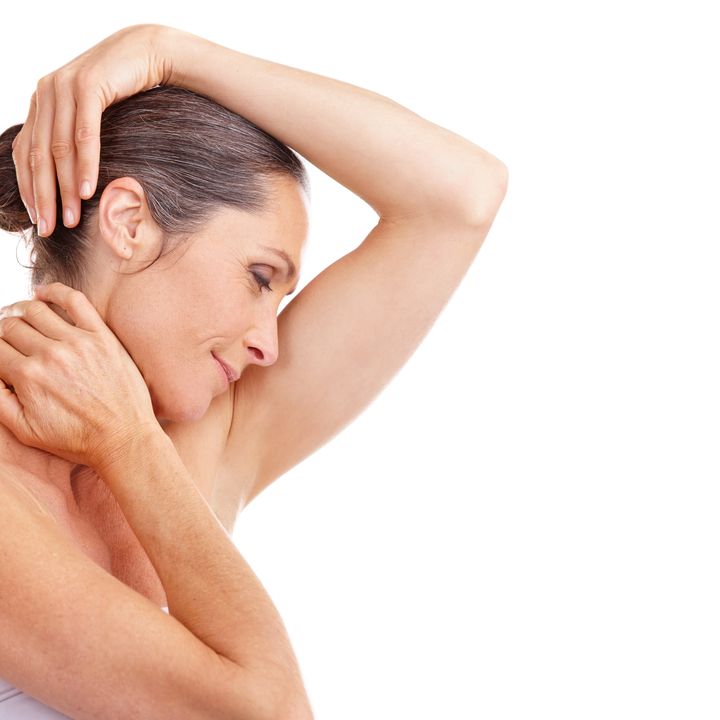
A head tilted forward, with one hand over the crown. The starting movements below use no hand pressure. YuriArcursPeopleimages / Envato.
First, choose what you want to improve
01 · Movement
Turn, tilt and glide
Explore a comfortable range with the weight of your head. Useful starting movements appear in NHS flexibility guidance. [1]
A guide to choosing your next step. This is not an anatomy diagram or a diagnostic tool.
Three neck movements you can do without weights
Begin slowly, with your shoulders relaxed. Stay within a range that feels comfortable; a bigger movement is not the target. These are individual options, not a circuit you must finish. [1]
Rotation
1. A slow head turn
Sit upright and face forward.
Turn to look toward one shoulder without forcing the end of the movement.
Return to the middle, then turn the other way.
The NHS flexibility routine uses a five-second hold and three turns to each side. [1] The direction also appears in University Orthopedics' neck guide. [5]
Related guide: seated neck rotations.
Side-bending
2. Ear toward shoulder
Look ahead with your shoulders resting down.
Let your head tilt toward one shoulder, only as far as feels comfortable.
Bring it back to center, then change sides.
You do not need to pull your head with your hand. NHS Inform describes this as a gentle side tilt; Leeds' exercise advice also uses the ear-toward-shoulder direction. [2]
Related guide: side neck stretch.
Retraction
3. A small chin glide
Sit or stand tall and keep looking forward.
Draw your head gently backward, making a small double-chin shape.
Relax and return; this is not a chin-to-chest bend.
Leeds describes a five-second hold. Alberta's dorsal-glide instructions use the same backward movement with the neck kept straight. [4]
The lying chin-tuck guide will cover a different starting position.
How hand-resisted neck strengthening works
Isometric means producing force without visible movement. Keep your head level while the hand and head push against each other. Alberta's patient guide specifies a firm, submaximal effort. You do not need to push as hard as you can. Check that this kind of exercise is appropriate with your clinician if you are treating a neck problem. [3]
Three directions of resistance — the head stays still
Exercise
Hand position
What you do
Flexion isometric
Palm against the forehead
Press forward into your hand while it stops your head from tipping.
Extension isometric
Hand or hands behind the head
Press backward against your hands without looking up.
Side-flexion isometric
Palm beside the head, above the ear
Press sideways into the hand without leaning; then change sides.
Alberta describes holds of about six seconds; University Orthopedics also describes neutral-position presses against the forehead and back of the head. The examples explain the movement, but a rehabilitation dose should come from the plan given to you. [5]
A seated flexion isometric and a neck extension hold have dedicated guides in preparation.
Does resistance training actually make the neck stronger?
Yes, for the strength outcome studied. A 2024 systematic review covering 26 articles found that resistance training improved isometric neck strength. It did not establish that resistance training prevents sports-related concussion; no included study tested that outcome directly. [7]
The newer 2026 review by Postula and colleagues also judged the relationship between neck strength and concussion risk inconclusive. If you box or play a collision sport, use a sport-specific coaching and medical plan; a stronger neck is not a guarantee against concussion. [8]
A starting point for stiffness, at home or at a desk
For a new, uncomplicated neck problem, NHS Inform suggests beginning with one or two movement exercises and only two or three repetitions at a time. Small amounts spread through the day can be more manageable than one long session. Add repetitions gradually as the movements become easier. [2]
An example: choose a head turn, do a few comfortable repetitions, then check how you feel before adding anything else. Do not treat the six options on this page as six required exercises. Your symptoms should not be worse overall afterward or the next morning. Stop an exercise that creates new pain or makes your symptoms worse.
What about posture?
Leeds' advice combines gentle movement with relaxed shoulders and a screen at eye height. Treat a chin glide as a movement you practice, rather than a position you strain to hold all day. [4]
What changes at the gym?
The exercise directory includes bands, cables, machines and weighted neck movements. Their presence in an index is not a recommendation to start with them. The hand-resisted exercises above let you understand the task without an external weight; decisions about heavier loading belong in a progressive plan matched to your goal and symptoms.
For neck size, the strength review is not a universal hypertrophy program. Its findings about isometric force do not establish how much your neck circumference will change. A dedicated neck workout is in preparation.
A brief map of what moves the neck
The neck is a group of muscles and joints, not one muscle to isolate. Its movements include turning, bending forward and backward, and side-bending. The sternocleidomastoid contributes to rotation and flexion; posterior muscles such as the splenius help extend and rotate the head. [11]
That is why a forward press and a backward press are different tasks. The planned neck muscle anatomy guide will go into more detail.
Neck pain: when to stop and get help
This page explains exercise choices; it cannot identify the cause of your symptoms. If you have had neck surgery or already have a diagnosed neck condition, follow your healthcare professional's advice. [2]
Seek urgent medical attention for these changes
Worsening weakness, numbness or tingling in an arm, or clumsy hands that are new or worsening.
New trouble walking or keeping your balance since the neck pain began.
Neck pain accompanied by a severe headache.
NHS Inform identifies these as reasons to contact a clinician urgently. Also seek medical advice if you feel generally unwell, develop dizziness or blurred vision, or the pain is not improving. [6]
Pinched nerves, arthritis and named pain conditions
Pain can spread from the neck into the shoulder or arm, and tingling or numbness may occur. An online list cannot tell you whether the cause is a pinched nerve. For a diagnosed condition—including arthritis or occipital neuralgia—ask which movements and loading are suitable for your case instead of borrowing a generic workout. [6]
Brachioradial pruritus is a separate clinical question
Brachioradial pruritus is a nerve-related itch, usually on the forearm, that may be associated with cervical spine problems. DermNet notes that there is no consensus on the best treatment and that the evidence is largely small case series and reports. Do not use a neck-strengthening routine as a self-prescribed treatment for unexplained itching. [10]
Will these exercises remove a double chin or “turkey neck”?
There is not enough evidence to promise that result. A 2025 systematic review of mechanical facial rejuvenation techniques included 12 studies involving 321 women aged 30–70. Some local improvements were reported, but the reviewers judged the evidence insufficient for confident conclusions. Neck movement and strength exercises should not be presented as a proven cosmetic lifting program. [9]
Three mistakes to avoid
Making range the score. For gentle movement, stay inside a comfortable range instead of forcing your head farther.
Turning an isometric into a moving repetition. Your hand resists the intended direction; the head stays level and still.
Adding everything at once. Begin with a small amount, then use your response to guide the next step. [2]
Neck exercise guides by equipment
The individual guides listed below are in preparation. They are grouped by the catalog's equipment labels so you can see what is planned; they are not a recommended routine. Availability of a guide does not establish that a movement is suitable for an injured or painful neck.
The bodyweight neck collection will bring together the options that do not use an external weight.
Without external weights · 40 guides in preparation
Arm Extended Neck Stretch
Arms Out Lateral Neck Bends
Bodyweight Wall Front Neck Bridge
Bodyweight Wall Rear Neck Bridge
Bodyweight Wall Side Neck Bridge
Br Neck Retraction
Cervical Extensor Mobilisation Seated Manual
Cervical Flexion 1 Seated Isometric
Cervical Flexion 2 Supine Isometric
Chin to Chest Stretch
Eagle Arms Chin Into Chest
Easy Pose Neck Stretch
Forward Neck Flexion Stretch
Half Neck Rolls
Lateral Neck Flexion
Lying Cervical Flexion 2
Lying Chin Tucks
Lying Isometric Neck Retraction
Neck Curl
Neck Extension
Neck Flexion and Extension
Neck Rotations
Rear Deltoid Stretch Across the Neck
Rotating Neck Stretch
Scalene Stretch
Seated Cervical Rotation Hold
Seated Cervical Side Flexion Hold
Seated Forward Neck Bend
Seated Neck Rotations
Seated Neck Stretch
Seated Neck Tap
Side Neck Stretch
Standing Forward Neck Bend
Standing Neck Extension
Standing Neck Flexions
Standing Neck Mobility Circumductions
Standing Neck Rotations
Standing Neck Side Flexions
Standing Neck Stretch
Turtle Neck
Resistance bands · 6 guides in preparation
Band Seated Cervical Side Flexion Eccentric
Band Seated Cervical Side Flexion Hold
Cervical Extension Band
Cervical Extension Banded Hold
Cervical Extension Eccentric Band
Cervical Side Flexion 4 Seated Theraband
Cables · 2 guides in preparation
Cable Neck Extension
Cable Neck Flexion
Specialized resistance and holds · 5 guides in preparation
Cervical Extension Hold
Weighted Neck Extension
Weighted Neck Flexion
Weighted Neck Harness Extension
Weighted Neck Lateral Flex
Massage and mobility tools · 3 guides in preparation
Cervical Extensor Mobilisation Supine Peanut Tool
Neck Tiger Tail
Upper Neck Massage Ball Stretch
Neck machines · 5 guides in preparation
Lever Lateral Neck Flexion H
Lever Neck Extension
Lever Neck Extention H
Lever Neck Flexion
Lever Neck Lateral Flexion
Stability ball · 3 guides in preparation
Stability Ball Neck Extension
Stability Ball Neck Flexion
Stability Ball Side Lying Neck Stretch
Suspension trainer · 3 guides in preparation
Suspended Neck Extension
Suspended Neck Flexion
Suspended Neck Lateral Flexion
Weight plates · 2 guides in preparation
Weight Plate Neck Extension Prone
Weight Plate Neck Flexion Supine
Sources and review
Training and safety information for adults. Individual medical advice takes priority. This page has not yet been reviewed by a qualified human trainer or clinical safety reviewer.
NHS. Flexibility exercises. Neck rotation and stretch instructions; reviewed November 2023.
NHS Inform. Exercises for neck problems. Movement options, gradual starting dose, symptom response and exclusions.
MyHealth.Alberta.ca / Ignite Healthwise. Neck: Exercises. Backward glide and neck isometrics; current July 2024.