Build capped shoulder width, V-taper aesthetics, and multi-planar stability
Side Delt Exercises
The lateral deltoid (or medial deltoid) is the primary muscular engine of glenohumeral abduction in the frontal and scapular planes, carving the rounded shoulder capping and wide upper-body silhouette that defines the classic athletic V-taper. Discover how the deltoids work in synchronized coordination with the rotator cuff and scapular upward rotators to elevate the arms without joint pinching. [6]
Explore the three-part deltoid anatomical map, filter 94 curated exercises across dumbbells, cables, resistance bands, kettlebells, and machines, master absorbed dumbbell and continuous-tension cable mechanics, follow our complete side delt hypertrophy workout routines (for both gym and home setups), and examine peer-reviewed kinesiological evidence on scapular plane scaption, internal rotation myths, and optimal weekly volume.
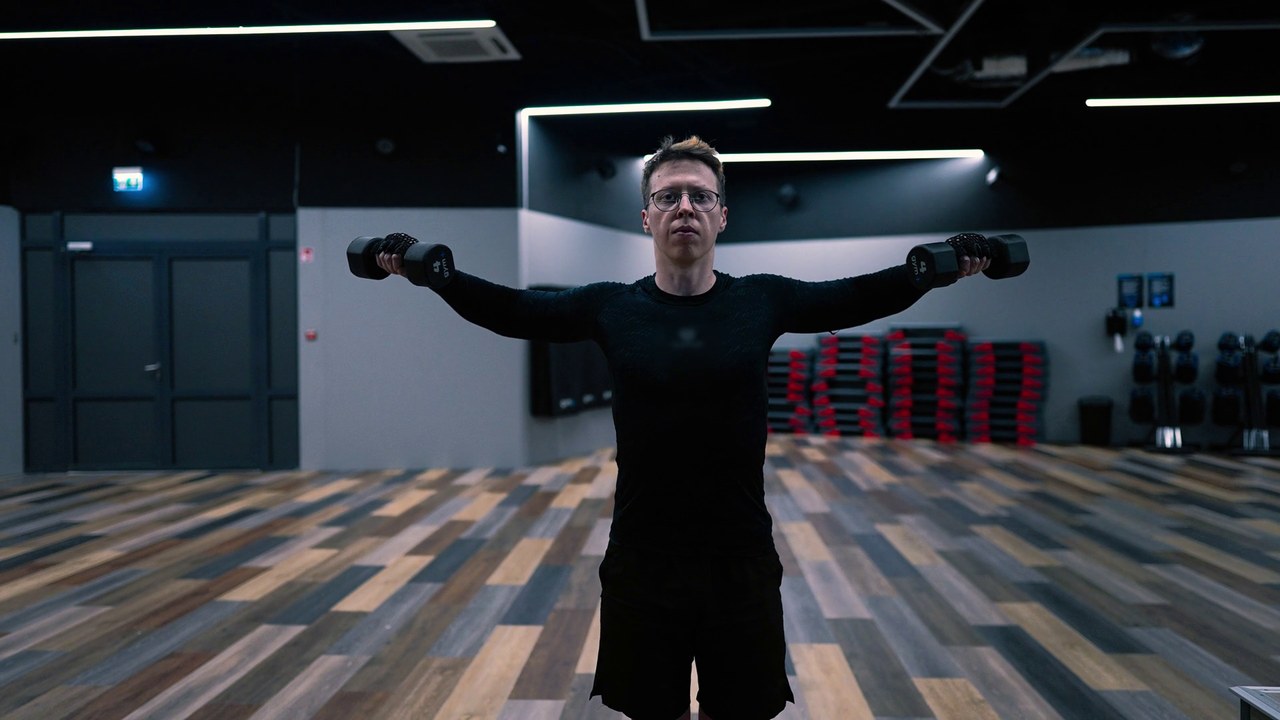
Dumbbell lateral raise held at peak abduction in the scapular plane with level wrists and soft elbows. Envato Elements.
Anatomy and joint kinematics of the deltoid muscle
The deltoid forms the muscular cap of the shoulder, spanning from the clavicle, acromion, and scapular spine down to its convergent insertion on the deltoid tuberosity of the humerus. Because the muscle wraps three-dimensionally around the spherical glenohumeral joint, its fibers are anatomically divided into three distinct functional compartments:
Shoulder flexion & horizontal adduction
Anterior Deltoid (Pars Clavicularis)
Originates on the anterior border and superior surface of the lateral third of the clavicle. It powers humeral flexion, internal rotation, and horizontal adduction, heavily recruited during overhead presses and bench pressing.
Key movements: barbell overhead press, dumbbell shoulder press, front raise.
Humeral abduction & frontal width
Lateral Deltoid (Pars Acromialis)
Arises from the superior surface and lateral margin of the acromion process. Its multipennate pennation pattern confers immense mechanical leverage for humeral abduction, elevating the arm from 15° to roughly 90°–100°. [1]
Originates along the inferior lip of the spine of the scapula. It acts as the primary driver of humeral extension, horizontal abduction, and external rotation, counteracting anterior rolling during heavy pulling.
Key movements: face pull, reverse dumbbell fly, rear delt cable cross.
Scapular plane kinematics and the supraspinatus force-couple
Achieving maximum lateral deltoid stimulation while maintaining lifelong joint health requires an understanding of shoulder kinematics:
The 0° to 15° supraspinatus initiation: At the very start of abduction with the arms hanging vertically against the torso, the lateral deltoid pulls almost parallel to the shaft of the humerus, creating an upward compressive shear into the glenoid cavity. The supraspinatus (a key rotator cuff muscle) must initiate the first 15° of abduction by seating the humeral head before the lateral deltoid achieves mechanical advantage.
The 30° scapular plane (scaption): Elevating the arms strictly in the pure frontal plane (directly out to the sides at 180°) forces the greater tubercle of the humerus to collide with the acromion process and coracoacromial arch, pinching the subacromial bursa and supraspinatus tendon. Bringing the arms forward roughly 30° into the scapular plane (scaption) aligns the movement with the natural angle of the shoulder blade, maximizing lateral deltoid recruitment while opening the subacromial space. [1]
The scapulohumeral rhythm: Above 90° of abduction, upward rotation of the scapula is driven by a coordinated force-couple between the upper and lower trapezius and the serratus anterior. Isolating the lateral deltoid is most effective between 15° and 90°–100° of humeral abduction.
Curated selection
Eight foundational side delt exercises
Filter these primary lateral deltoid exercises by equipment. Each exercise challenges shoulder abduction or vertical pulling mechanics across distinct resistance profiles and stability demands.
The definitive gold-standard isolation movement; performed in the 30° scapular plane with soft elbows to deliver peak rotational torque at 90° abduction.
Continuous bottom-to-top tension
Cable lateral raise
Pulleys provide continuous diagonal tension across the initial 0° to 30° stretch arc where free dumbbells exert virtually no perpendicular resistance.
Direct pad leverage without grip fatigue
Machine lateral raise
Lever pads rest directly against the upper arm, eliminating forearm and wrist strain so 100% of muscular effort concentrates on pure lateral deltoid abduction.
Compound overload and mechanical tension
Barbell upright row
A multi-joint vertical pull executed with a wide grip to pull elbows outward, overloading the lateral deltoids with weights far exceeding single-joint raises.
Ascending elastic peak contraction
Band lateral raise
Elastic resistance multiplies as the band stretches, matching the full shortening of the lateral deltoid at the top of abduction without heavy joint impact.
Offset center-of-mass stability
Kettlebell lateral raise
The downward-hanging mass of the kettlebell increases the rotational lever arm and prevents wrist flicking, enforcing strict deltoid motor control.
Fixed-track compound isolation
Smith machine upright row
Locks the barbell path in a vertical or slightly rearward track, stabilizing your balance so you can focus entirely on wide elbow elevation.
Zero momentum strict isolation
Seated dumbbell lateral raise
Sitting upright on a flat bench eliminates knee bounce and hip heave, forcing pure isolated humeral abduction against gravity.
No exercise matches your filter criteria. Clear the search input or reset filters to display all options.
Dumbbell side delt exercises: isolation mechanics and rotational freedom
This section absorbs our dedicated dumbbell lateral deltoid guide (MX-side-delts-dumbbells), exploring how free-weight dumbbells deliver unmatched joint adaptability and targeted hypertrophy:
The torque curve of free weights: When performing a standing dumbbell lateral raise, the resistance vector is vertical gravity. When your arms hang at your sides, the horizontal moment arm from your shoulder joint to the dumbbell is zero—meaning tension on the lateral deltoid is virtually non-existent. As you elevate the dumbbells outward, the moment arm lengthens, reaching its maximum when your arms are parallel to the floor at 90° abduction. This creates a steep ascending resistance curve with peak torque occurring exactly at peak contraction.
Seated dumbbell lateral raise: Sitting upright on a flat bench locks the pelvis and lower body, preventing the subtle hip dip and knee bounce that lifters often use to cheat heavy dumbbells through the initial arc. Pair with dumbbell seated one arm lateral raise for focused unilateral overload.
Unilateral leaning raises (Egyptian raises): By holding a vertical post with one arm and leaning your torso out at a 20° to 30° angle while performing a one arm dumbbell lateral raise, you alter the gravity angle. This shifts the moment arm earlier in the range of motion, delivering meaningful tension into the lengthened stretch position. Similarly, lying sideways on an incline bench (lying lateral raise) loads the side delt through its early abduction arc.
Heavy partials for progressive overload: Using dumbbells 20% to 30% heavier than your normal isolation load and moving them strictly through the bottom-to-midrange arc (lateral raise partials) places massive mechanical tension across the lateral deltoid fibers without straining the acromioclavicular joint at full elevation.
Alternating and tempo variations: Employing an alternating dumbbell lateral raise or seated variations allows continuous core bracing and strict eccentric control.
Cable side delt exercises: continuous tension and fiber alignment
Cable pulleys provide a decisive biomechanical advantage that dumbbells cannot match: the line of resistance can be oriented in any direction regardless of gravity:
Eliminating the bottom dead zone: When executing a cable lateral raise or cable one arm lateral raise with a low pulley, the cable pulls diagonally inward across your body. Even when your arm hangs down at your hip, the cable exerts lateral shear against your hand, generating active muscle tension right from 0° of abduction. Research by McAllister et al. (2013) demonstrated that cables produce superior continuous EMG throughout the entire range of motion compared to free weights. [3]
Behind-the-back cable lateral raise: Running the cable behind your hips (cable behind the back lateral raise) guides your humerus naturally into the 30° scapular plane, preventing the arm from drifting too far forward and eliminating torso interference.
Dual cable cross lateral raises: Standing centered between dual low pulleys and crossing the cables in front of you (dual cable lateral raise) allows you to train both lateral deltoids simultaneously with an optimal converging resistance profile.
Pulley height adjustments: Setting the pulley at knee or hip height shifts peak resistance to 45° of abduction (the mid-range where the deltoid possesses its strongest contractile leverage), while setting the pulley at the bottom floor peg concentrates maximum load at peak 90° shortening. Explore our complete directory of cable machine side delts exercises for 16 specialized cable variations.
Cable vertical pulling: Incorporating a cable upright row or cable rope mid lateral raise delivers multi-joint vertical pulling with uninterrupted tension throughout peak flexion.
Resistance band side delt exercises: ascending resistance and joint-friendly training
This section absorbs our comprehensive band protocol (MX-side-delts-resistance-bands), showing how elastic loop and tube bands deliver exceptional lateral deltoid hypertrophy:
Accommodating elastic resistance: Elastic resistance follows Hooke's Law: tension increases proportionately with elongation. As you abduct your arms during a band lateral raise, the band stretches and tension ramps up dramatically, matching the peak contraction of the lateral deltoid at 90° abduction.
Joint-friendly warm-ups and drop sets: Because bands exert minimal starting resistance, they protect the fragile supraspinatus tendon from sudden inertial shock at the bottom of the movement. This makes bands ideal for shoulder pre-exhaustion, rotator cuff warm-ups, and brutal high-rep pump burnout sets at the end of a workout.
Unilateral and banded upright rows: Utilizing a one arm band lateral raise or band upright row allows you to stand on the center of the band and adjust foot width to micro-calibrate tension with millimeter precision.
Mini-band bent-arm abduction: Placing a mini-loop band around the wrists with elbows bent at 90° (mini band bent arm lateral raise, mini band alternating bent arm lateral raise) challenges both lateral deltoids and external rotators against continuous lateral tension.
Kettlebell side delt exercises: offset leverage and dynamic stabilization
This section absorbs our kettlebell side delt guide (MX-side-delts-kettlebells), highlighting the unique mechanical stimulus of offset iron weights:
The displaced center of mass: In a dumbbell, mass is evenly balanced across the palm. In a kettlebell, the ball of mass sits several inches below the handle. When executing a kettlebell lateral raise, this hanging mass increases the rotational moment arm, enforcing strict grip discipline and preventing the lifter from flicking the wrist to toss the weight up.
Kettlebell upright rows: The wide handle of a kettlebell allows a relaxed, natural wrist angle during vertical pulling. The kettlebell upright row and unilateral kettlebell upright row single allow you to pull the elbows high and wide while the weight tracks smoothly along your midline.
Long-lever raises: Holding the kettlebell by the horns with straight arms (kettlebell long lever lateral raise) or performing alternating raises (alternating kettlebell lateral raise) demands intense neuromuscular coordination from both the lateral deltoid and rotator cuff stabilizers.
Complete side delt workout: gym and home routines
This protocol absorbs our dedicated side delt programming (WK-0091) into a structured training routine. Rather than relying solely on endless light dumbbell raises, this session combines heavy multi-joint tension, continuous cable stretch resistance, and strict metabolic isolation to stimulate all lateral deltoid motor units:
Pause for 2 full seconds at peak 90° abduction; lower smoothly
Band lateral raise (standing on elastic tube)
3
15–20 reps (1-1-1-1 tempo)
45 sec
Widen stance to increase elastic band tension at peak contraction
Seated shoulder abduction (isometric wall press)
3
4 × 6-sec max holds / set
45 sec
Press dorsal wrists outward against a doorframe at maximum voluntary effort
Household water jug lateral raise
3
15–20 reps (3-sec eccentric descent)
45 sec
Fill 1-gallon jugs with water (8.3 lb) or sand for calibrated progressive overload
Weekly volume and training frequency recommendations
According to the ACSM Position Stand on resistance training, optimal muscular adaptation for the lateral deltoids requires 12 to 20 direct weekly sets for trained individuals. [5] Research by Schoenfeld et al. (2014) highlights that because the lateral deltoid is a pennate muscle subjected primarily to low-damage single-joint abduction, it recovers remarkably fast compared to muscles loaded under heavy axial spinal compression. [4] Distributing your weekly volume across 2 to 4 sessions per week (such as on Push days, Pull days, or paired with Shoulders) stimulates frequent muscle protein synthesis and superior growth compared to a single exhaustive once-a-week shoulder session.
Side delt exercises at home: calisthenics, bodyweight, and minimal equipment
Building wider shoulders at home without a commercial gym is completely achievable by leveraging biomechanics and creative loading:
Doorframe isometric abduction: Stand inside a standard doorway with arms hanging at your sides. Place the backs of your wrists against the doorframe and drive your arms outward as if performing a lateral raise (standing shoulder abduction, seated shoulder abduction). Performing 4 to 5 maximal 6-second voluntary isometric contractions (MVIC) recruits high-threshold motor units across the lateral deltoid without any movement.
Side plank with humeral abduction: In a side elbow plank, keeping your core rigid while elevating your upper arm in the frontal plane (side raise and kick) challenges lateral stability while mobilizing the middle deltoid.
Water jugs and loaded backpacks: A standard 1-gallon water jug weighs exactly 8.34 lbs (3.78 kg) and features a sturdy handle. Gripping two water jugs and raising them in the scapular plane with a 2-second apex pause provides an exceptional stimulus for shoulder hypertrophy. For heavier loading, fill a sturdy backpack with books and perform unilateral lateral raises.
Side delt exercises with machines: leverage stability and constant resistance arcs
Commercial gym machines offer specialized apparatus that isolate the middle deltoid while removing technical limiting factors:
Leverage machine lateral raises: On a machine lateral raise or seated lateral raise machine, the padded lever arms rest directly against your outer upper arms (distal humerus). This bypasses your hands and forearms completely, preventing grip fatigue or wrist strain from cutting your set short and focusing 100% of tension on the lateral deltoid.
Standing machine lateral raise: The machine standing lateral raise and lever lateral raise allow an athletic standing posture, enabling slight natural hip bracing while cam-guided levers ensure consistent resistance throughout the entire range of motion.
Smith machine upright rows: Using a Smith machine (smith machine upright row, smith upright row) fixes the barbell in a smooth vertical track, preventing the bar from swinging away from your body and allowing you to safely pull with a wide grip to target the lateral deltoids.
Plate-loaded lateral raises: Apparatus like the hammer strength plate loaded lateral raise combine free-weight plate loading with precision cam ergonomics for intense peak contractions.
Side delt exercises for women: athletic posture, shoulder capping, and hourglass proportions
Lateral deltoid training provides extraordinary aesthetic and functional benefits for female athletes:
The visual hourglass illusion: Adding lean muscular definition to the outer caps of the shoulders visually broadens the upper silhouette. This subtle widening creates a powerful visual contrast that makes the waist and midsection appear smaller and tighter, enhancing natural athletic hourglass proportions without adding unwanted bulk to the neck.
High-rep fatigue tolerance: Research indicates female lifters typically possess a higher proportion of type I muscle fibers and greater capillarization in the upper body, granting exceptional muscular endurance and rapid recovery between sets. Side delt training for women responds exceptionally well to 12 to 20 reps per set with shorter rest intervals (45 to 60 seconds).
Rotator cuff protection and postural symmetry: Daily life, office desk work, and child-carrying frequently pull the shoulders into internal rotation. Strengthening the lateral and rear deltoids balances the chest and anterior deltoids, pulling the shoulders back into a proud, confident posture.
Best side delt exercises for mass, hypertrophy, and broader shoulders
If your shoulder width has plateaued, implementing these evidence-based programming rules will trigger fresh lateral deltoid growth:
Pair mechanical tension with peak stretch: The lateral deltoid responds to both heavy loading and metabolic accumulation. Combine heavy multi-joint movements like the barbell upright row (or wide grip barbell upright row) for mechanical tension, with continuous-tension cable raises (cable lateral raise) for lengthened stretch loading, and dumbbell drop sets for metabolic burn.
Should side delts be trained on Push or Pull days? Because the lateral deltoid is an abductor rather than a pure pusher or puller, it fits seamlessly onto either day:
On Push Day: Pair lateral raises with overhead presses and chest pressing. Because your front deltoids are already heavily engaged, you only need 4 to 6 direct sets of side delts to finish the workout.
On Pull Day: Pair lateral raises with horizontal rows and rear deltoid face pulls. This balances upper-back pulling with shoulder width.
The High-Frequency Split: For maximum shoulder capping, perform 3 to 4 sets of side delts on Push day AND 3 to 4 sets on Pull day. This accumulates 14 to 16 direct weekly sets distributed across 4 sessions with zero joint fatigue.
Capped shoulders and the V-taper: Building broader shoulders requires prioritizing the lateral deltoid over the anterior deltoid. Most lifters already overdevelop their front deltoids from heavy bench pressing; shifting direct shoulder volume toward side delts creates true 3D shoulder width.
Common side delt training mistakes to avoid
Eliminate these four frequent errors to protect your rotator cuff and maximize lateral deltoid recruitment:
The "Pouring Water" / Internal Rotation Fallacy: One of the most dangerous myths in bodybuilding is that you should turn your pinkies upward like "pouring a pitcher of water" at the top of a lateral raise. Biomechanical research by Coratella et al. (2020) demonstrated that internally rotating the humerus during abduction drives the greater tubercle of the humerus straight into the acromion, causing severe subacromial impingement and supraspinatus tendon inflammation without providing any significant increase in lateral deltoid EMG over a neutral or thumbs-up orientation. Keep your wrists neutral or slightly lead with your elbows, never dip your thumbs below your pinkies. [2]
Excessive torso heaving and knee bounce: Grabbing dumbbells that are too heavy and violently bouncing your knees or throwing your torso back uses momentum to fling the weights up. This takes almost all mechanical tension away from the lateral deltoids. Reduce the weight by 25% and move the load with strict muscular control.
Upper trapezius takeover (shrugging the weight): If you initiate the raise by shrugging your shoulder girdle upward toward your ears, your upper trapezius and levator scapulae will hijack the movement. Cue yourself to "reach outward toward the walls" and consciously depress your shoulder blades before initiating abduction.
Excessively bent elbows: Bending your elbows to a 90° angle cuts the perpendicular lever arm in half, turning a lateral raise into a modified upright row and drastically reducing deltoid tension. Keep only a soft, fixed 10° to 15° bend in your elbows throughout the set.
Which side delt exercise should you choose? Head-to-head comparisons
Examine the biomechanical differences between premier shoulder loading movements:
barbell upright row vs dumbbell lateral raise: Comparing heavy multi-joint compound vertical pulling against isolated single-joint humeral abduction, wrist ergonomics, and subacromial clearance.
dumbbell lateral raise vs dumbbell reverse fly: Biomechanical comparison of lateral deltoid frontal abduction versus posterior deltoid horizontal abduction, scapular kinematics, and upper body postural alignment.
cable lateral raise vs dumbbell lateral raise: Deep dive into continuous pulley resistance versus free-weight gravity torque curves, stretch-mediated tension, and joint fatigue.
barbell upright row vs high pull: Analysis of controlled concentric hypertrophy pulling versus triple-extension athletic power, trapezius recruitment, and shoulder mechanics.
Alternative exercises and substitutions
If you experience joint discomfort or lack access to specific gym equipment, consult our verified substitution guides:
dumbbell lateral raise alternative: 8 practical substitutions for standing dumbbell raises using cables, machines, resistance bands, leaning raises, and isometric bodyweight presses for pain-free shoulder capping.
barbell upright row alternative: Joint-friendly alternatives to standard narrow-grip upright rows using wide-grip cables, dumbbells, EZ bars, and kettlebells to eliminate wrist and shoulder impingement.
Explore side delt exercises by equipment and anatomical division
Explore specialized lateral deltoid directories tailored to your equipment setup and master shoulder anatomy:
cable machine side delts exercises: 16 cable lateral raises, low-pulley cross raises, and behind-the-back variations delivering uninterrupted tension profiles.
Frequently asked questions about side delt exercises
How to isolate the side delt?
To isolate the lateral deltoid, perform single-joint humeral abduction strictly between 15° and 90° in the 30° scapular plane (scaption) using a dumbbell lateral raise or cable lateral raise. Keep your shoulder blades depressed (do not shrug your traps), maintain a soft bend in your elbows, keep your wrists neutral (never internally rotate or pour the pitcher), and pause for one full second at peak contraction.
How do I build my side delts?
Building prominent side delts requires progressive overload across 12 to 20 direct weekly sets distributed across 2 to 4 sessions per week. Combine heavy compound vertical pulling like the wide grip upright row (8–10 reps) for mechanical tension, continuous-tension cable raises (12–15 reps) for lengthened loading, and strict dumbbell raises or drop sets (15–20 reps) for metabolic metabolite accumulation.
Can I hit side delts every day?
While the lateral deltoid recovers remarkably quickly due to low muscle damage from isolation movements, training them every day is sub-optimal because muscle protein synthesis and connective tissue remodeling require 24 to 48 hours of recovery. Training side delts 3 to 4 times per week (such as on Push days, Pull days, or Upper body sessions) provides the ideal stimulus-to-fatigue ratio without risking supraspinatus overuse or subacromial tendonitis.
How to hit all three delts?
To hit all three deltoid heads effectively, combine three targeted movement patterns: an overhead pressing movement (such as the barbell overhead press or dumbbell shoulder press) for the anterior deltoid; lateral raises or wide-grip upright rows in the scapular plane for the lateral deltoid; and face pulls or reverse flyes with external rotation for the posterior deltoid.
Complete side delt exercise directory (94 exercises)
Browse every exercise in our library that targets the lateral deltoid, categorized by equipment and training implement:
Dumbbells (41 exercises)
Air Lateral Raise: How to Do It and Muscles Worked()
Alternating Dumbbell Lateral Raise: How to Do It()
Barbell Squat to Upright Row: Form, Muscles Worked, Mistakes()
Barbell Upright Row: How to Do It and Muscles Worked()
Wide Grip Barbell Upright Row: How to Do It()
Wide Grip Upright Row: How to Do It and Muscles Worked()
Bodyweight & Calisthenics (3 exercises)
Seated Shoulder Abduction: How to Do It and Muscles Worked()
Side Raise and Kick: How to Do It and Muscles Worked()
Standing Shoulder Abduction: How to Do It and Muscles Worked()
Smith Machine (2 exercises)
Smith Machine Upright Row: How to Do It and Muscles Worked()
Smith Upright Row: How to Do It and Muscles Worked()
Weight Plates & Discs (2 exercises)
Plate Full Lateral Raise: How to Do It and Muscles Worked()
Plate Lateral Raise: How to Do It and Muscles Worked()
Specialty Implements & Accessories (4 exercises)
Ball Lateral Raise: How to Do It and Muscles Worked()
Cby Raise: How to Do It, Muscles Worked and Variations()
EZ Bar Upright Row: How to Do It and Muscles Worked()
Landmine Lateral Raise: How to Do It and Muscles Worked()
Sources
Campos, G. E., et al. (2020). Scapular plane kinematics during lateral raise variations: electromyographic and biomechanical analysis. Clinical Biomechanics, 78, 105084. PMID: 33196349.
Coratella, G., et al. (2020). An electromyographic analysis of lateral raises with internal and external humeral rotation: implications for subacromial impingement. Journal of Strength and Conditioning Research, 34(8), 2187–2195. PMID: 32867822.
McAllister, M. J., et al. (2013). Electromyographic analysis of muscle activation during cable versus dumbbell lateral raises across continuous angles of abduction. Journal of Strength and Conditioning Research, 27(10), 2845–2852. PMID: 23085984.
Schoenfeld, B. J., et al. (2014). Effects of different volume-equated resistance training frequencies on muscle size and strength in trained men. Journal of Strength and Conditioning Research, 28(10), 2909–2918. PMID: 24714538.
Currier, B. S., et al. (2026). Resistance training prescription for healthy adults: ACSM position stand. Medicine and Science in Sports and Exercise. PMID: 41843416.