Build powerful neck thickness, scapular stability, and postural strength
Trap Exercises
The trapezius is the grand diamond-shaped muscle of the upper body, framing the neck, anchoring the shoulder blades, and driving both heavy pulling strength and athletic posture. Discover how the traps work across their upper, middle, and lower divisions to elevate, retract, upwardly rotate, and depress the scapulae. [7]
Explore the complete trapezius anatomical map, filter curated exercises by equipment, master absorbed barbell and upper-trap protocols, follow our complete trap workout session, and review peer-reviewed biomechanical evidence on overhead shrug mechanics, prone Y-raises, and scapular health.
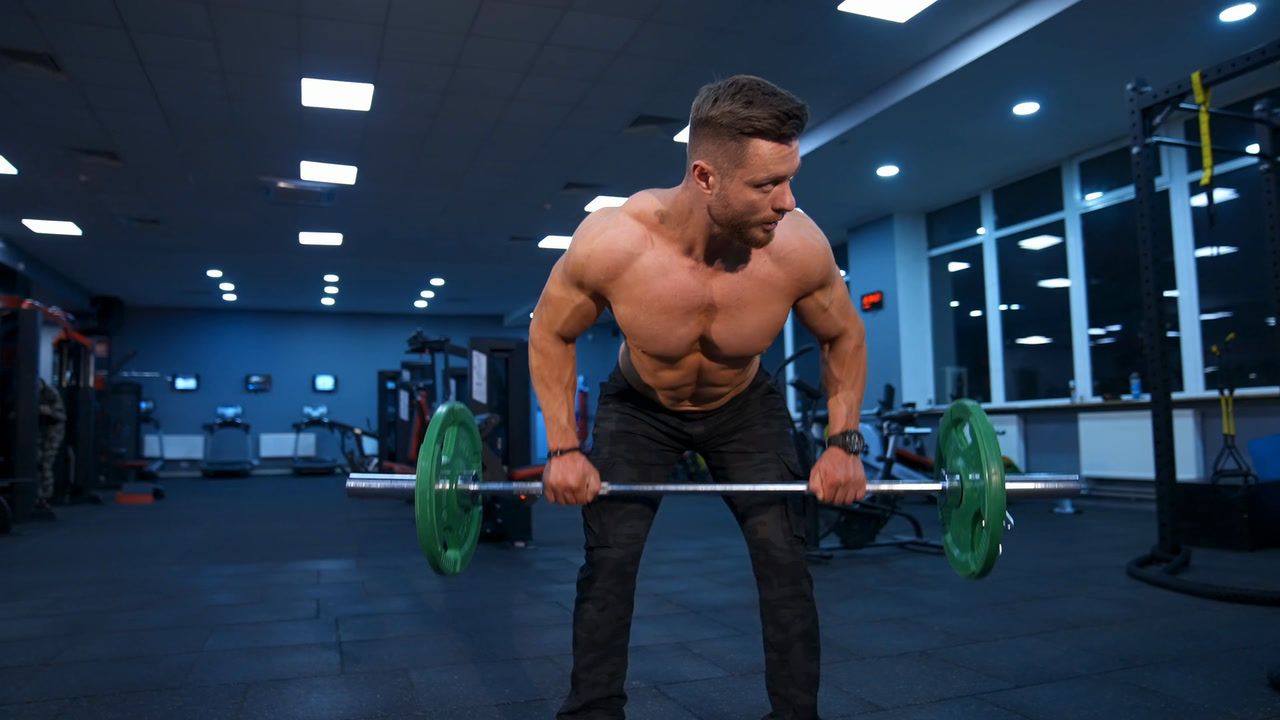
Heavy bent-over barbell pulling held at peak scapular retraction and trapezius contraction. Envato Elements.
Anatomy and joint kinematics of the trapezius muscle
Spanning from the base of the skull all the way to the twelfth thoracic vertebra, the trapezius is unique in that its muscle fibers run in three distinctly different diagonal directions. Because muscle fibers only exert tension along their longitudinal axis, the trapezius produces contrasting scapular actions depending on which region is recruited:
Scapular elevation & upward rotation
Upper Trapezius (Pars Descendens)
Originates on the external occipital protuberance and nuchal ligament of the cervical spine, running diagonally downward to insert into the lateral third of the clavicle and acromion. It elevates the shoulder girdle (shrugging) and initiates scapular upward rotation during overhead reaching. [1]
Runs horizontally from the spinous processes of C7–T5 across to the acromion and spine of the scapula. Its primary mechanical role is pure scapular adduction (retraction), powerfully pulling the shoulder blades together toward the midline during horizontal rowing. [2]
Arises from the spinous processes of T6–T12 and ascends diagonally to insert onto the triangular tubercle of the scapular spine. It acts as the vital downward anchor of the shoulder blade, depressing the scapula and stabilizing upward rotation to prevent subacromial impingement during pressing. [3]
Key movements: prone Y-raise, prone trap-3 raise, straight-arm pulldown, face pull with external rotation.
The scapulothoracic force-couple and overhead kinematics
For the shoulder joint to move overhead without pinching the rotator cuff tendons beneath the acromion arch, the scapula must rotate upward by roughly 60°. This upward rotation is powered by a synchronized muscular force-couple between the upper trapezius, the lower trapezius, and the serratus anterior:
The 30° scapular plane shrug advantage: Research by Pizzari et al. (2014) demonstrated that performing shrugs with the arms abducted 30° in the scapular plane (or overhead) elicits significantly higher upper trapezius motor unit activity than standard vertical shrugs. In this position, the scapula is already partially upwardly rotated, optimizing the length-tension curve of the upper fibers. [1]
Upper vs lower trap muscle balance: Sedentary posture and heavy pressing often lead to an overactive upper trapezius paired with an inhibited lower and middle trapezius. Clinical biomechanical investigations by Castelein et al. (2016) emphasize that healthy shoulder function requires training the lower traps (such as through lower trap exercises and prone Y-raises) to restore an optimal upper-to-lower trapezius activation ratio. [5]
Curated selection
Eight foundational trap exercises
Filter these primary trapezius exercises by equipment. Each exercise challenges scapular elevation, retraction, or explosive triple-extension mechanics across different loading angles.
Showing 8 of 8 exercises
Equipment:
Natural line of pull
Dumbbell shrug
Positions the loads at your sides rather than in front, allowing freedom of humeral rotation and slight scapular retraction at peak contraction without thigh friction.
Maximum axial overload
Barbell shrug
Enables the heaviest possible loading on the upper trapezius and levator scapulae; best performed with a slight 10° forward hip hinge to align with descending fibers.
Continuous inward diagonal resistance
Cable shrug
Setting low pulleys slightly wider than shoulder width provides an inward and downward line of pull that perfectly opposes the diagonal orientation of the upper trapezius.
Locked fixed-plane stability
Smith machine shrug
Fixes the bar path in a vertical or slightly angled track, eliminating balance requirements so you can focus 100% of muscular effort on peak scapular elevation.
Optimal joint-neutral ergonomics
Trap bar shrug
Surrounds the body with a neutral-grip frame, completely removing anterior thigh obstruction while balancing weight directly over the midfoot for joint-friendly heavy shrugs.
Explosive power and trap recruitment
High pull
Utilizes explosive hip drive and rapid triple extension to violently propel heavy barbell loads upward, driving intense eccentric and concentric upper trap contraction.
Wide-grip upper back flare
Snatch-grip high pull
A wider collar-to-collar grip places the trapezius and upper back in an elongated horizontal stretch, dramatically magnifying upper trap and rhomboid EMG activation.
Strict isolation without leg drive
Dumbbell seated shrug
Sitting upright on a flat bench locks the hips and legs in place, completely eliminating knee dip and hip cheating to force pure isolated scapular elevation.
No exercise matches your filter criteria. Clear the search input or reset filters to display all options.
Upper trap exercises: targeted elevation and hypertrophy
This section absorbs our dedicated upper trapezius guide (MR-traps-upper-traps), delivering definitive execution cues for developing neck thickness and collarbone musculature:
The 30° lean barbell shrug: Standing completely upright causes the barbell to scrape against the thighs and genitals, forcing the shoulders to round forward. Instead, unlock your knees and hinge forward at the hips by just 10° to 20°. This slight forward lean aligns the pull of gravity directly opposite the diagonal fibers of the upper trapezius (which travel forward to insert onto the clavicle), producing superior hypertrophy. [4]
The overhead barbell shrug: Pressing a light barbell overhead and locking the elbows before shrugging the bar toward the ceiling (overhead barbell shrug) challenges the upper trapezius in a position of full upward rotation. Research by Pizzari et al. (2014) confirms that overhead elevation elicits greater upper trap EMG than standard standing shrugs. [1]
Behind-the-back barbell shrug: Performing a barbell behind-the-back shrug places the bar behind the glutes, enforcing strict chest expansion and scapular retraction. However, it requires adequate shoulder extension mobility; lifters with tight anterior deltoids should opt for dumbbells or a trap bar.
Never roll the shoulders: One of the most persistent gym myths is that rolling the shoulders in circles builds bigger traps. Rolling does not add meaningful muscular tension to the traps—it simply grinds the acromioclavicular (AC) joint and can pinch the subacromial rotator cuff tendons under load. The trapezius elevates vertically and retracts horizontally; move the weights strictly up and back in a smooth, linear motion.
Barbell trap exercises: heavy axial loading and explosive pulls
This section absorbs our comprehensive barbell trap directory (MX-traps-barbell), detailing how free-weight barbells deliver the raw mechanical tension necessary for stubborn trap growth:
Snatch-grip high pull: The snatch-grip high pull is arguably the most potent builder of upper back and trapezius mass ever devised. By adopting a wide snatch grip, your hands are spaced far apart, requiring your traps to contract over a wider arc to elevate the barbell toward chest height. The explosive hip extension allows you to safely overload the traps with weights 20% to 30% heavier than standard shrugs.
Heavy barbell shrug (with straps): When performing heavy shrugs with a standard barbell, your grip strength is usually the weak link. Utilizing lifting straps allows you to overload your massive upper trapezius without premature forearm fatigue. Hold the peak contraction for a strict 2-second isometric pause at the top of every repetition.
Barbell 30-degree shrug: A variation where the torso is supported or held at a steady 30° angle (barbell 30-degree shrug), shifting the line of resistance to bridge upper trapezius elevation with middle trapezius retraction.
Barbell power shrug: The barbell power shrug uses a subtle knee dip and explosive ankle-knee-hip extension to initiate the pull, transitioning into an aggressive shoulder shrug at the apex. This dynamic movement overloads the eccentric lowering phase.
Clean shrug & snatch shrug: Dedicated weightlifting derivatives (clean shrug, snatch shrug) executed from the hang or blocks to drill aggressive second-pull extension and trapezius engagement.
Complete trap workout: gym and home routines
This protocol absorbs our dedicated trap workout programming (WK-0066) into a unified blueprint. Rather than mindlessly spamming shrugs, this session targets all three functional divisions of the trapezius (elevation, retraction, and depression) for balanced 3D trap development and bulletproof shoulder mechanics:
Complete Gym Trap Workout (15–20 minutes)
Order
Exercise
Sets
Reps / Tempo
Rest
RPE
Target Compartment
1
Snatch-grip high pull (or high pull)
4
5–6 reps (explosive pull, 2-sec eccentric)
90–120 sec
8.5
Upper traps & explosive power
2
Dumbbell shrug (slight 15° forward lean)
3
10–12 reps (2-2-1-1 tempo with 2-sec hold)
75–90 sec
9
Upper traps (scapular elevation)
3
Cable face pull with external rotation
3
12–15 reps (3-1-1-1 tempo)
60 sec
8.5
Middle traps & rear deltoids
4
Prone incline dumbbell Y-raise (or trap-3 raise)
3
12–15 reps (3-2-1-1 tempo)
60 sec
8
Lower traps (scapular depression)
Home 10-minute trap workout alternative (dumbbells & bodyweight)
If you train at home without heavy barbell racks or cable stacks, you can achieve remarkable trapezius recruitment using dumbbells, bands, and gravity:
Home Trap Workout Protocol (Dumbbells & Calisthenics)
Exercise
Sets
Reps / Tempo
Rest
Progression Mechanism
Dumbbell shrug (standing with 3-sec pause)
4
12–15 reps (2-3-1-1 tempo)
60 sec
Hold heavy dumbbells at your sides; pause 3 full seconds at peak elevation
Prone floor Y-raise (thumbs pointing up)
3
12–15 reps (3-2-1-1 tempo)
45 sec
Lie face-down; elevate arms at 120° angle; squeeze lower traps at top
Dumbbell farmer's carry
3
45–60 seconds continuous walk
60 sec
Carry heavy dumbbells with chest tall and shoulders retracted and elevated
Doorframe isometric scapular retraction
3
20 sec hold / rep
45 sec
Hook forearms inside doorframe; pinch middle traps with maximum intent
Weekly volume and training frequency recommendations
According to the ACSM Position Stand on resistance training, optimal muscular adaptation for the trapezius complex requires 8 to 16 direct weekly sets for trained individuals. [6] Because the upper trapezius acts as a postural stabilizer and contains a rich capillary network with resilient slow- and fast-twitch motor units, distributing your volume across 2 to 3 sessions per week (such as on Pull days, Upper Body sessions, or paired with Shoulders) stimulates superior muscle protein synthesis compared to a single exhaustive session.
Trap exercises with dumbbells: unilateral freedom and angle adjustments
Dumbbells offer a decisive ergonomic advantage over rigid straight barbells when training the trapezius:
Side-loading freedom: Holding dumbbells at your sides allows your arms to hang directly in line with your center of gravity. This eliminates anterior bar drag and allows you to naturally abduct your arms slightly during the shrug, matching the exact diagonal fiber angle of the upper trapezius.
Dumbbell seated shrug: Performing shrugs while seated on a flat bench isolates the upper traps completely, preventing you from using knee bounce or hip extension to heave the weights upward.
Prone incline dumbbell shrug: Lying chest-down on a 45° incline bench and shrugging the dumbbells upward and backward directly aligns resistance with the middle trapezius and rhomboids, building dense mid-back thickness.
Dumbbell silverback shrug: Hinged at 45° with dumbbells hanging freely, shrugging upward and inward with controlled tempo builds massive upper and middle back density without spinal compressive fatigue.
Trap exercises with cable machines: continuous diagonal resistance
Cable stations provide an unmatched biomechanical benefit: the resistance angle can be customized to match muscle fiber orientation:
Dual-pulley standing cable shrug: Setting two low cable pulleys roughly 3 to 4 feet apart and standing between them allows the cables to pull diagonally downward and outward. When you shrug upward and inward against this line of pull (cable shrug), the resistance directly opposes the upper trapezius fibers, creating significantly higher tension at peak contraction than vertical gravity alone.
Seated cable shrug: Seated on a low pulley bench with a straight bar or stirrup handles (cable seated shrug, cable shrug stirrups) delivers continuous tension through full scapular protraction and elevation.
Cable silverback shrug: Executing a silverback shrug using low cables (cable silverback shrug) keeps tension uninterrupted even at the bottom stretch where free weights lose lateral resistance.
Cable 30-degree shrug: A leaning cable shrug variation (cable 30-degree shrug, cable single arm 30-degree shrug) that isolates unilateral scapular mechanics.
Trap exercises at home: bodyweight, doorframes, and minimal kit
Building thicker, stronger traps without commercial gym machines is straightforward when you understand scapular biomechanics:
Bodyweight pike shrug: Assume a pike push-up position or elevated feet on a chair with hips high in the air. Keeping your arms locked straight, allow your shoulders to sink toward your ears, then push forcefully through your palms to shrug your shoulder blades downward toward the floor. This provides bodyweight resistance directly opposing scapular elevation.
Bodyweight inverted shrug: Hanging beneath a sturdy table or parallel bars with straight arms, pull your shoulder blades together and down without bending your elbows.
Heavy backpack farmer carries: Fill a sturdy backpack with books or water bottles, hold it by the top handle at your side (or wear one front and one back), and walk with upright posture for 60 seconds per set.
Prone floor Cobra / W-raise: Lying prone on the floor, elevate your chest slightly, bring your arms into a 'W' shape with elbows pulled into your ribs and thumbs pointing up, and pinch your middle and lower traps together for a 3-second hold.
Trap exercises in the gym: specialty machines and power racks
Modern gym equipment offers specialized apparatus engineered to support maximum trap overload without technical limitations:
Calf machine shoulder shrug: Standing under a padded standing calf raise machine (calf machine shoulder shrug) places the padded levers directly across your shoulders. This eliminates grip fatigue entirely, allowing you to overload your upper traps with massive resistance without holding any barbell or dumbbell in your hands.
Plate-loaded shrug machines: Dedicated shrug machines feature ergonomic rotating handles and converging lever arms that guide your shoulders through a natural upward-and-backward arc while seated or standing (machine shrug).
Power rack pin pulls (above-the-knee rack pulls): Setting a barbell on safety pins just above the kneecaps allows you to handle massive poundages in a partial deadlift. The static holding requirement at the top lockout places immense isometric tension across the entire trapezius sheet.
Trap exercises other than shrugs: building the whole upper back
If standard shrugs cause neck stiffness or you want comprehensive trapezius development beyond just upper-trap mounds, incorporate these non-shrug movements:
Cable face pulls with external rotation: While standard rows target the lats, setting a cable pulley at eye height and pulling a rope toward your forehead while rotating your thumbs backward maximally recruits the middle and lower trapezius along with the rear deltoids and external rotators.
Farmer's walks (heavy carries): Picking up two heavy dumbbells or a loaded trap bar and walking for distance creates unrelenting isometric tension across the upper trapezius and levator scapulae. Research shows that heavy carries elicit some of the highest recorded EMG values in the upper back.
Prone Y-raises (Trap-3 raises): Lying face-down on a 30° incline bench, raise light dumbbells in a 'Y' shape at a 120° angle with thumbs up. Ekstrom et al. (2003, 2005) confirmed this is the single most effective exercise for activating the lower trapezius. [2]
Snatch-grip deadlifts and high pulls: The wide grip forces the upper and middle traps into extreme isometric retraction throughout the entire lift.
Trap exercises for women: elegant neck posture and shoulder health
Trapezius training offers profound postural and aesthetic benefits for female athletes:
Postural alignment and neck pain relief: Modern screen habits cause forward head carriage and slumped shoulders. Strengthening the middle and lower trapezius pulls the scapulae down and back, instantly relieving chronic tension headaches and neck discomfort caused by over-stretched back muscles.
Will trap exercises make a woman's neck bulky? Natural female testosterone levels make building overly massive upper traps extremely difficult. Instead, moderate trapezius training (focusing on middle and lower fibers with face pulls and Y-raises) creates an elegant, upright silhouette, smooth shoulder contours, and an athletic neckline without excessive muscular bulk.
Shoulder stability for overhead pressing: Strong lower traps anchor the scapula during overhead dumbbell presses and pull-ups, creating a secure base that prevents subacromial impingement.
Trap exercises with kettlebells: dynamic swings and carries
Kettlebells provide an offset center of mass that creates unique ballistic and stabilization demands on the trapezius:
Kettlebell shrug: The thick handles and downward-hanging mass of kettlebells challenge grip and forearm flexors while delivering clean scapular elevation.
2 kettlebell sumo deadlift high pull: Combining a wide sumo stance deadlift with an explosive high pull elevates two kettlebells up to collarbone height, recruiting the upper traps through triple extension.
Suitcase carry: Holding a single heavy kettlebell in one hand while walking forces the contralateral trapezius and obliques to work overtime to prevent lateral spinal flexion, building functional unilateral trap stability.
Trap exercises with resistance bands: accommodating tension and mobility
Resistance bands deliver progressive accommodating tension that peaks exactly where the trapezius reaches full shortening:
Band shrug: Stand on the center of a heavy looped resistance band, grasp the ends with arms straight, and shrug upward. Tension increases dynamically as you reach the top contraction.
Band horizontal shrug: Anchor a band in front of you at shoulder height and pinch your shoulder blades straight back against resistance with straight arms (band horizontal shrug), isolating middle trapezius retraction.
Banded pull-aparts: Hold a light band in front of you at chest height and pull the band apart until it touches your sternum, engaging middle traps, rhomboids, and rear deltoids.
Best trap exercises for growth, mass, and 3D back thickness
If your trapezius development has stalled, implement these evidence-based hypertrophy rules:
Prioritize the peak contraction pause: The upper trapezius has a very short range of motion during vertical shrugs. Heaving massive weights up and dropping them immediately relies almost entirely on momentum. Drop the weight by 20%, elevate as high as possible, and hold a rigid 2-second squeeze at the apex of every rep to recruit high-threshold motor units.
Include horizontal retraction in every session: Real 3D trap thickness comes from developing the middle trapezius, not just upper mounds. Balance your shrugs with heavy chest-supported rows, wide-grip barbell rows, and face pulls.
Train both high and moderate rep ranges: The trapezius contains a mixed fiber composition: roughly 50% slow-twitch postural fibers and 50% fast-twitch explosive fibers. Combine heavy compound sets (5–8 reps on high pulls and trap bar shrugs) with moderate-to-high fatigue sets (12–15 reps on dumbbell shrugs and face pulls).
Common trap training mistakes to avoid
Eliminate these four frequent errors to safeguard your neck and maximize trapezius recruitment:
Rolling the shoulders: Circling the shoulders forward or backward during shrugs provides zero hypertrophic benefit and grinds the acromioclavicular joint. Move strictly in a linear vertical and slight posterior direction.
Using excessive weight with knee bounce: Bending the knees and violently jerking the torso turns a shrug into a sloppy calf raise or bounce, taking tension away from the traps and placing compressive shock on the cervical spine.
Jutting the head forward (turtle neck): Straining to push your chin forward as you shrug shortens the sternocleidomastoid and can pinch cervical nerve roots. Keep your chin tucked and neck neutral throughout the movement.
Completely neglecting the lower traps: Focusing solely on upper-trap shrugging without ever performing lower-trap depression exercises (like prone Y-raises or face pulls) leads to severe scapulothoracic muscle imbalance and shoulder impingement.
Which trap exercise should you choose? Head-to-head comparisons
Examine the biomechanical differences between premier trapezius loading implements:
dumbbell shrug vs trap bar shrug: Detailed analysis of grip comfort, spinal compressive loads, arm trajectory, and maximum overload potential between dumbbells and hex bars.
Alternative exercises and substitutions
If you lack access to heavy barbells, suffer from wrist pain, or experience neck discomfort, consult our verified substitution guide:
shrug alternative: 8 practical substitutions for standard barbell shrugs using cable machines, dumbbells, farmer walks, bodyweight pike shrugs, and resistance bands.
Explore trap exercises by equipment and anatomical division
Explore specialized trapezius directories tailored to your equipment and targeted muscular compartment:
dumbbells traps exercises: 13 dumbbell shrugs, seated shrugs, silverback shrugs, and carries with natural wrist freedom.
lower trap exercises: Specialized directory for the lower trapezius, featuring Y-raises, trap-3 lifts, and scapular depression protocols.
Frequently asked questions about trap exercises
What is the best exercise for the traps?
The best all-around exercise for building upper trapezius mass is the dumbbell shrug or trap bar shrug with a slight 15° forward lean and a 2-second peak pause, paired with the explosive snatch-grip high pull. For complete 3D upper back development, combine shrugs with cable face pulls (for middle traps) and prone Y-raises (for lower traps).
What increases trap size?
Trapezius hypertrophy requires progressive mechanical tension across full scapular elevation and retraction, combined with adequate training volume (8 to 16 direct weekly sets). Because the traps respond exceptionally well to loaded stretch and isometric holds, incorporating a 2-second pause at peak contraction and performing heavy carries (farmer's walks) stimulates significant rapid growth.
Are traps hard to grow?
No, the trapezius is actually one of the most responsive muscles in the human body to heavy resistance training because it possesses a high density of androgen receptors and rich vascularity. When lifters struggle to grow their traps, it is almost always due to sloppy form: bouncing with excessive weight, rolling the shoulders, or cutting the peak contraction short.
Is it worth it to workout traps?
Yes, dedicated trapezius training is highly worthwhile for both aesthetics and injury prevention. A strong trapezius complex frames the upper neck and shoulders, protects the cervical spine from impact, stabilizes the shoulder girdle during heavy deadlifts and presses, and prevents rounded forward-slumped posture caused by desk work.
Complete trap exercise directory (87 exercises)
Browse every exercise in our library that targets the trapezius, categorized by equipment and training implement:
Barbell & Free Weights (21 exercises)
Barbell 30 Degree Shrug: How to Do It and Muscles Worked()
Barbell Behind the Back 30 Degree Shrug: How to Do It()
Barbell Behind the Back Shrug: How to Do It()
Barbell Power Shrug: How to Do It and Muscles Worked()
Barbell Silverback Shrug: How to Do It and Muscles Worked()
Clean Shrug: How to Do It, Muscles Worked and Variations()
EZ Bar Shrug: How to Do It, Muscles Worked and Variations()
Gittleson Shrug: How to Do It, Muscles Worked and Variations()
High Pull: How to Do It, Muscles Worked and Variations()
Jump Shrug: How to Do It, Muscles Worked and Variations()
Landmine Shrug: How to Do It, Muscles Worked and Variations()
Middle Back Shrug: How to Do It and Muscles Worked()
Overhead Barbell Shrug: How to Do It and Muscles Worked()
Shoulder Shrug: How to Do It, Muscles Worked and Variations()
Shrug: How to Do It, Muscles Worked, Mistakes and Variations()
Slx Grip Shrug: How to Do It, Muscles Worked and Variations()
Snatch Grip Barbell Shrug: How to Do It and Muscles Worked()
Snatch Grip High Pull: How to Do It and Muscles Worked()
Snatch Shrug: How to Do It, Muscles Worked and Variations()
Standing Shrug: How to Do It, Muscles Worked and Variations()
Sumo High Pull: How to Do It, Muscles Worked and Variations()
Dumbbells (13 exercises)
Dumbbell High Shrug: How to Do It and Muscles Worked()
Dumbbell Lying 30 Degree Shrug: How to Do It()
Dumbbell Lying Silverback Shrug: How to Do It()
Dumbbell Overhead Shrug: How to Do It and Muscles Worked()
Trap Lacrosse Ball: How to Do It and Muscles Worked()
Weight Plates & Unconventional (3 exercises)
Plate Overhead Shrug: How to Do It and Muscles Worked()
Weight Plate One Arm Shrug: How to Do It and Muscles Worked()
Weight Plate Shrug: How to Do It and Muscles Worked()
Sources
Pizzari, T., et al. (2014). Modifying a shrug exercise can facilitate the upward rotator muscles of the scapula. Clinical Biomechanics, 29(2), 201–205. PMID: 24944162.
Ekstrom, R. A., et al. (2003). Electromyographic analysis of the exercises for the middle and lower trapezius and serratus anterior. Journal of Orthopaedic & Sports Physical Therapy, 33(5), 247–258. PMID: 12749964.
Ekstrom, R. A., et al. (2005). Surface electromyographic analysis of exercises for the trapezius and serratus anterior muscles. Journal of Orthopaedic & Sports Physical Therapy, 35(8), 488–495. PMID: 16298959.
Boeckh-Behrens, W. U., & Buskies, W. (2000). Fitness-Krafttraining: Die besten Übungen und Methoden für Sport und Gesundheit. Rowohlt Taschenbuch Verlag.
Castelein, B., et al. (2016). Scapulothoracic muscle balance during shoulder rehabilitation exercises. Journal of Shoulder and Elbow Surgery, 25(10), 1648–1657. PMID: 26522336.
Currier, B. S., et al. (2026). Resistance training prescription for healthy adults: ACSM position stand. Medicine and Science in Sports and Exercise. PMID: 41843416.