
IPF GL Points Calculator
Calculate your official score on the International Powerlifting Federation (IPF) GoodLift scoring scale. Evaluates relative strength across bodyweight, biological sex, equipment categories (Classic / Raw versus Equipped), and event formats (full 3-lift SBD versus single-lift Bench Press). Implements the official 2020 exponential model, optional McCulloch age scaling, and cross-comparison with DOTS and Wilks.
IPF GL Points Calculator Tool
Worked Example: Manual Step-by-Step Calculation
To verify the mathematical accuracy of the IPF GoodLift formula, consider an 83.0 kg male lifter competing in the Classic (Raw) division who records a 250.0 kg Squat, a 160.0 kg Bench Press, and a 290.0 kg Deadlift for a 3-lift total of 700.0 kg.
IPF GL Points = Total (kg) × 100 ÷ [A - B × e^(-C × Bodyweight)]
| Step | Operation | Formula / Parameters | Result |
|---|---|---|---|
| 1 | Lookup Parameters | Men Classic 3-Lift: A = 1199.72839, B = 1025.18162, C = 0.009210 | Official IPF Parameters |
| 2 | Exponential Exponent | -C × Bodyweight = -0.009210 × 83.0 | -0.764430 |
| 3 | Natural Exponential Evaluation | e^(-0.764430) = 2.7182818^(-0.764430) | 0.465598 |
| 4 | Scaled Subtraction Term | B × e^(-C × BW) = 1025.18162 × 0.465598 | 477.322588 |
| 5 | Denominator (Predicted Max Total) | A - 477.322588 = 1199.72839 - 477.322588 | 722.405802 kg |
| 6 | IPF GL Coefficient | 100 ÷ 722.405802 | 0.138426 |
| 7 | Final IPF GL Score | 700.0 × 0.138426 = 70,000 ÷ 722.405802 | 96.90 Points |
The lifter achieves 96.90 IPF GL Points, which securely places him in the Advanced competitive classification. To attain the Elite benchmark (100.00 GL points), the lifter requires a competition total of 722.4 kg, representing an additional 22.4 kg on his 3-lift sum.
The Scientific Architecture of the IPF GoodLift (GL) Formula
From 1997 through 2018, the International Powerlifting Federation utilized the Wilks formula, authored by Robert Wilks, to determine the "Best Lifter" awards across different weight classes. While the Wilks polynomial provided substantial improvements over previous hand-drawn logarithmic tables (such as Schwartz and Malone coefficients), statistical analysis across thousands of modern international meet results uncovered systematic distortion patterns known mathematically as Runge's phenomenon.
Because high-degree polynomials (such as the 5th-degree equation underpinning Wilks) fit curves by oscillating between sample data points, the extremes of the bodyweight spectrum suffered from artificial amplification. Light male lifters (under 60 kg) and heavy super-heavyweights (over 130 kg) systematically scored higher relative points for equivalent standard deviations of performance than mid-weight lifters (74 kg to 93 kg). In 2019, the IPF briefly tested the linear "IPF Formula," but replaced it permanently in May 2020 with the IPF GL (GoodLift) formula, engineered by Dr. Sergey Fonin.
The mathematical breakthrough of the GoodLift system lies in replacing oscillatory polynomials with an exponential saturation model. In physiological terms, human muscle cross-sectional area and force generation do not grow indefinitely with body mass; they follow an asymptotic curve of diminishing returns described by allometric scaling. The denominator of the GoodLift formula models the theoretical maximum performance ceiling of an elite lifter at a given bodyweight:
Denominator(BW) = A - B × e^(-C × BW)
As bodyweight approaches infinity, the exponential term \(e^{-C \times \text{BW}}\) decays smoothly toward zero, causing the denominator to asymptotically approach the parameter \(A\). This eliminates the runaway polynomial inflections that plagued legacy formulas and guarantees that super-heavyweights must produce genuine, world-record mass on the barbell to achieve 115+ points.
Official IPF Parameter Matrix across Divisions
The International Powerlifting Federation calibrates separate sets of constants for men and women across both Classic (Raw) and Equipped divisions, as well as distinct parameters for single-lift Bench Press competitions. The official coefficients published by the IPF Technical Committee are tabulated below:
| Division | Equipment Type | Event Format | Parameter A | Parameter B | Parameter C |
|---|---|---|---|---|---|
| Men | Classic (Raw) | 3-Lift (SBD) | 1199.72839 | 1025.18162 | 0.009210 |
| Men | Equipped | 3-Lift (SBD) | 1236.25115 | 1449.21864 | 0.016440 |
| Men | Classic (Raw) | Bench Only | 320.98041 | 281.40258 | 0.010080 |
| Men | Equipped | Bench Only | 381.22073 | 733.79378 | 0.023980 |
| Women | Classic (Raw) | 3-Lift (SBD) | 610.32796 | 1045.59282 | 0.030480 |
| Women | Equipped | 3-Lift (SBD) | 758.63878 | 949.31382 | 0.024350 |
| Women | Classic (Raw) | Bench Only | 142.40398 | 442.52671 | 0.047240 |
| Women | Equipped | Bench Only | 221.82209 | 357.00377 | 0.029370 |
Because the parameters are derived independently from verified competition databases, single-lift bench press specialists receive a tailored mathematical ceiling rather than a crude fraction of the 3-lift total. For example, a 105 kg male raw lifter benching 220 kg achieves 98.51 GL points against the dedicated Bench-Only scale, accurately reflecting world-caliber single-lift specialization.
Comparative Analysis: IPF GL versus DOTS and Wilks
Modern powerlifters regularly encounter three distinct relative strength handicapping formulas across different federations. Understanding the structural differences among these equations ensures lifters accurately benchmark their progress regardless of the platform:
| Metric / Feature | IPF GL Points (2020) | DOTS Formula (2019) | Wilks 2 (2020 Revision) | Classic Wilks (1994) |
|---|---|---|---|---|
| Governing Federation | IPF, USAPL (historical), NAPF, EPF | WRPF, USPA, IPL, USPC | Powerlifting Australia, Raw Iron | Legacy open-source meets |
| Mathematical Model | Exponential saturation (\(A - B \cdot e^{-C \cdot \text{BW}}\)) | 4th-degree polynomial | 5th-degree polynomial (re-centered) | 5th-degree polynomial |
| Scale Normalization | ~100 points = Elite International | ~500 points = Elite International | ~600 points = Elite International | ~500 points = Elite International |
| Equipment Parity | Separate constants for Raw & Equipped | Single raw-calibrated scale | Raw & Equipped variants | Single historical scale |
| Bench-Only Scale | Dedicated independent parameters | None (uses general formula) | None (uses general formula) | None (uses general formula) |
| Super-Heavyweight Bias | Neutral (asymptotic ceiling) | Neutral (4th-degree stabilized) | Slightly conservative | High positive bias at extremes |
While DOTS and Wilks 2 utilize polynomial curves centered around 500 or 600 points, the IPF GL formula is scaled intentionally so that a 100.00 score represents a clean, intuitive marker of world-class excellence. Lifters scoring above 115 points are podium contenders at the IPF World Classic Championships, while scores between 85 and 99 represent advanced regional competitors.
Age Adjustments: The McCulloch and Foster Factors
Under official IPF World Championship regulations, Best Lifter awards in the Open, Junior, Sub-Junior, and Masters divisions are decided strictly using raw, unadjusted GL points within each respective age flight. However, regional, club, and unsanctioned exhibitions frequently desire an overall champion across all ages combined. In these contexts, meet directors multiply the lifter's raw score by an age handicap factor.
For Masters athletes aged 40 and older, the McCulloch Age Factor provides an evidence-based scaling coefficient that offsets the progressive physiological decline in motor unit recruitment, type II muscle fiber cross-sectional area, and joint elasticity:
- Ages 24 to 39 (Open Division Baseline): Coefficient equals 1.000. No adjustment is applied during the peak biological strength window.
- Ages 14 to 23 (Sub-Juniors & Juniors): The Foster / McCulloch adolescent factor accounts for ongoing skeletal maturation and neuromuscular development.
- Ages 40 to 49 (Masters 1): Coefficients gradually scale from 1.000 at age 40 to approximately 1.130 at age 49 (~1.3% adjustment per year).
- Ages 50 to 59 (Masters 2): Factors scale from 1.145 to 1.300, recognizing accelerated sarcopenic resistance challenges.
- Ages 60+ (Masters 3 & 4): Factors exceed 1.340, allowing veteran lifters to compete on an equitable relative playing field against prime open competitors.
IPF GL Competitive Classification Standards
To establish clear training targets and assess meet readiness, lifters can benchmark their current GL score against standardized competitive classifications:
| Classification | GL Points Range | Male 83 kg Total (Approx.) | Female 63 kg Total (Approx.) | Competitive Standard |
|---|---|---|---|---|
| World Class | ≥ 115.00 | ≥ 830.0 kg | ≥ 525.0 kg | IPF World Championship podium caliber; international record territory. |
| Elite | 100.00 – 114.99 | 722.5 – 829.9 kg | 457.0 – 524.9 kg | National championship medalist; international team selection standard. |
| Advanced | 85.00 – 99.99 | 614.0 – 722.4 kg | 388.0 – 456.9 kg | State / provincial champion; seasoned multi-year competitive strength. |
| Intermediate | 70.00 – 84.99 | 505.5 – 613.9 kg | 319.5 – 387.9 kg | Consistent club-level competitor with established progressive overload. |
| Novice | 50.00 – 69.99 | 361.0 – 505.4 kg | 228.5 – 319.4 kg | Regional meet participant building competition technique and confidence. |
| Developing | < 50.00 | < 361.0 kg | < 228.5 kg | Foundational barbell training phase; developing technical mastery. |
Visual Reference & Social Card
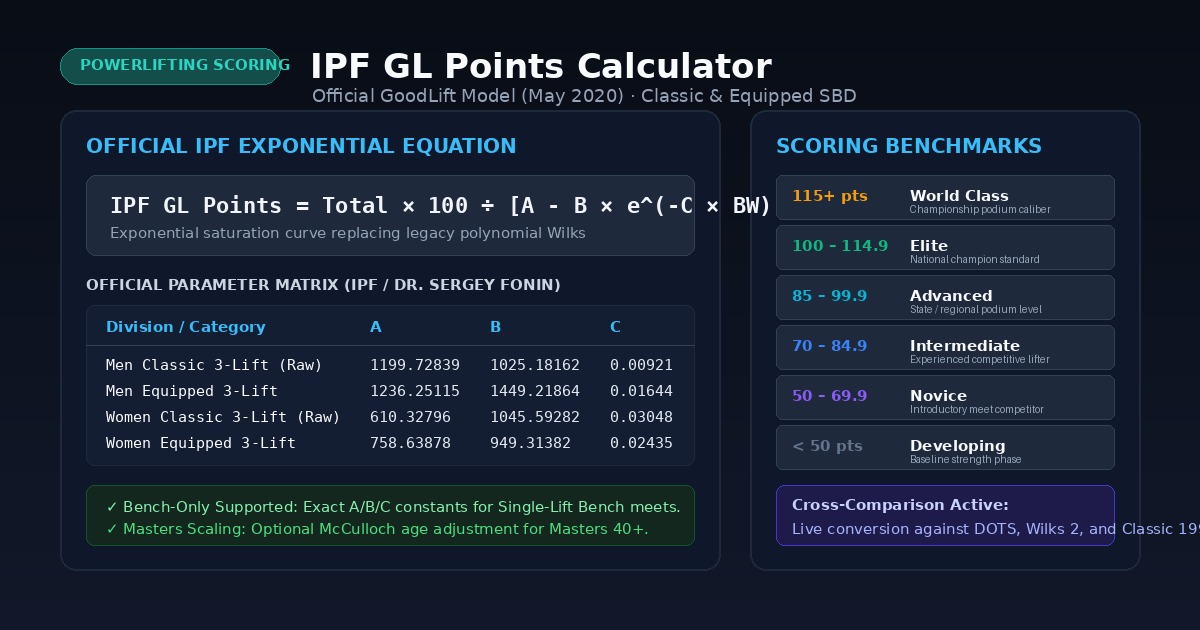
Below is the verified graphical reference card summarizing the GoodLift exponential formula, official parameter tables, and cross-federation benchmarks for powerlifting competition:
Frequently Asked Questions
Why did the IPF replace the Wilks formula with IPF GL Points?
The IPF replaced the Wilks formula in May 2020 because Wilks suffered from mathematical polynomial distortion (Runge's phenomenon). In modern powerlifting datasets, Wilks systematically favored extreme lightweight lifters and super-heavyweights while penalizing middleweight athletes (74 kg to 93 kg). The GoodLift formula employs an exponential saturation curve that accurately reflects human muscle scaling and ensures fairness across all weight classes.
What is considered a "good" IPF GL score?
Because the GoodLift formula is normalized so that an elite national champion scores around 100 points, scores break down intuitively: 70–84 points represents a solid intermediate club lifter; 85–99 points represents an advanced regional podium contender; 100–114 points represents national-level elite strength; and 115+ points represents world-championship caliber performance.
Does the calculator support single-lift Bench Press competitions?
Yes. The IPF publishes separate, dedicated mathematical constants for single-lift Bench Press events for both men and women across Classic and Equipped divisions. When you select "Single-Lift (Bench Press Only)" in the competition event dropdown, the calculator automatically applies the official bench-only constants rather than an estimated ratio.
How do IPF GL Points differ from DOTS points?
DOTS is a 4th-degree polynomial created in 2019 by Tim Konertz and used primarily by the WRPF, USPA, and IPL. It is scaled around a 500-point elite benchmark. In contrast, IPF GL Points use an exponential equation (\(A - B \cdot e^{-C \cdot \text{BW}}\)) scaled around a 100-point benchmark, created by Dr. Sergey Fonin for the IPF. Both formulas provide superior parity over legacy Wilks, but they belong to different federation rulebooks.
Can I enter my bodyweight and lifts in pounds instead of kilograms?
Yes. You can switch the unit dropdown to Pounds (lb). The calculator converts your inputs to kilograms using the NIST standard factor (1 lb = 0.45359237 kg) before evaluating the exponential GoodLift formula, ensuring 100% adherence to official international scoring.
Scientific & Federation References
- International Powerlifting Federation (IPF). Technical Rules Book and Scoring Guidelines. Luxembourg: IPF Executive Committee, 2020.
- Fonin S. The IPF GL Formula: Mathematical Modeling of Relative Performance in Powerlifting. International Powerlifting Federation Research Commission, May 2020.
- Konertz T. The DOTS Formula: Developing an Unbiased Relative Scoring Function for Powerlifting. Cologne, Germany, 2019.
- Wilks R. Standardising the Comparison of Strength: The Wilks Formula. Powerlifting Australia, Melbourne, 1994.
- McCulloch J. Age Correction Factors for Master Powerlifters. British Powerlifting Association, 1996.
- Vanderburgh PM, Batterham AM. Validation of allometric scaling for powerlifting performance across body mass divisions. Med Sci Sports Exerc. 1999;31(4):572-577.