Start by choosing the job: squat, hinge, pull, press or direct arm work. Then check the whole setup and choose a load you can control for that exercise. A dumbbell chest press and a lateral raise need different movements; owning one pair does not make every exercise an equally useful choice. [1]
This guide helps you select movements, put together a short session and decide what to change when a fixed pair stops fitting. The goblet-squat guide is available now; the individual guides marked in preparation below will become links as they are published.
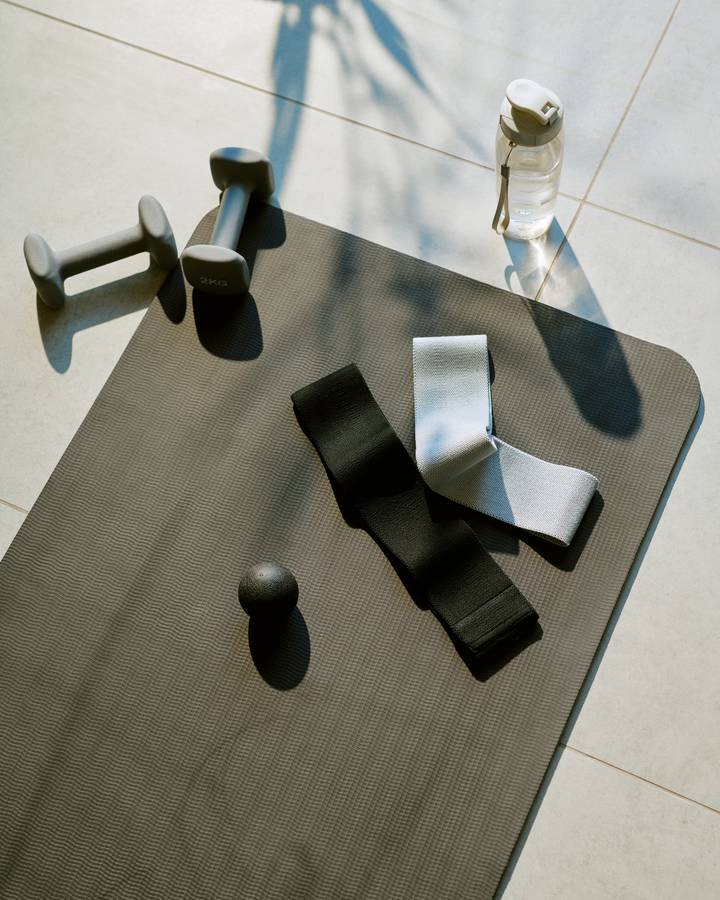
A pair is a starting point. The exercise determines the setup.AnnaStills / Envato
Selection before a long list
Eight useful dumbbell exercises, for different jobs
These are editorial choices for covering different movements, rather than a ranking of muscle-building results. Use the setup column to spot the extra equipment a name can hide. Read the full exercise instructions before trying an unfamiliar movement.
Another lower-body option when you want a split stance and rear-foot support. [10]
A bench or box as well as the weight. It is a different setup from a standing goblet squat.
Farmer's carry
A loaded walking option rather than another press or curl. [11]
A dumbbell in each hand and a walking route you can use.
For a first exercise tutorial, open our goblet-squat guide. The other exercise titles remain topics in preparation until their guides are available.
Go by the area you want to train
Dumbbell exercises by muscle group
For your back, the supported row is a pulling option. For your chest, a bench press involves more than the chest alone; the shoulders and arms also participate. The lateral raise is a shoulder option, while curls provide direct arm work. The press is also relevant when choosing triceps work.
A dumbbell is a handheld weight with a short central grip and a weighted end on either side. That describes the equipment, not a body part it is restricted to: the squat and hinge options above also use dumbbells. [12]
Read an exercise's complete equipment list. “Dumbbell exercise” may still mean a pair plus a bench, rather than one weight and an empty floor.
Put the choices together
A short starting session
This example is for healthy adults who already know the movements. Use a weight that makes the repetitions challenging while you retain control. Mayo Clinic describes one set of about 12–15 repetitions as a useful starting point for general health and fitness. [1]
A four-movement example, with the setup chosen before the weight
Use a suitable bench and plan the setup and finish.
Dumbbell Romanian deadlift
1 set of 12–15 repetitions
Check the instructions for the dumbbell variation.
Rest long enough to repeat the next movement with control; this is not a timed circuit. If a movement is unfamiliar, learn it with a qualified fitness professional before using this example. You do not need to force every set to the point where another repetition is impossible: ACSM's 2026 review did not find a consistent additional benefit from training to momentary muscle failure. [2]
For a regular routine, ACSM recommends training the major muscle groups at least twice a week. This is a starting example, not a complete long-term plan for every muscle or goal. [3] Use the workout guide and program guide to think through the rest of the week.
Dumbbell sessions and programs in preparation
Upper-body dumbbell workout
Dumbbell chest workout
Full-body dumbbell workout plan
Dumbbell upper/lower split
Dumbbell push/pull/legs program
When the weight cannot change
One fixed pair: check each exercise separately
Use the decision map below for the movement in front of you. NIDDK's guidance describes gradually building repetitions, then considering more weight when the work is easy. It also recommends tracking activity and progress. [15]
More repetitions and heavier weights answer different goals
A 2017 meta-analysis of 21 studies found similar muscle growth with lower and higher loads, but greater improvements in one-repetition-maximum strength with heavier loads. All included training protocols took sets to momentary failure, and participants had no known condition or injury limiting training. It does not establish that any light pair will work indefinitely. [13]
ACSM's updated 2026 review likewise found that heavier loads favored maximal strength. Increasing difficulty can take different forms, but a slower repetition or a different exercise is not a guaranteed substitute for more load. Choose the change for the outcome you want, not simply to make the session feel harder. [2]
For example, suppose a pair is still challenging for your row while your squat repetitions have become easy. Keep tracking the row and reconsider the squat's loading separately. This is an illustration of the decision process, not a prediction about what any particular weight should feel like.
The dedicated progressive-overload guide is in preparation.
The exercise index
Browse dumbbell exercise topics
Filter these 20 topics by name or body area. The goblet-squat tutorial is available; the other detailed guides are in preparation. All topics remain readable without JavaScript.
No topic matches. Clear the search or reset the filters to see the full list.
Before adding effort
Setup, beginners and older adults
Choose the version whose instructions match your actual equipment. A bench-supported row, a standing row and a chest press are separate setups; the equipment name alone does not supply their technique.
Warm up before strength training, breathe during the work, and learn unfamiliar technique with a qualified fitness professional. [1]
Check how you will start and finish a bench exercise. ACE includes assistance from a spotter in its dumbbell chest-press instructions. [7]
If an exercise causes pain, stop it. If you have a chronic condition or concerns about exercising safely, speak with your healthcare professional before starting. [1]
Are dumbbell exercises different for seniors?
Age alone does not tell you which weight or movement fits. Start from the movements you can perform, your health and the help you need learning the setup. Strength training can help preserve muscle and strength with age, but this general exercise list is not an individual rehabilitation plan. [1]
Questions about using dumbbells
Can I train with just one dumbbell?
Yes, for exercises designed that way. The goblet squat uses one, and ACE's supported row uses one with a bench. A pair-based exercise needs its own variation if you want to change the setup; do not assume the two versions have identical instructions.
Are 20 lb (about 9 kg) dumbbells enough to build muscle?
There is no universal answer from the number on the weight. The relevant questions are whether that load challenges the particular exercise, whether you can control it and how you can progress. Research supports muscle growth across a range of loads, while heavier loads tend to improve maximal lifting strength more. A fixed pair can remain useful for some exercises after it stops being enough for others. [13]
Do I have to keep making every session more complicated?
No. ACSM's 2026 guidance emphasizes regular participation and adapting training to your goals. Equipment type and complex programming did not consistently change outcomes for the average healthy adult. Keep a clear reason for each exercise and for each change. [3]