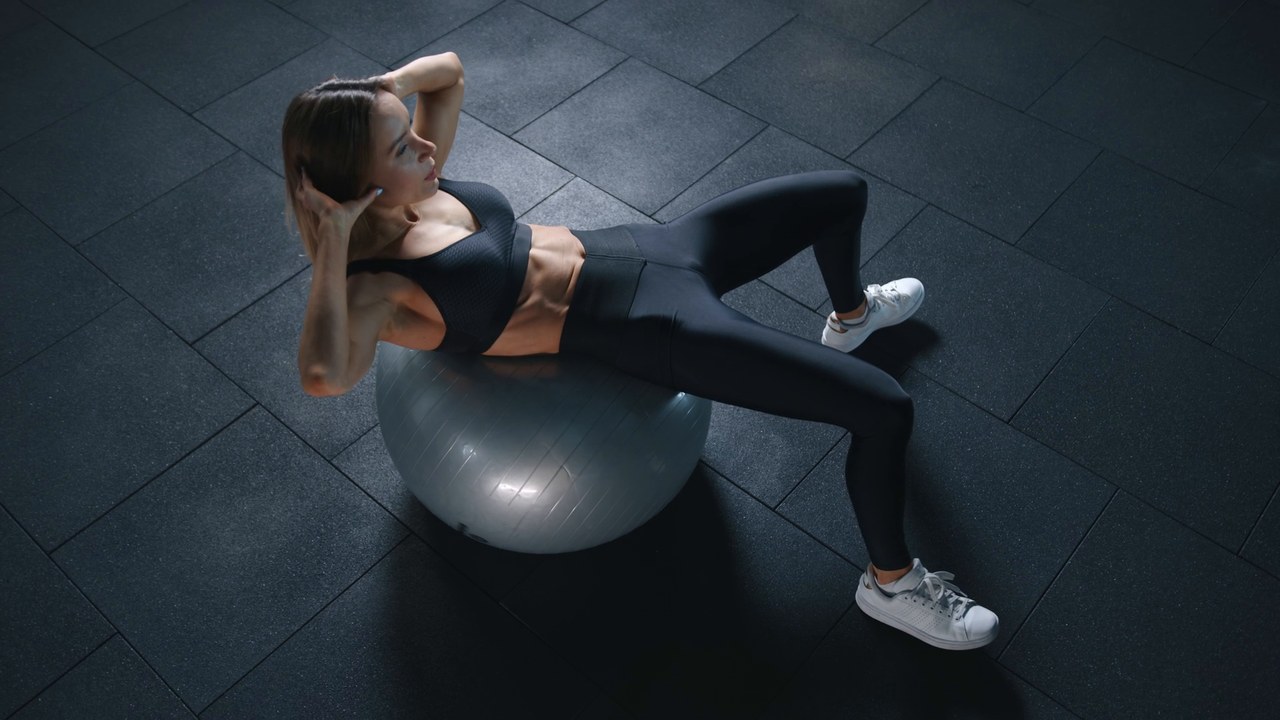
The abdominal wall comprises the rectus abdominis, transverse abdominis, and internal and external obliques, working synergistically to flex the spine, tilt the pelvis, control rotational torque, and maintain intra-abdominal pressure. [1] Learn how the abs work in our comprehensive anatomy guide.
Explore the abdominal anatomical map, filter curated exercises by available equipment, follow the absorbed complete ab workout routine, and examine peer-reviewed research comparing spinal flexion crunches, hanging leg raises, and isometric anti-extension planks.
A stability ball crunch permits spinal extension past neutral followed by full lumbar flexion, expanding rectus abdominis active range of motion. Envato Elements.
Start with abdominal muscle anatomy and joint mechanics
Training the abdominals effectively requires understanding the distinct roles of the anterior abdominal wall layers. While popular culture often views the "six-pack" as a purely aesthetic display, its anatomical architecture serves critical biomechanical functions: transferring forces between lower and upper extremities, bracing the lumbar spine against shearing forces, and regulating intra-abdominal pressure during heavy compound lifting. [2]
The anterior flexor
Rectus Abdominis
Originates on the pubic crest and pubic symphysis, inserting into the costal cartilages of the 5th through 7th ribs and the xiphoid process. It is a single paired muscle divided longitudinally by the linea alba and horizontally by tendinous intersections (giving the six-pack appearance). Its primary actions are flexing the vertebral column (pulling ribcage toward pelvis) and posteriorly tilting the pelvis (pulling pubis toward ribcage). [8]
Key movements: cable crunch, hanging leg raise, reverse crunch.
The internal corset
Transverse Abdominis (TVA)
The deepest abdominal layer, with horizontal fibers originating on the lateral third of the inguinal ligament, iliac crest, thoracolumbar fascia, and lower six costal cartilages, wrapping around to insert into the linea alba. It does not flex the spine; instead, it compresses the abdominal viscera, tightens the thoracolumbar fascia, and stabilizes the lumbar spine like an internal weight belt. [5]
Key movements: ab wheel rollout, RKC plank, dead bug, stomach vacuum.
Rotational stabilizers
Internal & External Obliques
Flanking the rectus abdominis, the external obliques (superficial, run downward and medially) and internal obliques (deep, run upward and medially) form a muscular sling. Working bilaterally, they assist spinal flexion and pelvic stabilization; working unilaterally, they generate lateral flexion and resist rotational torque (anti-rotation). [1]
Key movements: Russian twist, Pallof press, side plank, bicycle crunch.
Spinal flexion versus anti-extension bracing: the scientific consensus
A longstanding debate in strength and conditioning contrasts dynamic spinal flexion against isometric core bracing:
Isometric anti-extension and core stability (Dr. Stuart McGill): McGill's laboratory research demonstrated that repetitive, end-range lumbar flexion under heavy load increases shear stress on intervertebral discs and the risk of posterior disc herniation. For spinal health and athletic stabilization, McGill advocates isometric bracing patterns—such as the McGill Big 3 (curl-up with lumbar support, side plank, and bird dog)—which maximize torso stiffness while minimizing compressive disc loads. [2][4]
Dynamic spinal flexion for rectus abdominis hypertrophy (Contreras & Schoenfeld): Conversely, sports scientists Brad Schoenfeld and Bret Contreras highlighted that like any skeletal muscle, the rectus abdominis undergoes optimal hypertrophy when taken through controlled concentric and eccentric contractions against progressive overload. The physiological solution is disciplined, moderate-range spinal flexion (bending the thoracic and upper lumbar spine through ~30° to 45° of flexion without forceful ballistic compression) combined with anti-extension rollouts and planks. [7]
A complete abdominal routine integrates both philosophies: progressive loaded flexion (such as kneeling cable crunches) for rectus hypertrophy, and rigorous isometric bracing (such as ab wheel rollouts and planks) for deep core endurance and spinal protection.
Curated selection
Eight foundational ab exercises
Filter these top exercises by available equipment. Each movement provides a proven stimulus for anterior wall hypertrophy, deep transverse bracing, or rotational control.
Showing 8 of 8 exercises
Equipment:
Lower rectus overload
Hanging leg raise
Hanging from a bar removes lumbar compression while demanding powerful posterior pelvic tilt. Curling the pelvis upward toward the sternum recruits the lower rectus abdominis at peak intensity. [1]
Loaded hypertrophy driver
Cable crunch
The definitive exercise for progressive overload. Kneeling with a rope attachment maintains continuous tension through the entire arc of spinal flexion, allowing precise weight increments. [7]
Peak anti-extension tension
Ab wheel rollout
Generates extreme eccentric and isometric torque across the entire rectus abdominis and transverse abdominis. Escamilla (2006) ranked rollouts among the highest activation core exercises tested. [1]
Expanded range of motion
Stability ball crunch
Draping your lumbar spine over the curvature of a Swiss ball permits pre-stretch into hyperextension before curling into flexion, elevating rectus abdominis EMG beyond flat floor crunches. [6]
Foundational isometric bracing
Plank
The gold standard for transverse abdominis endurance and anti-extension control. Transitioning into an active RKC plank (contracting glutes and pulling elbows toward toes) triples core muscle tension. [2]
Pelvis-initiated curl
Reverse crunch
Initiating lumbar flexion from the bottom up isolates the sub-umbilical rectus abdominis while keeping the cervical spine completely relaxed on the floor or bench. [1]
Spine-friendly motor control
Dead bug
Challenges anterior core stability as opposing limbs extend. Pressing the lower back firmly into the floor activates the deep transverse abdominis without placing compressive force on lumbar discs.
Loaded rotational stability
Russian twist
Holding a dumbbell while balancing in a V-sit engages the internal and external obliques alongside the rectus abdominis through controlled trunk deceleration. [5]
No exercise matches your filter criteria. Clear the search input or reset filters to display all options.
Complete ab workout: gym and home routines
This evidence-based abdominal workout absorbs the dedicated ab workout session into a practical, comprehensive guide. It targets all regions of the abdominal wall—upper rectus, lower rectus, transverse abdominis, and obliques—using both heavy loaded contractions and high-tension isometric holds.
Primary Gym Ab Workout (12–15 minutes)
Order
Exercise
Sets
Reps / Duration
Rest
RPE
Focus Note
1
Hanging leg raise
3
8–12 reps
75–90 sec
8
Posteriorly tilt pelvis at the top; avoid swinging or using hip momentum
2
Cable crunch
3
10–12 reps
60 sec
8.5
Keep hips fixed back; curl elbows down toward knees using rectus abdominis
3
Ab wheel rollout
3
8–10 reps
60 sec
8.5
Squeeze glutes; roll out only as far as you can maintain a neutral lumbar spine
4
RKC plank
3
20–30 sec
45 sec
9
Drive elbows toward toes with maximal isometric tension throughout core wall
Home 10-minute ab workout alternative
If you train at home without access to high-cable pulleys or pull-up bars, this focused 10-minute ab workout utilizes bodyweight leverage and dumbbell resistance to stimulate the core wall:
Home Ab Routine (Bodyweight & Dumbbells)
Exercise
Sets
Reps / Duration
Rest
Progression Mechanism
Dead bug
3
10 reps / side
45 sec
Press lumbar spine down; slow 3-second eccentric extension of opposite arm and leg
Reverse crunch
3
12–15 reps
45 sec
Curl pelvis off the floor 2–3 inches; pause for 1 second at peak contraction
Hollow body hold
3
25–35 sec
45 sec
Extend arms overhead and legs straight; eliminate any arch under lower back
Dumbbell Russian twist
3
12–15 / side
45 sec
Hold a light dumbbell at chest; rotate shoulders through 45° without flailing legs
Weekly volume and frequency recommendations
The ACSM position stand on resistance training recommends 8 to 16 direct weekly sets for core muscles in healthy trainees. [3] Because the abdominal musculature possesses a high percentage of fatigue-resistant Type I muscle fibers and recovers rapidly, dividing volume across 2 to 4 training sessions per week (such as 3–4 sets at the conclusion of your main workouts) produces superior progressive overload compared to a single exhaustive core session.
Gym ab exercises and machine training
Training in a commercial gym provides specialized resistance equipment that enables true progressive overload for the abdominal wall, a stimulus difficult to replicate with floor bodyweight exercises alone:
Kneeling cable crunches: Using a high cable pulley with a rope attachment allows you to adjust resistance in exact increments. Keep your hips stationary over your knees and focus on curling your sternum toward your pelvis rather than sitting down on your heels.
Captain's chair knee and leg raises: The padded armrests support your upper torso, eliminating grip fatigue and shoulder strain so you can focus entirely on posterior pelvic tilt and lower abdominal contraction.
Decline crunch benches: Increasing the decline angle elevates the gravitational torque on the rectus abdominis during the first 45° of trunk flexion. Holding a weight plate across your chest adds progressive overload.
Plate-loaded and selectorized crunch machines: Fixed-axis crunch machines stabilize the hips, allowing you to train the rectus abdominis directly to muscular failure with zero balance demands.
Ab exercises at home with bodyweight leverage
You can build an exceptionally strong and defined core without gym machinery by manipulating lever lengths, tempo, and pelvic positioning:
Hollow body holds: Originating in gymnastics training, the hollow body position requires maximum transverse abdominis and rectus recruitment to eliminate the lumbar lordotic curve against extended limb levers.
Lying leg raises and flutter kicks: Lying supine with hands at your sides, elevating your legs challenges the lower core to prevent the pelvis from tilting anteriorly. If your lower back arches, bend your knees to shorten the lever arm.
Stability ball roll-ins and pikes: Placing your shins on a Swiss ball in a push-up position and curling your knees or lifting your hips into an inverted V creates immense anti-extension and flexion tension. [1]
Plank shoulder taps: Shifting weight between arms in a high plank forces the deep core and obliques to resist rotational torque through anti-rotational stabilization.
Ab exercises with dumbbells and weights
Once you can perform 20 bodyweight crunches easily, standard bodyweight repetitions primarily build local muscular endurance rather than muscle hypertrophy. Adding external resistance is essential for lifters looking to grow underdeveloped abs:
Dumbbell straight-arm crunches: Holding a dumbbell vertically toward the ceiling while performing a curl-up extends the resistance moment arm, loading the upper rectus abdominis effectively.
Dumbbell Russian twists: Clasping a dumbbell between both hands adds rotational inertia, forcing the external and internal obliques to decelerate and reverse momentum under load.
Weighted planks: Placing a weight plate across your mid-back (positioned over the pelvis and lumbar spine) dramatically increases the anti-extension torque required of the rectus and transverse abdominis.
Standing dumbbell overhead carries: Walking with a dumbbell held overhead forces the entire core wall to brace isometrically against multi-planar sway and spinal compression.
Targeting the lower abs: pelvic tilt biomechanics
Lifters frequently ask how to isolate the lower abdominals. From an anatomical standpoint, the rectus abdominis is a single paired muscle belly; however, electromyographic (EMG) studies confirm that regional motor unit recruitment is distinct based on movement initiation:
Top-down vs. bottom-up initiation: Exercises that curl the ribcage down toward a fixed pelvis (like standard crunches) show preferential EMG amplitude in the upper rectus segments. In contrast, exercises that curl the pelvis upward toward a stabilized ribcage (such as hanging leg raises, reverse crunches, and Captain's chair raises) elicit significantly higher activation in the sub-umbilical lower rectus abdominis. [1]
The critical pelvic tilt cue: Simply flexing your hips (lifting your thighs with your hip flexors) does not recruit the lower abs. The quadriceps and psoas handle hip flexion. To load the lower abs, you must actively curl your pelvis upward—drawing your belt buckle toward your chest—at the peak of every repetition.
Tailored ab training for women and men
While the fundamental muscle architecture of the core wall is identical between sexes, program design often reflects specific functional considerations and physique goals:
Functional core training for women: Focuses on deep transverse abdominis activation and pelvic floor synergy. For postpartum lifters recovering from diastasis recti (separation of the rectus abdominis along the linea alba), avoiding heavy intra-abdominal pressure and aggressive spinal flexion in favor of dead bugs, diaphragmatic breathing, and gentle transverse bracing restores midline integrity. Furthermore, many women favor high-rep isometric bracing over heavy weighted oblique side bends to maintain a tapered waistline.
Hypertrophy-focused training for men: Lifters aiming to grow underdeveloped upper and lower abs benefit from progressive overload with heavy resistance (cable crunches with progressive pin stacks, weighted hanging raises, and weighted planks) to increase the physical thickness and depth of the rectus abdominis ridges.
The reality of belly fat, six-packs, and spot reduction
One of the most persistent misconceptions in physical fitness is that performing hundreds of daily crunches will burn subcutaneous belly fat to reveal a six-pack in days. Scientific research has thoroughly debunked this concept:
Spot reduction myth refuted: In a landmark randomized controlled study by Vispute et al. (2011), twenty-four healthy adults performed intense abdominal training 5 days per week for 6 weeks on an isocaloric diet. While abdominal muscular endurance increased dramatically, there was no significant change in abdominal subcutaneous fat, body fat percentage, or waist circumference compared to the non-exercising control group. [9]
Visibility requires systemic body fat reduction: The visibility of the abdominal wall is determined almost entirely by total body fat percentage. Typically, abdominal definition emerges at approximately 10% to 12% body fat for men and 18% to 22% for women. Direct ab exercises thicken the muscle bellies so they display more prominence, but caloric restriction via nutritional energy balance is the sole driver of fat loss.
Common ab training mistakes to avoid
Pulling on the cervical spine: Interlacing your fingers behind your neck and forcefully yanking your head forward puts severe compressive stress on the cervical vertebrae without increasing abdominal activation. Place fingertips lightly on your temples or cross your hands over your chest.
Hip flexor dominance: Performing full sit-ups with your feet locked under pads primarily loads the psoas major and rectus femoris. As the hip flexors pull on the lumbar spine, they can cause hyperextension and lower back discomfort. Focus on curling only the thoracic spine through 30° to 45°. [2]
Overarching the lower back during planks: Allowing your pelvis to tilt anteriorly and your lumbar spine to sag during planks shifts load from the transverse abdominis onto passive facet joints. Squeeze your glutes and maintain a slight posterior pelvic tilt.
Bouncing with momentum: Swinging your legs during hanging raises or jerking through crunches relies on elastic rebound rather than controlled muscular work. Use a 2-second concentric curl and a controlled 2-second eccentric return.
Neglecting progressive overload: Repeating 50 easy bodyweight crunches every workout produces diminishing returns. Gradually increase resistance, lever length, or time under tension just as you would for squats or bench press.
Frequently asked questions about ab exercises
What is the most effective abs workout?
An evidence-based ab workout combines a bottom-up pelvic tilt movement (such as hanging leg raises), a top-down loaded spinal flexion movement (such as kneeling cable crunches), and an anti-extension core hold (such as ab wheel rollouts or RKC planks). This tri-planar combination recruits all four abdominal layers—upper and lower rectus abdominis, obliques, and transverse abdominis—in under 15 minutes. [1]
What are the Big 3 ab workouts?
Developed by renowned spine biomechanist Dr. Stuart McGill, the McGill Big 3 consists of the curl-up (performed with hands supporting the lumbar arch and one knee bent to spare discs), the side bridge (side plank), and the bird dog. These three exercises are clinically proven to maximize core stiffness and muscular endurance across all planes with minimal compressive and shear stress on the lumbar spine. [2]
What are the best 4 AB exercises?
Based on electromyographic muscle activation and progressive overload capability, the top four ab exercises are: 1. Hanging leg raise (maximal lower rectus and pelvic tilt recruitment), 2. Kneeling cable crunch (constant loaded tension for rectus hypertrophy), 3. Ab wheel rollout (intense anti-extension tension across the entire core wall), and 4. Side plank or half-kneeling cable chop (anti-lateral flexion and oblique rotational control). [1]
Can I get a 6 pack in 4 days?
No. Skeletal muscle hypertrophy and adipose tissue oxidation are biological adaptations that require weeks to months. Fat loss occurs at a healthy rate of roughly 0.5 to 1.0 kg (1 to 2 lbs) per week in a sustained caloric deficit. Any visual changes observed over 4 days stem entirely from fluctuations in water retention, sodium balance, carbohydrate glycogen depletion, or digestive fullness—not genuine fat loss or muscle development. [9]
Can ab exercises burn belly fat directly?
No. Abdominal exercises strengthen and thicken the underlying core musculature, but they cannot selectively burn the fat layer sitting on top of them. A landmark study by Vispute et al. (2011) proved that 6 weeks of direct ab training had zero effect on abdominal subcutaneous fat compared to an isocaloric control group. Subcutaneous fat is mobilized systemically throughout the entire body when total daily energy expenditure exceeds caloric intake over time. [9]
Compare ab exercises and movement patterns
Evaluate key differences in spinal mechanics, muscle recruitment, and equipment requirements across our detailed exercise comparison guides:
Crunch vs sit up
Crunch vs decline crunch
Flutter kick vs scissor kick
Crunch vs plank
Hanging leg raise vs lying leg raise
Core exercise alternatives by movement pattern
If you experience joint discomfort, lack specialized equipment, or need an accessible progression, explore dedicated alternatives for foundational core exercises:
Plank alternative
Sit up alternative
Crunch alternative
Reverse crunch alternative
Hanging leg raise alternative
Plank with shoulder taps alternative
Cable crunch alternative
Dead bug alternative
Flutter kick alternative
V up alternative
Explore ab exercises by equipment and muscle focus
Browse targeted exercise collections filtered by specific core regions, gym equipment, and dedicated workout routines:
Lower ab exercises
Upper ab exercises
Bodyweight abs exercises
Stability ball abs exercises
Cable machine abs exercises
Dumbbells abs exercises
Machines abs exercises
Pull-up bar abs exercises
Bench abs exercises
Barbell abs exercises
Plank workout
Complete ab exercise library (521 movements)
Browse our exhaustive directory of 521 abdominal exercises, organized by equipment and training implement. Select any movement to view full execution steps, muscle activation charts, and coaching cues:
View all 521 ab exercises by equipment
Bodyweight (283)
Ab Crunch
Ab Draw Leg Slide
Abdominal Hip Roll
Abdominals Stretch Variation Four
Abdominals Stretch Variation One
Abdominals Stretch Variation Three
Abdominals Stretch Variation Two
Abductor Leg Raise Side Lying
Abductor Leg Raise Side Lying Isometric
Adductor Leg Raise Side Lying
Adductor Leg Raise Side Lying Isometric
Alternating Arm Leg Reach
Alternating Bent Leg Raise
Alternating Heel Touch
Alternating Straight Leg Lowering
Alternating Straight Leg Raise
Ankle Tap Push Up
Arm Leg Raise
Assisted Straight Leg Raise
Ball Dead Bug
Ball Plank
Bench Jack Knife
Bench Jackknife Sit Up
Bench Leg Pull
Bench Plank
Bench Reverse Crunch
Bench Sit Up
Bent Knee Chair Leg Raise
Bent Knee Hip Raise
Bird Dog Crunch
Body Saw
Body Saw Plank
Bodyweight Ball Crunch
Bodyweight Feet Plank Jack
Bodyweight Hand Plank Jack
Bodyweight Hanging Leg Hip Raise Ab Strap
Bodyweight Incline Crunch
Bodyweight Incline Crunch Down
Bodyweight Incline Sit Up
Bodyweight Knee Plank Up Down
Bodyweight Plank Arm Lift
Bodyweight Plank Up Down
Bodyweight V Up Hold
Bosu Ball Crunch
Bosu Ball Forearm Plank
Bosu Ball Forearm Sideplank
Bosu Ball Hand Plank
Bosu Ball Hand Sideplank
Bosu Ball Hand Sideplank Hip Abduction
Bosu Ball Sit Up
Bosu Crunch
Bosu High Plank
Bosu Plank
Bosu Plank Push Up
Bosu Sit Up
Butt Up
Butterfly Sit Up
Captains Chair Leg Raise
Cardio Forward Scissor
Chair Knee Raise
Chair Plank Jack
Chair Twisting Knee Raise
Cocoon
Core Stability 2 Opposite Shoulder Tap 4 Pt Position
Core Stability 4 Crosslateral Limb Raise Push Up Position
Core Stability 5 Crosslateral Limb Raise Into Knee Elbow Tuck Push Up Position
Core Stability Regression Crosslateral Limb Raise Push Up Position