
Plank
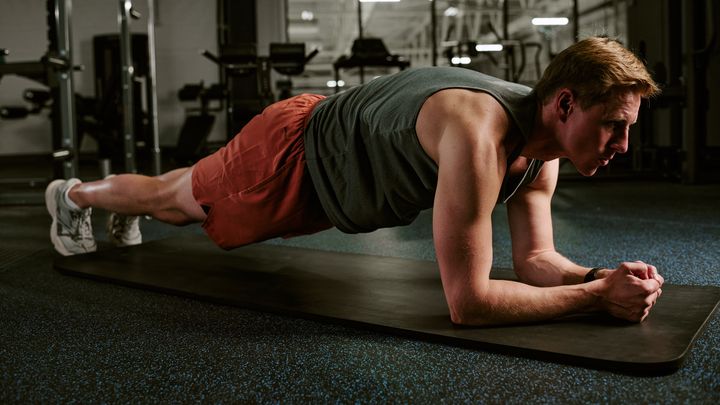
The baseline brace: hold a straight line and breathe. Hover-style variations that also recruit shoulders and glutes were among the highest-activation moves in the 16-exercise EMG comparison. [1]
Your core is not one muscle — it is several muscle groups sharing one job: keeping your trunk steady while your arms and legs move. When researchers measured muscle activity across 16 exercises, the moves that also recruit the shoulders or glutes produced the greatest abdominal and lower-back activation — not the isolated ab work. [1]
And when a systematic review pooled 17 studies, it found no consensus on a single most effective core exercise — so this hub is organised by what each movement family trains, not by a fake ranking. [2]
Below: which family loads which muscles, a starter session, what to do at home or in a gym, and — clearly separated — what lower-back pain changes and when to see a clinician. Individual exercise guides are still being written; every topic in preparation is listed at the bottom, labelled clearly.
The rectus abdominis — the visible “six-pack” — flexes the trunk: it pulls your ribs toward your pelvis in a crunch, and it controls the tilt of your pelvis the rest of the time. [5]
The obliques, external and internal, run along your sides and rotate or laterally flex the trunk — and just as often resist those movements. [5]
The transverse abdominis is the deepest layer, wrapping the trunk like a belt; it braces the midsection before the bigger muscles move it. The erector spinae along your spine extends the trunk — the back half of the core that “ab workouts” forget. Your hip flexors assist by linking the legs to the trunk.
The EMG evidence shapes the selection question. In a study of 20 participants (10 men, 10 women) performing 16 exercises, the abdominal and lumbar muscles were activated most during integration exercises that also required the deltoids and glutes — not during isolation moves that worked the trunk alone. [1]
A systematic review of 17 studies covering 252 participants found moderate evidence that the lumbar multifidus worked harder in free-weight exercises than in ball or device exercises, while the transverse abdominis worked about the same in stability and ball exercises — which is why the review’s authors point toward multijoint free-weight work rather than gadget-based core training. [2]
Two practical consequences: a machine or a ball is optional, not required, and no single move covers all four families below — a week of core training borrows from more than one.
Core work gets simple when you sort it by what the trunk does — or refuses to do — instead of by equipment names. The diagram below was drawn for this page and shows which family loads which muscles.
Bracing and resisting are half the map — the reason the three-move “Big 3” routine popularised by spine researcher Stuart McGill (curl-up, side plank, bird dog) contains no crunching motion at all; it was selected from quantitative work that ranked stabilising exercises by spine stability against spinal load. [4]
The individual guides below are being written; the selection logic is here today and each card becomes a working link the day its guide ships.
The baseline brace: hold a straight line and breathe. Hover-style variations that also recruit shoulders and glutes were among the highest-activation moves in the 16-exercise EMG comparison. [1]
A brace lying on your back: keep the trunk quiet while opposite arm and leg extend — the same skill as the plank, learned with a supported spine.
Bracing on one side: the obliques and the deep belt hold the hips up. One of the three moves in the McGill trio. [4]
Flexion plus rotation in one slow move — bring the shoulder toward the opposite knee without pulling on the neck.
Press a cable or band straight out while it tries to twist you — anti-rotation work for the obliques without moving the spine.
Flexion with the legs as the lever: harder than it looks, so bend the knees or shorten the range before the lower back lifts.
The gymnasts’ brace: lower back pressed down, arms and legs floating — short holds, full tension.
The long-lever anti-extension move: roll out a short distance, keep the hips quiet, and pull back with the trunk, not the arms.
This page also answers the “core workout” search, so here is the honest version: one move per family, two to three sets each, twice a week. That schedule fits the ACSM’s current position stand — a 2026 overview of 137 reviews — which found strength improving from two or more sessions per week over two to three sets. [3]
| Move (family) | Sets | Time or reps | Rest |
|---|---|---|---|
| Dead bug (brace) | 2–3 | 6–8 slow reps per side | 30–45 s |
| Plank (brace) | 2–3 | 10–30 s holds | 30–45 s |
| Reverse crunch (flex) | 2–3 | 8–15 reps | 45 s |
| Pallof press (rotate) | 2–3 | 8–12 reps per side | 45 s |
| Side plank (side) | 2–3 | 10–20 s per side | 30–45 s |
Hold times and reps here are starting ranges, not targets: stop each set while you can still hold position, and add time or reps as it gets easy. A dedicated routine built around the McGill trio — the McGill Big 3 workout — is in preparation and will be linked here when it ships.
Most core training needs no equipment at all — 38 of the 55 guides planned for this collection are bodyweight moves. A floor and ten minutes cover all four families: dead bug and plank to brace, reverse crunch to flex, a slow Russian twist to rotate, side plank for the sides.
Add the cable station for Pallof presses and cable crunches, a pull-up bar for hanging knee and leg raises, and an ab wheel for the long-lever brace. The bodyweight, kettlebell, medicine ball and resistance band collections will list each side once those pages ship.
No. The 2013 systematic review found the transverse abdominis worked about as hard in plain stability exercises as in ball or device versions, and the lumbar multifidus worked harder with free weights than with devices. [2] A ball can make a crunch more comfortable; it does not make it more necessary.
The ACSM’s recommendations are written for healthy adults and make no separate core prescription by sex. [3] Start where your current strength is, not at a gendered chart.
The same families apply, with shorter levers and slower pacing — and any existing back problem moves this from training advice to clinician territory; read the next section first.
The ACSM’s 2026 position stand — an overview of 137 reviews covering more than 30,000 healthy adults — reports that strength improved with two or more sessions per week over two to three sets, and that muscle growth responded most to higher weekly volume, from about ten sets per muscle group. [3] For the core, that usually looks like two or three moves across families, twice a week, progressed slowly.
Two honesty notes. A burning muscle is not a scoreboard — the EMG percentages researchers report measure electrical activity during a protocol, not the muscle you will build. And you do not need to train to failure: in the 2026 overview, pushing to momentary failure did not consistently change the outcome. [3]
This page is training information, not a diagnosis. Back pain has many possible causes — a pulled muscle is common, and rarer causes include a slipped disc or a trapped nerve — and the right exercise for one cause can be wrong for another. [6]
There is real evidence behind careful core work: in a 2024 randomised trial of 60 young men with chronic non-specific low back pain, a supervised core-stability programme improved pain scores, disability scores and trunk muscle function more than traditional waist strength training. [8] That was a guided rehabilitation setting — it supports the approach, and it is not a licence to self-prescribe through pain.
NHS guidance on when to get checked: see a GP if back pain is not improving after a few weeks, is stopping your daily activities, or comes with unexplained weight loss, a lump, or pain that is worse at night. Get urgent help — an urgent GP appointment or NHS 111 — for sudden severe or rapidly worsening pain, or if you feel feverish and unwell. [6]
Call emergency services for the red flags: pain, tingling, weakness or numbness in both legs, numbness around the genitals or anus, changes in bladder or bowel control, chest pain, or back pain that started after a serious accident. [6] In training: stop any move that reproduces your pain and keep only what is pain-free while you wait to be assessed.
One per family covers the map: a plank to brace, a dead bug to brace with moving limbs, a reverse crunch to flex, a Pallof press to resist rotation, and a side plank for the sides. Research has not crowned a single best move — the 2013 systematic review of 17 studies explicitly found no consensus, which is why the families matter more than the pick. [2]
The phrase usually means the “McGill Big 3”: the curl-up, the side plank and the bird dog, popularised by spine researcher Stuart McGill. The trio came out of laboratory work that ranked stabilising exercises by how much spine stability they bought per unit of spinal load. [4] It is a solid spine-sparing starting set — and not the only legitimate way to train the four families.
By family: planks, dead bugs and hollow holds to brace; crunches, sit-ups and reverse crunches to flex; Russian twists and Pallof presses to rotate or resist rotation; side planks and side bends for the sides. Pick one per family and you are covered.
Two per family: plank and dead bug (brace); crunch and reverse crunch (flex); Russian twist and Pallof press (rotate); side plank and side bend (side). Two sessions a week of that list beats a daily hundred of any single one.
No — not locally. In the 6-week trial, five weekly sessions of abdominal exercise on an unchanged diet improved muscular endurance without significantly reducing abdominal fat or waist size. [7] Train the core for strength and control; manage fat loss through your overall diet and training picture.
No individual core-exercise guide is published yet; this hub is the first. Each entry below becomes a working link the day its guide ships — until then it stays plain text so you never hit a dead end.
Related collections and the workout in preparation:
Grouped by the equipment each guide needs.
All activation and fat-measurement findings come from the studies’ own abstracts, with each study’s population stated next to it. The family diagram and all wording were created for this site; the photograph is licensed through Envato Elements for fitnessinstructor.ai (see the credit caption).