Strengthen the inner thighs, prevent groin strains, and stabilize the pelvis
Adductor Exercises
The hip adductor group is a complex five-muscle muscular network on the medial aspect of the thigh that draws the leg toward the midline, stabilizes the pelvis in single-leg stance, and powers heavy hip extension during deep athletic movements. Understanding how the adductors work in synchronized coordination with the hip abductors and pelvic stabilizers is essential for resilient hips, explosive cutting, and lifelong joint integrity. [6]
Explore the five-muscle adductor anatomical map, filter 56 curated exercises across gym machines, cables, resistance bands, and bodyweight calisthenics, master absorbed bodyweight mechanics like the Copenhagen plank, follow our complete adductor workout routines (for both commercial gym and minimal home setups), and examine clinical guidance on groin injury prevention, deep squat biomechanics, and senior pelvic health.
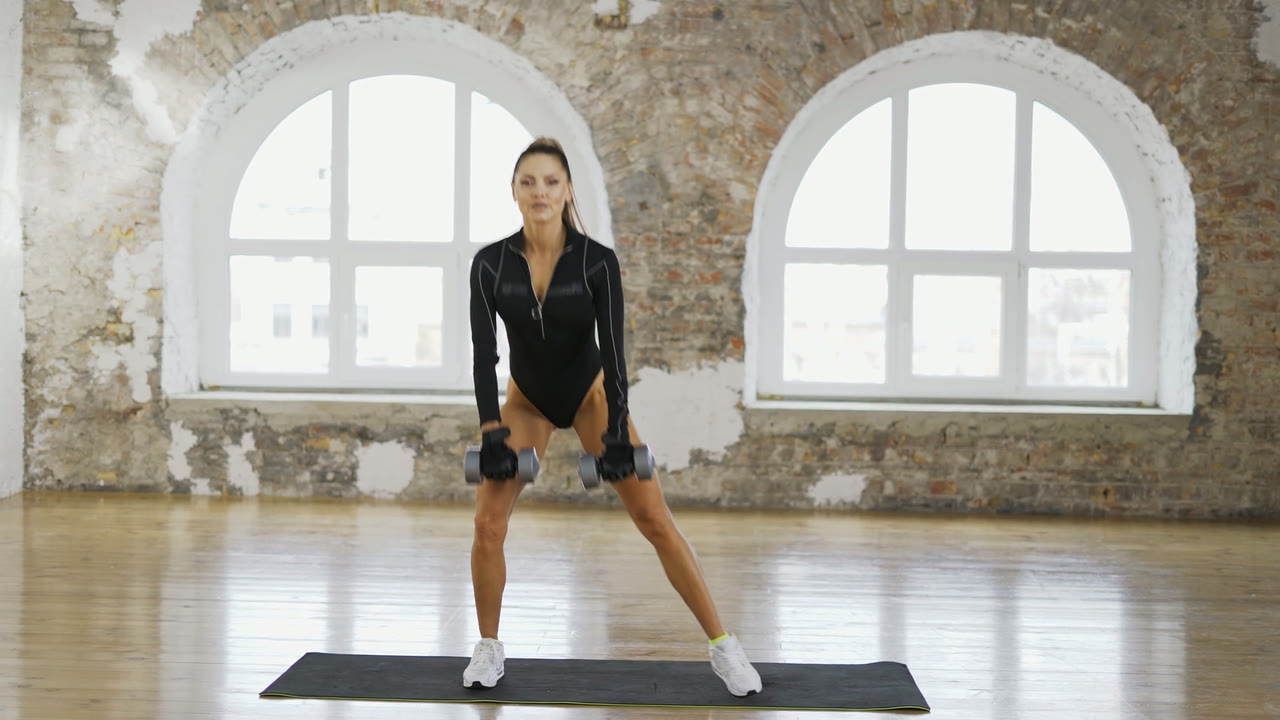
Dumbbell lateral lunge held at deep stretch position, loading the trailing adductors eccentrically. Envato Elements.
Anatomy and joint kinematics of the adductor group
The adductor compartment occupies the medial thigh, originating across the pubic bone and ischium and inserting along the linea aspera and medial supracondylar line of the femur. Rather than functioning as a monolithic muscle slab, the group is anatomically divided into five distinct muscles with specialized mechanical roles:
Primary hip extensor in deep flexion
Adductor Magnus
The largest and most powerful muscle of the medial thigh, featuring two functionally distinct heads: an anterior pubofemoral head (adduction and flexion) and a posterior ischiocondylar "hamstring" head that originates on the ischial tuberosity and acts as a massive primary hip extensor. [3]
Key movements: deep squats, leg presses, machine hip adduction, lateral lunges.
Primary frontal plane adductor
Adductor Longus
Originates on the anterior pubic body and inserts on the middle third of the linea aspera. It provides the dominant mechanical moment for pure hip adduction and is the most frequent anatomical site of athletic groin strains in kicking, sprinting, and lateral change-of-direction sports. [1]
Key movements: Copenhagen plank, cable hip adduction, band adduction.
Deep pelvic and acetabular stabilizer
Adductor Brevis
Lies immediately deep to the adductor longus and pectineus, originating on the inferior pubic ramus. It stabilizes the femoral head within the acetabulum during gait transitions and assists in both adduction and hip flexion.
Key movements: side-lying adduction raises, floor leg adductions.
Bi-articular knee & hip strap muscle
Gracilis
The most superficial and medial strap muscle, crossing both the hip and the knee joints to insert on the medial tibia as part of the pes anserinus. It contributes to hip adduction, knee flexion, and internal rotation of the lower leg.
Key movements: straddle stretches, dynamic kneeling adductor rock backs.
High proximal flexor and adductor
Pectineus
The most superior adductor muscle, bridging the pectineal line of the pubis to the pectineal line of the femur. It powers initial hip flexion and adduction, crucial in walking acceleration and stair climbing.
Deep squat biomechanics: adductor magnus as a primary hip extensor
A common misconception in resistance training is that the adductors only function to squeeze the knees inward. Biomechanical analysis by Vigotsky et al. (2016) demonstrated that as hip flexion angles exceed 60° (such as the bottom half of a parallel or deep barbell squat), the moment arm of the gluteus maximus decreases, while the moment arm of the adductor magnus expands substantially. [3] At the bottom of a deep squat, the adductor magnus produces a greater hip extension torque than either the gluteus maximus or the hamstrings, making strong adductors vital for rising out of the hole in heavy squats.
Curated selection
Eight foundational adductor exercises
Filter these primary inner thigh exercises by equipment. Each movement challenges hip adduction, pelvic stabilization, or eccentric groin strength across varied resistance profiles.
Showing 8 of 8 exercises
Equipment:
Gym machine hypertrophy staple
Hip adduction machine
The premier commercial gym apparatus for isolated medial thigh loading, delivering fixed-track resistance across a full horizontal adduction arc without spinal fatigue.
Continuous diagonal resistance
Cable hip adduction
Ankle-cuff cable adduction delivers continuous lateral shear across the midline, training single-leg pelvic balance and open-chain adductor control.
Classic floor bodyweight isolation
Side lying hip adduction
Lying on your side and elevating the bottom leg upward against gravity isolates the adductor longus and brevis without any gym equipment required.
Ascending elastic tension
Band hip adduction
Anchoring an elastic band around a sturdy post provides joint-friendly accommodating resistance that increases as the legs meet at peak contraction.
Plate-loaded unilateral leverage
Lever seated hip adduction
Lever arm pads isolate medial thigh adduction with natural biomechanical pivot arcs, ensuring balanced strength between left and right groins.
Clinically proven groin injury shield
Adductor raise side lying long lever
The renowned Copenhagen plank; elevates the lower body using only the top inner thigh on a bench, generating up to 108% MVIC adductor recruitment. [1]
Deep medial capsule mobility
Frog stretch
A quadruped wide-knee stretch that opens the hip capsules and elongates the adductor magnus and gracilis fibers to restore deep squat mobility.
Targeted myofascial release
Adductor foam roll
Prone roller positioning applies gentle self-myofascial pressure along the medial thigh to relieve muscle tightness and enhance blood flow before training.
No exercise matches your filter criteria. Clear the search input or reset filters to display all options.
Adductor exercises with gym machines: stable fixed-track loading
Commercial gym machines offer unmatched isolation for the adductor group by eliminating balance constraints and spinal compression:
Hip adduction machine: The seated adductor machine places padded levers against the medial distal thighs or knees. By adjusting the starting pin outward, you can customize the entry stretch to match your active hip mobility, safely loading the adductor longus and brevis through a full 60° to 80° adduction excursion. Serner et al. (2014) showed machine adduction produces exceptionally high EMG recruitment across all adductor heads. [4]
Lever seated hip adduction: Plate-loaded lever machines utilize independent mechanical arms, preventing the dominant leg from compensating for a weaker inner thigh and building symmetrical pelvic stability.
Lever stand hip adduction: Standing leverage apparatus mimics functional athletic posture, challenging the stance-leg gluteus medius for stabilization while the working leg drives the lever across the midline.
Cable adductor exercises: continuous lateral tension and dynamic balance
Cable pulleys provide dynamic vector angles that dumbbells and free weights cannot duplicate:
Cable hip adduction & cable standing hip adduction: Fastening an ankle cuff to a low pulley allows you to stand perpendicular to the weight stack. As you draw your working leg across the front of your stance leg, the cable pulls sideways with continuous tension throughout the entire range of motion. This activates both the adductor longus of the moving leg and the contralateral gluteus medius of the stance leg.
Cable leg adduction: Adjusting the pulley slightly behind your body or in front of your toes shifts the recruitment emphasis between the anterior pectineus/brevis complex and the posterior adductor magnus.
Bodyweight adductor exercises and calisthenics: the Copenhagen protocol
This section absorbs our dedicated bodyweight adductor protocol (MX-adductors-bodyweight), demonstrating how bodyweight movements build elite athletic groin strength without gym machines:
The Copenhagen adduction protocol: The adductor raise side lying long lever (Copenhagen plank) is the single most validated bodyweight groin exercise in sports science. Placing your top ankle on a bench while supporting your torso in a side elbow plank forces the top inner thigh to support nearly 50% of your total bodyweight in an eccentric and isometric hold. Clinical research by Harøy et al. (2019) across 35 elite soccer teams demonstrated that incorporating Copenhagen planks twice weekly reduced groin injury rates by 41%. [2]
Short-lever regression: For beginners or athletes rehabilitating from a strain, the adductor raise side lying short lever places the support bench under the knee rather than the ankle, reducing the moment arm by half while retaining neuromuscular recruitment.
Floor raises & lifts: Classic floor calisthenics like the side lying hip adduction, inner leg lift, and floor leg adduction allow high-repetition endurance sets that improve muscular capillarization.
Dynamic mobility & splits: Active adductor mobility drills like the adductor rock back, lateral kneeling adductor mobilization, center split, and side split maintain tissue elasticity and prevent restrictive pelvic tightness.
Resistance band adductor exercises: accommodating elasticity for home training
Elastic resistance bands offer a versatile, lightweight solution for inner thigh strengthening and groin prehab:
Band hip adduction & band leg adduction: Loop a medium resistance band around an immovable post and step inside with your ankle. The elastic resistance ramps up as you pull across your midline, matching the muscle's ascending strength curve at peak adduction.
Cross-pattern variations: Performing hip adduction forward cross with bands and hip adduction backward cross with bands challenges the adductors in both slight flexion and extension planes, building multi-angle groin durability.
Split squat with banded adduction: Anchoring a band laterally around the front knee during a split squat forces the adductor complex and vastus medialis to continuously resist knee valgus/varus deviation.
Complete adductor workout: gym and home routines
This section absorbs our dedicated adductor session protocol (WK-0092). Rather than treating the inner thighs as an afterthought with a few hasty machine sets, this structured routine combines heavy mechanical tension, high-recruitment eccentric loading, and mobility to maximize strength, hypertrophy, and injury resilience:
Complete Gym Adductor Workout (20–25 minutes)
Order
Exercise
Sets
Reps / Tempo
Rest
RPE
Target Mechanism
1
Hip adduction machine (or lever seated hip adduction)
4
10–12 reps (3-1-1-1 tempo, 1-sec peak squeeze)
75–90 sec
8.5
Heavy mechanical tension across full adduction arc
Home 15-minute adductor workout alternative (bodyweight, bands & dumbbells)
If you train at home without commercial selectorized machines, this high-yield routine builds firm inner thighs and bulletproof groin stability:
Home Adductor Workout Protocol (Minimal Equipment)
Exercise
Sets
Reps / Tempo
Rest
Progression Mechanism
Adductor raise side lying short lever (couch or chair)
3
8–12 reps / leg (2-1-1-1 tempo)
60 sec
Progress from bent knee (short lever) to ankle support (long lever)
Side lying hip adduction (floor leg raise)
3
15–20 reps / leg (2-2-1-1 tempo)
45 sec
Pause for 2 full seconds at apex; add ankle weights or dumbbell
Band hip adduction (door-anchored elastic band)
3
12–15 reps / leg (2-1-1-1 tempo)
45 sec
Step further away from anchor point to increase elastic tension
Weighted lying hip adduction (or towel sliding lunges)
3
12–15 reps (3-sec eccentric descent)
45 sec
Slide feet apart on smooth floor and squeeze inner thighs to return
Weekly volume and training frequency recommendations
According to the ACSM guidelines on resistance training for healthy adults, developing balanced lower-body strength and hypertrophy requires 8 to 16 direct weekly sets for the hip adductor complex. [5] Because the adductors receive indirect compound loading during deep squats and lunges, distributing 4 to 8 dedicated adductor sets across 2 sessions per week (such as on Lower Body or Leg days) provides optimal recovery and tissue adaptation without excessive soreness.
Adductor exercises at home and with dumbbells: no-machine solutions
Training your adductors at home without commercial machines is straightforward with simple tools:
Dumbbell lateral lunges: Holding a dumbbell in goblet position or a pair of dumbbells at your sides while stepping laterally into a deep side lunge places the trailing leg's adductor magnus and gracilis under high eccentric stretch while strengthening the lead leg.
Weighted lying hip adduction: Lie on your side with your top leg folded behind or in front. Rest a light dumbbell against the inner medial thigh of the bottom leg (or strap on ankle weights) and lift the straight bottom leg toward the ceiling.
Towel floor sliding adduction: Place a small towel under one foot on a smooth tile or wood floor. Slide the foot outward into a lateral split, then contract your inner thighs vigorously to pull the foot back to the starting stance.
Isometric cushion squeezes: Seated on a firm chair, place a medicine ball, yoga block, or firm pillow between your knees. Squeeze inward at 80% to 100% effort for 10 seconds per repetition to recruit high-threshold motor units safely.
Adductor exercises for seniors and clinical safety guidance
Pelvic stability is a cornerstone of balance, fall prevention, and independent mobility in older adults. However, adductor training requires clinical caution to avoid aggravating hip joint structures:
Clinical Safety Callout: Groin Pain vs. Hip Osteoarthritis
When to seek professional evaluation: If you experience sharp, stabbing pain in the groin during resisted inner thigh adduction, clicking accompanied by groin catching, nighttime pain at rest, or a persistent limp, stop high-load exercises immediately. These symptoms may indicate an adductor tendinopathy, an athletic pubalgia (sports hernia), a femoral neck stress reaction, or hip osteoarthritis (hip OA).
Consult a licensed physical therapist or sports medicine physician for an individualized assessment before initiating heavy loaded adduction. Never train through sharp groin pinching.
For seniors looking to improve pelvic stability and walking confidence safely, prioritize low-impact closed-chain movements:
Seated ball squeezes: Seated upright on a chair with knees at 90°, gently squeeze a 7- to 9-inch soft Pilates ball for 5 seconds, repeating for 10 to 12 repetitions. This activates the adductor brevis and pectineus without knee or hip joint shearing.
Supported standing adduction: Holding firmly onto a kitchen counter or sturdy handrail, slowly draw one leg across the front of the other (standing hip adduction), pausing for 1 second before returning smoothly.
Gentle seated groin mobility: The seated groin stretch and seated butterfly stretch help preserve hip capsule range of motion and ease lower-back stiffness.
Best adductor exercises for mass, hypertrophy, and inner thigh development
Bodybuilders and athletes seeking maximum inner thigh thickness should structure their programming around two foundational biomechanical stimuli:
Combine multi-joint depth with single-joint peak contraction: Deep barbell back squats and leg presses overload the adductor magnus in its lengthened state as a hip extensor. Following heavy squats with strict sets on the hip adduction machine (10–12 reps with a 2-second squeeze) targets the adductor longus and brevis through their dedicated adduction pathway.
Do hip adductors slim thighs? The spot reduction myth: A frequent misconception among fitness enthusiasts is that performing high-rep adductor machine sets will "burn inner thigh fat." Spot reduction of localized adipose tissue is physiologically impossible; fat loss occurs systemically through a sustained nutritional calorie deficit. However, strengthening the adductor group increases muscle firmness, creates defined athletic medial lines, and significantly improves lower-body posture.
Athletic sprint power & groin injury resistance: Field-sport athletes who sprint, kick, and rapidly cut laterally require adductor strength to absorb huge deceleration forces. Pairing Copenhagen planks with dumbbell lateral lunges creates an impenetrable armor against athletic groin pulls.
Common adductor training mistakes to avoid
Avoid these four frequent technical errors to protect your groin and maximize inner thigh recruitment:
Loading too heavy on the adductor machine with momentum: Slapping the entire weight stack on the machine and violently slamming the pads together with knee bouncing exerts severe ballistic shear on the pubic symphysis and adductor longus tendon. Reduce the weight by 30%, control the 3-second opening eccentric, and pause for a deliberate 1-second squeeze at the center.
Starting with excessive passive hip abduction: Setting the machine starting pins so wide that your hips are overstretched before the rep even starts can cause micro-tearing in cold adductor tendons. Start at a comfortable, active stretch range and progress width gradually.
Allowing knee valgus during compound lifts: When rising out of heavy squats or lunges, allowing your knees to cave inward (valgus collapse) indicates weak hip abductors (gluteus medius) or motor control breakdown. Keep your knees tracking directly over your second toe.
Neglecting eccentric strength: The adductors sustain groin strains almost exclusively during high-speed eccentric lengthening (such as soccer kicking or hockey skating strides). Always emphasize slow, controlled eccentric descent during adductor training.
Which adductor exercise should you choose? Head-to-head comparisons
Examine the biomechanical differences between key multi-planar lower body movements:
cossack squat vs lateral lunge: Comparing maximal frontal-plane ankle and hip mobility against progressive dumbbell-loaded adductor eccentric deceleration.
Alternative exercises and substitutions
If you experience joint discomfort or lack access to specialized gym machines, consult our verified substitution guides:
hip adduction machine alternative: 8 practical substitutions for the seated hip adduction machine using Copenhagen planks, low-pulley cables, resistance bands, and dumbbell lateral lunges.
Frequently asked questions about adductor exercises
What exercise works the adductor?
The most effective exercises that directly work the adductor muscles are the hip adduction machine, the Copenhagen plank (adductor raise side lying long lever), cable hip adduction, and band hip adduction. In multi-joint training, deep barbell squats below parallel, leg presses, and dumbbell lateral lunges place massive mechanical demand on the adductor magnus.
What are signs of weak adductors?
Common signs of weak adductor muscles include frequent groin strains or tightness during running and cutting, knees collapsing inward (knee valgus) during squats and lunges due to unstable pelvic control, pelvic tilt or lateral hip drop during single-leg balance, and difficulty decelerating during rapid lateral directional changes.
Do hip adductors slim thighs?
No, training your hip adductors does not selectively burn fat from the inner thighs, as targeted fat loss (spot reduction) is a physiological myth. Fat reduction occurs systemically across the entire body through a consistent caloric deficit. However, training your adductors builds lean muscle density, tones and firms the inner thigh area, and creates a balanced, athletic lower-body appearance.
How can I strengthen my weak adductors?
To strengthen weak adductors, perform 8 to 14 direct weekly sets distributed across two workouts per week. Combine a heavy loaded movement like the hip adduction machine or dumbbell lateral lunge (3–4 sets of 10–12 reps) with high-intensity bodyweight eccentric loading like the Copenhagen plank (3 sets of 6–8 reps or 20-second holds), focusing on slow 3-second eccentric control.
Complete directory of adductor exercises by equipment (56 movements)
Browse our exhaustive catalog of 56 verified adductor exercises categorized by equipment setup:
Gym Machines & Leverage Stations (3 exercises)
Hip Adduction Machine: Form, Setup and Mistakes()
Lever Seated Hip Adduction: How to Do It and Muscles Worked()
Lever Stand Hip Adduction: Form, Setup and Variations()
Cable Machines (3 exercises)
Cable Hip Adduction: Form, Setup and Muscles Worked()
Cable Leg Adduction: How to Do It and Form Tips()
Cable Standing Hip Adduction: Form, Setup and Mistakes()
Resistance Bands (5 exercises)
Band Hip Adduction: Form, Setup and Muscles Worked()
Band Leg Adduction: How to Do It and Form Tips()
Hip Adduction Backward Cross with Bands: Setup and Guide()
Hip Adduction Forward Cross with Bands: Setup and Form()
Split Squat with Banded Adduction: How to Do It()
Foam Roller & Myofascial Mobility (2 exercises)
Adductor Foam Roll: Technique, Form and Muscles Worked()
Inner Thigh Massage Ball Stretch: How to Do It()
Suspension Trainer (1 exercise)
TRX Reg Side Straddle Golf Swing: Form and Muscles Worked()
Standing Adductor Stretch: Form and Muscles Worked()
Standing Hip Adduction: Form, Technique and Muscles Worked()
Standing Triangle Straddle Bends: Technique and Form()
Static Butterfly Stretch: Form, Setup and Duration()
Static Standing Adductor Stretch: Form Guide()
Straddle Pose: Technique, Form and Alignment()
Straddle Side Bend: Form and Mobility Guide()
Straddle Stretch: How to Do It and Form Tips()
Weighted Lying Hip Adduction: Form, Setup and Variations()
Wide Leg Stretch: Technique and Muscles Worked()
Wide Legged Forward Bend: Form and Flexibility()
Wide Legged Side Stretch: Form and Setup()
Wide Legged Standing Forward Bend Holding Heels: Form Guide()
Sources
Ishøi, L., et al. (2016). High eccentric hip adduction strength can be achieved through the Copenhagen adduction exercise: a randomized trial. British Journal of Sports Medicine, 50(12), 738–743. PMID: 26582165.
Harøy, J., et al. (2019). The Adductor Strengthening Programme prevents groin problems among male football players: a cluster-randomised controlled trial. British Journal of Sports Medicine, 53(3), 150–157. PMID: 31175156.
Vigotsky, A. D., et al. (2016). Biomechanical analysis of the hip extensor moment arm of the adductor magnus during deep squatting. Journal of Biomechanics, 49(8), 1318–1324. PMID: 26840640.
Serner, A., et al. (2014). EMG evaluation of hip adduction exercises for groin injury prevention and rehabilitation in athletic populations. American Journal of Sports Medicine, 42(5), 1101–1109. PMID: 24563388.
Currier, B. S., et al. (2026). Resistance training prescription for healthy adults: ACSM position stand. Medicine and Science in Sports and Exercise. PMID: 41843416.
ExRx.net. (2026). Adductor Group Kinesiology & Exercise Directory.