
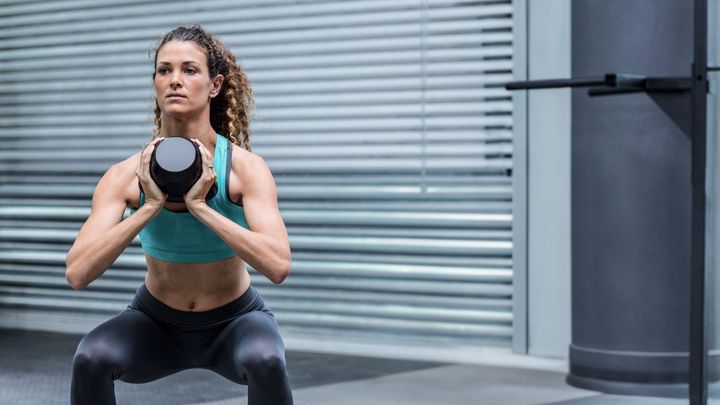
Goblet Squat
The squat pattern learned safely: a dumbbell at the chest, elbows inside the knees. Its full guide is already published.
Your legs hold the largest muscle groups in your body, and no single move covers them all: the quads straighten the knee, the hamstrings bend it and extend the hip, the glutes drive the hip, and the calves point the foot. When researchers compared the two most popular lower-body lifts in trained women, the barbell hip thrust produced roughly double the glute activation of the back squat — and the quad readings did not differ significantly. [1]
This hub maps each pattern to the muscle it loads, gives you a starter session for home or gym, and — clearly separated — what bad knees and ageing change, with the evidence for each. Individual exercise guides are still being written; every topic in preparation is listed at the bottom, labelled clearly.
The quadriceps are four muscles on the front of the thigh — rectus femoris and the three vastus heads. They extend the knee, and the rectus femoris also helps flex the hip because it crosses both joints. [5]
The hamstrings run down the back of the thigh: they bend the knee and help extend the hip. The glutes are the main hip extensors — the prime movers of hinges, thrusts and standing up. The calves (gastrocnemius and soleus) point the foot down; the adductors and abductors keep the thigh tracking straight when you stand on one leg.
The comparison people actually argue about — squat versus hip thrust — has a measured answer. In 13 trained women at estimated 10RM loads, the barbell hip thrust produced significantly greater gluteus maximus activation than the back squat (mean 69.5% vs 29.4% MVIC for the upper glutes, 86.8% vs 45.4% for the lower), plus more biceps femoris activity, while the vastus lateralis did not differ significantly between the two. [1] The same abstract carries the honest caveat: whether higher activation turns into more strength or size over months needs longitudinal trials — so the result guides exercise selection, it does not crown a winner.
Leg day gets simple when you sort moves by what the joints do instead of by machine names. The diagram below was drawn for this page.
A week that touches squat, hinge, lunge and thrust leaves only the calves to add — two calf-raise sets cover them.
The individual guides below are being written; the selection logic is here today and each card becomes a working link the day its guide ships.
The squat pattern learned safely: a dumbbell at the chest, elbows inside the knees. Its full guide is already published.
The loaded squat for when the pattern is familiar — quads and glutes under real load.
The hinge that teaches the hamstrings: hips back, spine long, the bar slides down the thighs.
The direct glute driver — in the measured comparison it roughly doubled the back squat’s glute activation. [1]
The single-leg test: rear foot elevated, one leg does everything — balance and quad load together.
The machine squat: a fixed path for loading the pattern when a free barbell is not the right call today.
Straight from the floor or a step — the calves answer the ankle, slowly and under control.
A knee-height box and body weight: the friendliest single-leg pattern for home and for older adults rebuilding strength.
One move per pattern, two to three sets each, twice a week. That schedule fits the ACSM’s current position stand — a 2026 overview of 137 reviews — which found strength improving from two or more sessions per week over two to three sets. [4]
| Move (pattern) | Sets | Reps | Rest |
|---|---|---|---|
| Goblet squat (squat) | 2–3 | 8–12 | 60 s |
| Romanian deadlift (hinge) | 2–3 | 8–12 | 60 s |
| Step-up or split squat (lunge) | 2–3 | 8–10 per leg | 45 s |
| Glute bridge or hip thrust (thrust) | 2–3 | 10–15 | 45 s |
| Calf raise (raise) | 2–3 | 12–15 slow | 30 s |
The goblet squat guide is already live with full instructions.
The leg workout, leg workout at home and legs and abs session are in preparation and listed below.
Bodyweight squats, reverse lunges, step-ups on a sturdy step, single-leg glute bridges and calf raises cover all five patterns. Of the guides planned in this collection, 26 of 48 need no equipment — and the balance-focused moves (single-leg stands, clock reaches) are the same drills used in fall-prevention research for older adults. [2]
A pair of dumbbells turns the starter session into loaded work: goblet squats, Romanian deadlifts, loaded step-ups and weighted bridges. The dumbbell, kettlebell and resistance band collections will list each side once those pages ship.
The barbell opens the back squat and hip thrust; the leg press and Smith machine give fixed paths for heavy loading; the cable column covers the abductor and adductor work. Each has its own collection below.
No. The ACSM’s recommendations are written for healthy adults and make no separate leg prescription by sex. [4] The patterns and the starting point are the same.
The ACSM’s 2026 position stand — an overview of 137 reviews covering more than 30,000 healthy adults — reports that strength improved with two or more sessions per week over two to three sets, and that muscle growth responded most to higher weekly volume, from about ten sets per muscle group. [4] For legs, that usually looks like one session touching squat, hinge and thrust, twice a week, with lunges and calves folded in.
Two honesty notes. Higher activation is not proof of faster growth — the hip-thrust-versus-squat result guides which move loads which muscle, and the authors themselves call for longitudinal trials before declaring a winner. [1] And more exercises are not the point: cover the patterns, then progress the load or the reps.
This page is training information, not a diagnosis. Knee pain has many causes — from a simple strain to osteoarthritis — and the right move for one can be wrong for another.
The evidence for doing something is strong: a Cochrane review of land-based exercise for knee osteoarthritis (54 studies) found high-quality evidence that exercise reduces joint pain — by about 12 points on a 0–100 scale — and improves physical function right after the programme. [3]
And in older adults, a Cochrane review of 94 studies with 9,917 participants found that strengthening and balance exercise improved the measures that predict falls, like the Timed Up & Go test and one-leg standing. [2]
What that means in practice: start with the supported patterns — sit-to-stand, step-ups, bridges, supported calf raises — keep every rep inside a pain-free range, and let a clinician or physiotherapist see anything that is sharp, swollen, locking or giving way. If knee pain is not improving after a few weeks, is stopping your daily activities, or started after an injury, that is a GP or physiotherapist visit, not another week of testing it. [6]
One per pattern: a squat (goblet or back squat), a hinge (Romanian deadlift), a lunge (step-up or split squat), a thrust (glute bridge or hip thrust) and a calf raise. That five covers every large leg muscle; the EMG comparison shows why the thrust deserves its slot instead of a second squat variation. [1]
There is no official trio the way the “Big 3” exists for core work. The honest frame from the evidence: one squat, one hinge and one single-leg move cover the quads, hamstrings, glutes and calves between them — and a hip-thrust pattern is the measured way to load the glutes hardest. [1]
The one that touches all five patterns with loads you control: the starter session above is exactly that, twice a week. “Best” is a schedule you repeat, not a magic list — the ACSM evidence floor is two sessions a week. [4]
Progressive resistance and balance exercise, starting supported: sit-to-stand, step-ups, bridges and calf raises, adding load or reps as they get manageable. The Cochrane evidence in older adults shows these programmes improve the strength and balance measures linked to fall risk. [2] Anyone with a recent fall, a joint replacement or pain that is getting worse should rebuild with a physiotherapist, not alone.
No individual leg-exercise guide beyond the goblet squat is published yet; this hub is the map. Each entry below becomes a working link the day its guide ships — until then it stays plain text so you never hit a dead end.
Grouped by the equipment each guide needs.
All findings come from the studies’ own abstracts, with each study’s population stated next to it. The pattern diagram and all wording were created for this site; the photograph is licensed through Envato Elements for fitnessinstructor.ai (see the credit caption).