Build peak, thickness, and functional pulling strength
Bicep Exercises
The anterior compartment of the arm is driven by the biceps brachii, the underlying brachialis, and the brachioradialis, coordinating elbow flexion and forearm supination across compound pulls and targeted curls. [2] Learn how the biceps work in our comprehensive anatomy guide.
Explore the anterior arm anatomical map, filter curated exercises by available equipment, follow our absorbed complete bicep workout routine, and examine peer-reviewed research on stretch-mediated hypertrophy, forearm rotation angles, and optimal weekly training volume.
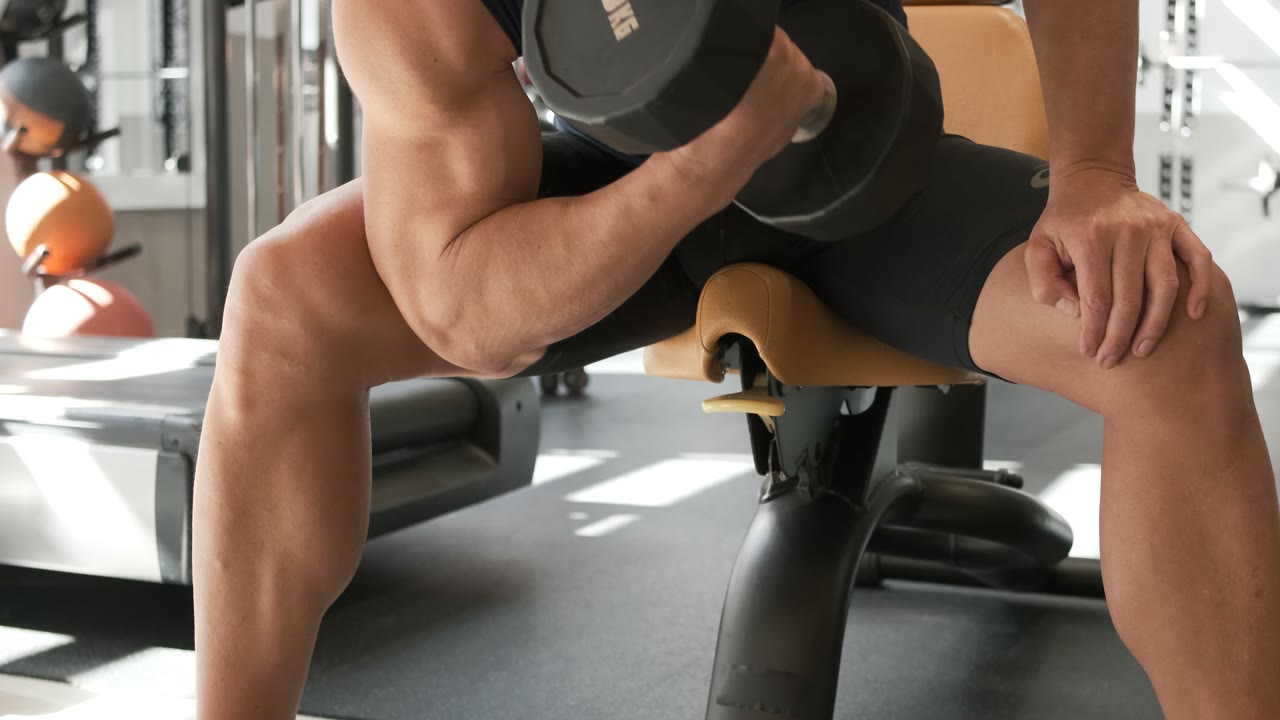
A seated dumbbell concentration curl isolates the biceps brachii by bracing the elbow against the inner thigh, preventing momentum and maximizing peak contraction tension. Envato Elements.
Anatomy and joint mechanics of the anterior arm
Maximizing bicep hypertrophy and functional pulling power requires understanding the architectural division between the two heads of the biceps brachii, the deeper brachialis, and the forearm flexors. Because the biceps crosses both the shoulder (glenohumeral) joint and the elbow joint, altering arm position relative to your torso modifies muscle fiber recruitment and passive stretch tension. [1]
The two-headed flexor
Biceps Brachii (Long & Short Heads)
Originates via two distinct proximal tendons: the long head originates on the supraglenoid tubercle of the scapula (passing through the intertubercular groove of the humerus), forming the outer "peak" of the bicep. The short head originates on the coracoid process, providing inner arm width and thickness. Both heads insert onto the radial tuberosity. Beyond flexing the elbow, the biceps brachii is the most powerful supinator of the forearm when the elbow is flexed to 90°. [3][6]
Originates on the distal anterior surface of the humerus and inserts into the ulnar tuberosity and coronoid process of the ulna. Because the ulna does not rotate during pronation or supination, the brachialis acts as a pure, unwavering elbow flexor regardless of hand orientation. Hypertrophy of the brachialis pushes the biceps brachii upward and outward, dramatically expanding mid-arm circumference. [2]
Originates on the lateral supracondylar ridge of the humerus and inserts into the radial styloid process at the wrist. Possessing a long moment arm across the elbow, it acts as a primary elbow flexor when the forearm is held in a neutral or mid-pronated position. Developing the brachioradialis creates dense upper forearm thickness that seamlessly connects the wrist to the upper arm. [4]
Stretch-mediated hypertrophy and shoulder position mechanics
Recent advances in muscle physiology underscore that resistance training performed at long muscle lengths elicits superior hypertrophy through stretch-mediated adaptations:
Long head stretch overload (shoulder extension): Because the tendon of the long head crosses the glenohumeral joint, positioning your upper arm behind your torso (shoulder hyperextension)—as seen in incline dumbbell curls and Bayesian cable curls—places the long head under pronounced passive and active stretch. Maeo et al. (2023) and Kassiano et al. (2023) demonstrated that training elbow flexors and extensors in lengthened ranges triggers enhanced fascicle lengthening and cross-sectional hypertrophy compared to training exclusively in shortened ranges. [1]
Short head peak tension (shoulder flexion): Conversely, positioning your upper arms in front of your torso (shoulder flexion)—as in preacher curls and spider curls—shortens the long head, causing active insufficiency at the shoulder. This mechanical leverage shifts the workload disproportionately onto the short head and brachialis, producing peak tension during the initial 90° of elbow flexion.
Forearm supination requirements: Landmark electromyographic studies by Basmajian & Latif (1957) and Oliveira et al. (2009) proved that the biceps brachii cannot produce maximal contractile force when the forearm is pronated. To achieve complete motor unit recruitment of both heads, curls must incorporate active, forceful supination (turning palms fully toward the ceiling) at the top of the concentric contraction. [3][2]
Curated selection
Eight foundational bicep exercises
Filter these primary exercises by available equipment. Each movement provides a proven biomechanical stimulus for peak contraction, stretch-mediated growth, or brachialis thickness.
Showing 8 of 8 exercises
Equipment:
Peak long head stretch
Incline dumbbell curl
Setting an adjustable bench to 45° to 60° hyperextends the shoulder joint, putting the biceps long head into maximal stretch before elbow flexion begins. This delivers a potent stretch-mediated hypertrophy stimulus. [1]
Ergonomic bilateral mass builder
EZ-bar curl
The angled grips of an EZ-curl bar accommodate natural carrying angles at the elbow and relieve carpal valgus strain while preserving maximal bicep brachii recruitment on par with straight barbells. [4]
Supination and peak contraction
Dumbbell bicep curl
Allows independent limb loading and natural wrist rotation from neutral at the bottom to full supination at the top, unlocking the complete dual function (flexion + supination) of the biceps brachii. [3]
Continuous lengthened tension
Cable Bayesian curl
Facing away from a low pulley with your arm extended behind your torso keeps constant tension across the entire range of motion, overcoming the dead spot common in free-weight curls at full extension.
Using a neutral grip (palms facing each other) places the biceps in a mechanically disadvantaged position, transferring dominant load to the brachialis and brachioradialis for overall arm width. [2]
Strict short head overload
Preacher curl
Resting your upper arms on a 45° angled pad prevents any shoulder assistance or body swing, focusing maximum mechanical tension on the short head during the bottom-to-mid range of the curl.
Heavy compound overload
Chin-up
An underhand supinated grip transforms this classic vertical pulling exercise into a massive compound bicep builder, allowing you to load the elbow flexors with your entire body weight plus added resistance.
Pinpoint isolated contraction
Concentration curl
Seated with your elbow anchored against your inner thigh, this movement eliminates all momentum and rotational cheating, producing elite EMG activation at peak concentric squeeze.
No exercise matches your filter criteria. Clear the search input or reset filters to display all options.
Complete bicep workout: gym and home routines
This evidence-based bicep routine absorbs our standalone bicep workout programming into a comprehensive training guide. Designed to stimulate the long head, short head, brachialis, and forearm flexors, it blends heavy compound vertical pulling, lengthened-range curls, and isolated peak contractions.
Primary Gym Bicep Workout (12–15 minutes)
Order
Exercise
Sets
Reps
Rest
RPE
Focus Note
1
Chin-up
3
6–8 reps
90 sec
8
Underhand grip; pull chest to bar; control 2-second eccentric lower
2
Incline dumbbell curl
3
8–10 reps
75 sec
8.5
Bench at 50°; let arms hang fully vertical behind torso for deep long head stretch
3
Preacher curl
3
10–12 reps
60 sec
8.5
Pin armpits to the top of pad; do not hyperextend elbow at the bottom
Neutral grip throughout; squeeze brachialis at the top; avoid torso swinging
Home 10-minute bicep workout alternative
If you train at home with a single pair of adjustable dumbbells or bodyweight leverage, this efficient 10-minute workout covers all anterior arm heads:
Home Bicep Routine (Dumbbells & Bodyweight)
Exercise
Sets
Reps
Rest
Progression Mechanism
Dumbbell curl with supination
3
10–12 reps
60 sec
Rotate wrist forcefully outward at peak; 3-second controlled descent
Neutral palms; cross-body arc or straight upward for brachialis growth
Concentration curl
3
12–15 / side
45 sec
Elbow pinned to inner thigh; zero body sway; 1-second peak isometric hold
Underhand table/door inverted row
3
8–12 reps
60 sec
Supinated grip beneath sturdy table or doorway pull-up bar for bodyweight overload
Weekly volume and frequency recommendations
The ACSM position stand on resistance training recommends 8 to 14 direct weekly sets for smaller muscle groups such as the biceps in healthy adults. [5] Because the biceps receives substantial secondary volume during compound pulling movements (such as barbell rows, lat pull-downs, and deadlifts), lifters performing 10+ weekly sets of heavy back work should count roughly 1 indirect bicep set for every 2 pulling sets. Splitting direct bicep work across 2 sessions per week (such as 4–6 sets at the end of an upper body or pull day) maximizes muscle protein synthesis without overwhelming the distal biceps tendon.
Dumbbell bicep exercises: hitting all heads with free weights
Dumbbells remain the single most versatile and effective training implement for building complete bicep development. Unlike barbells which lock wrists and elbows into a fixed transverse path, dumbbells allow your hands to rotate naturally through pronation, neutral, and supination. This absorbs our dedicated dumbbell bicep exercises guide into an actionable hierarchy:
Hitting the long head (outer peak): Perform incline dumbbell curls on a 45° incline. By allowing your elbows to hang behind your torso, the long head begins the movement under maximum passive stretch, stimulating enhanced muscle fiber recruitment. [1]
Hitting the short head (inner fullness): Perform concentration curls or seated dumbbell curls with your upper arms kept slightly forward. As you curl upward, emphasize maximal supination—directing your pinky finger higher than your thumb at the apex of the movement.
Hitting the brachialis and brachioradialis: Perform hammer curls with your palms facing each other. By removing forearm supination, the biceps brachii is mechanically inhibited, forcing the underlying brachialis to generate prime elbow flexion torque. [2]
Dumbbell curls at home: For lifters with limited weight increments, utilize tempos such as 3-second eccentrics, 1-second peak isometric pauses, and 1.5-rep partials to drive metabolic stress and mechanical tension without requiring heavier dumbbells.
Cable bicep exercises and machine training
While dumbbells and barbells rely on gravity—creating a resistance curve that drops to near zero at the bottom (straight arms) and top (stacked joints)—cable machines deliver continuous, multi-directional tension throughout the entire range of motion:
Bayesian cable curls: Setting the pulley at floor height and stepping forward so the cable pulls backward creates maximum tension at the fully lengthened position, perfectly exploiting stretch-mediated hypertrophy. [1]
Standing high-cable Hercules curls: Grasping cables from opposing high pulleys with arms abducted to 90° targets the biceps brachii in a shortened position, delivering an intense peak contraction and mind-muscle pump.
Rope hammer cable curls: Using a rope attachment allows you to pull through a neutral grip at the bottom while flaring the rope outward at the top, integrating brachialis overload with active radial deviation.
Machine preacher curls: Modern selectorized and plate-loaded preacher machines maintain a customized cam profile that ensures constant torque throughout the beginning, middle, and peak of the curl without joint dead spots.
Targeting each head: long head vs short head isolation
Can you truly isolate one bicep head over the other? While both heads share a common distal tendon insertion at the radial tuberosity—meaning you cannot fire one head while completely turning off the other—you can manipulate elbow angle and shoulder positioning to preferentially recruit specific fibers:
Long Head (Outer Peak): Favors movements where the humerus is positioned behind the torso (incline dumbbell curls, drag curls, cable curls facing away). The resulting stretch on the supraglenoid origin forces the long head to perform greater active work during elbow flexion.
Short Head (Inner Width): Favors movements where the humerus is positioned in front of the torso (preacher curls, spider curls on an incline bench, high cable curls). Shortening the long head over the shoulder shifts mechanical leverage to the short head.
Growing underdeveloped biceps: If your arms lack thickness when viewed from the front, focus on the short head and brachialis (preacher curls and hammer curls). If your arms lack vertical height in a front double-biceps pose, prioritize long-head stretch movements (incline curls and Bayesian curls).
Bicep exercises without weights and no equipment
Training biceps without access to gym equipment presents a unique challenge, as virtually all bodyweight pushing exercises (push-ups, dips, planks) target the triceps and chest. However, you can build formidable bicep strength and mass using creative pulling leverage:
Chin-ups and supinated bar hangs: A pull-up bar is the ultimate bodyweight bicep builder. Performing chin-ups with palms facing you produces bicep EMG activation equal to or greater than heavy barbell curls.
Inverted table rows with supinated grip: Lie under a sturdy dining table, grip the edge with an underhand grip, keep your body in a rigid reverse plank, and pull your chest to the underside of the tabletop.
Towel doorframe curls: Wrap a bath towel around a vertical door post or door handle. Place your feet close to the baseboard, lean back, and curl your forehead toward your fists using your biceps to pull your body weight.
Self-resisted curls: Place a towel under your foot while seated, hold both ends with your hands, and curl upward while pressing downward with your foot to generate manually matched variable resistance.
Bicep training for women: strength, tone, and proportion
Bicep training for female lifters follows the exact same physiological and biomechanical laws of progressive overload and motor unit recruitment. Misconceptions about arms becoming "bulky" from lifting weights have been repeatedly dispelled by exercise science:
Functional pulling balance: Strong biceps protect the elbow joint during heavy compound pulling (deadlifts, rows, pull-ups) and assist in everyday carrying, lifting, and posture stabilization.
Upper arm definition: Developing moderate muscle tone in the biceps creates clean aesthetic separation between the shoulder deltoids, triceps, and upper arm. Combining supinated dumbbell curls with hammer curls develops balanced anterior arm contours.
Rep ranges and progression: Women frequently thrive on moderate to higher rep ranges (10 to 15 reps) due to superior muscular endurance and recovery kinetics in Type I and Type IIa fibers, using progressive overload by gradually increasing weight or controlling eccentric tempo.
Common bicep training mistakes to avoid
Torso swinging and hip momentum: Leaning backward and using hip thrust to launch heavy dumbbells turns a bicep curl into an inefficient lower back exercise. Keep your torso erect, pin your shoulder blades down, and initiate movement solely through elbow flexion.
Elbows drifting excessively forward: Allowing your elbows to rise forward toward your chest recruits the anterior deltoid and removes tension from the biceps at the peak of the curl. Keep your upper arms pinned close to your ribcage.
Cutting the eccentric stretch short: Lowering the weight only halfway down robs you of the most hypertrophic portion of the repetition—the lengthened eccentric stretch. Fully extend your elbows at the bottom of every rep before initiating the next curl. [1]
Failing to supinate the wrist: Keeping wrists locked in a neutral semi-pronation during standard curls limits biceps brachii activation. Actively rotate your pinky finger toward your shoulder as you pass 90° of elbow flexion. [3]
Excessive weekly volume causing tendon irritation: Performing 20+ direct bicep sets in addition to heavy back workouts frequently triggers distal biceps or brachialis tendinopathy. Limit direct work to 8–14 weekly sets and prioritize exercise execution quality over junk volume. [5]
Frequently asked questions about bicep exercises
What is the best exercise for biceps?
From an evidence-based perspective, there is no single "best" exercise because complete bicep development requires stimulating the long head, short head, and brachialis. However, for sheer mechanical loading and overall recruitment, the incline dumbbell curl (for long head stretch overload), the EZ-bar curl (for bilateral loading with joint comfort), and the chin-up (for compound overload) consistently rank at the top of electromyographic and hypertrophic research. [1][4]
What are the only three bicep exercises you need?
If you want a minimalist yet comprehensive arm routine, select one exercise for each distinct biomechanical mechanism: 1. Incline dumbbell curl (targets the long head in shoulder extension for stretch-mediated growth), 2. Preacher curl or concentration curl (targets the short head in shoulder flexion for peak contraction squeeze), and 3. Hammer curl (targets the brachialis and brachioradialis for cross-sectional arm width). [2]
Should I do 3 or 4 bicep exercises?
In a single workout, 2 to 3 well-chosen bicep exercises (totaling 6 to 9 sets) are optimal for most lifters. Performing 4 or more bicep exercises in one session leads to diminishing returns and excessive fatigue in a small muscle group, especially when preceded by compound back training. It is far more effective to distribute 3 to 4 total exercises across two separate weekly sessions. [5]
How to build biceps after 50?
Building biceps after 50 requires prioritizing joint-friendly implements, controlled tempo, and tendon preservation: 1. Use EZ-bars, dumbbells, or cables instead of straight barbells to alleviate wrist, elbow, and shoulder strain. 2. Focus on a 3-second eccentric tempo and moderate rep ranges (10 to 15 reps) at an RPE of 7 to 8 rather than grinding low-rep maximums. 3. Ensure adequate recovery with 48 to 72 hours between arm sessions to support collagen synthesis in the distal biceps tendon.
Can you grow biceps without weights?
Yes, provided you apply progressive overload to bodyweight pulling movements. Chin-ups (palms facing you) load the biceps with your entire body weight, eliciting extreme muscular tension. Inverted rows under a table and towel doorframe curls provide accessible scalable alternatives. As bodyweight reps become easy, slow down your tempo, add isometric pauses at peak contraction, or wear a weighted backpack to continually drive progressive overload.
Compare bicep exercises and movement patterns
Evaluate key biomechanical differences, joint angles, and muscle recruitment across our detailed exercise comparison guides:
Chin Up vs Pull Up
Dumbbell Bicep Curl vs Hammer Curl
Hammer Curl vs Reverse Curl
Barbell Curl vs Dumbbell Bicep Curl
Chin Up vs Dumbbell Bicep Curl
Concentration Curl vs Preacher Curl
Concentration Curl vs Dumbbell Bicep Curl
Dumbbell Bicep Curl vs Preacher Curl
Dumbbell Bicep Curl vs Zottman Curl
Barbell Curl vs Preacher Curl
Hammer Curl vs Zottman Curl
Incline Dumbbell Curl vs Preacher Curl
Barbell Curl vs EZ Bar Curl
Preacher Curl vs Spider Curl
Incline Dumbbell Curl vs Spider Curl
Cable Curl vs Cable Drag Curl
Bicep exercise alternatives by movement pattern
If you experience joint discomfort, lack specialized equipment, or need an accessible progression, explore dedicated alternatives for foundational bicep movements:
Dumbbell Bicep Curl Alternatives
Hammer Curl Alternatives
Barbell Curl Alternatives
Concentration Curl Alternatives
Chin Up Alternatives
Cable Curl Alternatives
Reverse Curl Alternatives
Preacher Curl Alternatives
Incline Dumbbell Curl Alternatives
Zottman Curl Alternatives
Explore bicep exercises by equipment and muscle focus
Browse targeted exercise collections filtered by specific arm regions, gym equipment, and dedicated workout routines:
Cable Bicep Exercises
Barbell Bicep Exercises
Kettlebell Bicep Exercises
Resistance Band Bicep Exercises
Pull-up Bar Bicep Exercises
TRX Bicep Exercises
Weight Plate Bicep Exercises
Short Head Bicep Exercises
Long Head Bicep Exercises
Complete bicep exercise library (417 movements)
Browse our exhaustive directory of 417 bicep exercises, organized by equipment and training implement. Select any movement to view full execution steps, muscle activation charts, and coaching cues: