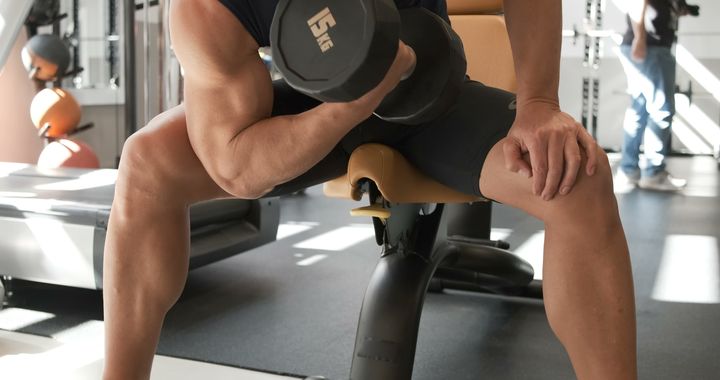
Start with a curl to train the front of your upper arm and an elbow extension to train the triceps at the back. Dumbbells, bands and gym equipment give you different ways to add resistance. Chin-ups and close-grip presses also involve the arms alongside larger muscle groups. [2][3][5][6]
This guide helps you choose across the whole arm and put a short session together. The separate biceps, triceps and forearm collections below narrow that choice further; they are labelled as they become available.
A concentration curl with the upper arm supported against the thigh. Still from a MegiasD / Envato clip; it shows one position, not a full demonstration.
Six useful choices, without a universal winner
Use the first two as a simple pair, or choose a variation that fits your equipment. The last two are compound lifts: ACE lists the chin-up under arms and back, and the close-grip bench press under arms and chest. They belong in the wider training picture. [5][6]
Dumbbell curl
A direct option for the front of the upper arm, standing or seated. Keep the wrist straight and let the elbow bend without swinging the arm. Mayo Clinic and the American Heart Association agree on those basic cues. [2][10]
Dumbbell curl guide
Lying triceps extension
An elbow-extension option you can perform on the floor or a weight bench with a dumbbell. Mayo describes a slow, controlled movement with the upper arm stabilized. [3]
Lying-extension guide
Hammer curl
Another dumbbell curl, with the palms facing the body. ACE emphasizes a straight wrist and a grip position that suits your elbow structure, rather than forcing the weights tightly against your sides. [4]
A different arm position for triceps work. It has promising muscle-growth evidence from cable training, but that does not make every overhead variation the right choice for every shoulder. [7]
A bar-based pull involving both the back and biceps. Choose it when you want a compound pulling movement, rather than another curl variation. [5]
Chin-up guide
Close-grip bench press
A barbell pressing option for the arms and chest. Its equipment and setup differ from a single dumbbell extension; use the full pressing guide before attempting it. [6]
Close-grip press guide
Read the arm by what moves
Bend the elbow
The curl trains the front of the upper arm. Start your selection here for direct biceps work. [2]
ACE's arm directory also separates wrist flexion, extension and forearm rotation exercises. Those are different entries from a biceps curl. [12]
Forearm collection
A movement map, not an anatomical illustration or a ranking. Use the action to narrow the exercise choice.
A simple arm session to start from
Illustrative session for a healthy adult: one set of each movement below. Mayo Clinic gives 12–15 repetitions as a practical starting set for both exercises. This is a starting example, not a complete full-body program or a personalized prescription. [2][3]
Two direct movements, using dumbbells
Movement
Starting set
What to watch
Dumbbell curl
1 × 12–15 per arm
Keep the wrist straight; raise and lower smoothly without swinging.
Lying dumbbell triceps extension
1 × 12–15 per arm
Stabilize the upper arm; bend and straighten the elbow under control.
Rest before the next set until you can repeat the movement with control. For a way to describe how demanding a set felt, see the RPE and reps-in-reserve tool.
For a band-based home option, replace the dumbbell curl with a tubing curl. Mayo describes anchoring the tubing under the foot and keeping the elbow close to the body as you curl. The closer the foot is to the handle, the greater the resistance. [11] Read the equipment instructions and the full movement description before using an unfamiliar band setup.
At the gym, a chin-up or close-grip press can form part of your broader session, with the curls and extensions used as direct arm work. See the back guide and chest guide to plan beyond an arm-only session.
How much work—and does exercise choice matter?
Build a repeatable week before adding variations
ACSM's 2026 guidance recommends resistance training for all major muscle groups at least twice weekly. Its evidence review found that higher weekly volume, around 10 or more sets per muscle group, enhanced hypertrophy. That is a muscle-growth finding, not a compulsory starting dose or a reason to add 10 sets to every exercise. [1][13]
Choose the amount you can sustain and progress. Training to momentary failure and choosing a particular equipment type did not consistently change results across the review. For the wider programming discussion, continue with the muscle-building guide.
Overhead triceps work: useful evidence, specific conditions
In Maeo and colleagues' 2023 study, 21 adults trained cable elbow extensions for 12 weeks, with one arm overhead and the other at the side. MRI measured greater whole-triceps growth in the overhead arm: 19.9% versus 13.9%. Both positions improved strength. [7]
That supports considering arm position when choosing a cable extension. It does not establish a universal ranking of dumbbells, dips, pushdowns and presses, which were not all compared in that trial. Nor is its five-set protocol a required beginner workout.
What about arm fat or “bat wings”?
Training a muscle and choosing where fat comes off are different questions. In a 12-week study of 104 adults who trained one arm, MRI did not find a greater reduction in subcutaneous fat in the trained arm than in the untrained arm. Skinfold measurements gave a different result in men, illustrating why the measurement method matters. [8]
Use resistance work to pursue strength and muscle development. These studies do not establish a skin-tightening treatment or a rapid, targeted arm-fat solution.
Choose for home, the gym and your own starting point
With dumbbells: the curl and lying extension above provide a small, concrete starting pair. You can do the extension on the floor; a bench is not essential for that version. [3]
With bands: tubing curls offer another form of resistance at home. Without handheld weights: bodyweight resistance remains a legitimate training option under ACSM's guidance. Equipment is a means of loading a movement, not a guarantee of better results. [11][13] Our push-up guide explains one available pressing movement.
For women and older adults: choose according to your goal, current ability and health, rather than a sex-specific “toning” label or a fixed weight assigned to an age. ACSM emphasizes individualization; people with symptoms or medical concerns need advice appropriate to their situation. [13][9]
Watch for two avoidable mistakes: swinging through curls, and jerking through extensions. The movement guides emphasize control. Do not copy the weight in a stock photograph as a recommended working load. [2][3]
When pain changes the plan
Stop exercising if you develop pain or feel unwell. Ask a healthcare professional before starting if you have an injury, symptoms, a health condition, recent surgery, or uncertainty about what is suitable. These are general exercise choices, not treatment for a painful elbow or shoulder. [9]
The NHS advises urgent assessment for severe arm pain with difficulty moving, a snapping injury or changed arm shape, or tingling or numbness. Arm pain that appears during exercise and eases with rest also needs prompt medical advice. Sudden arm pain with chest pressure, heaviness or squeezing is an emergency: call your local emergency number. Pain that persists for weeks warrants an appointment. [14]
Browse the arm collection
The individual arm-exercise guides below are in preparation. An unavailable topic stays plain text until its guide is published; the broader resources linked above are available now.
Equipment-specific collections
Dumbbells
Cables
Bodyweight
Barbell
Kettlebells
Machines
Resistance bands
Pull-up bar
Suspension trainer
Weight plate
Smith machine
Bench
Curl guides in preparation
Barbell curl
Concentration curl
Reverse curl
Cable curl
Preacher curl
Incline dumbbell curl
Zottman curl
Machine preacher curl
Seated dumbbell curl
Drag curl
Dumbbell preacher curl
Cable reverse curl
EZ-bar curl
Extensions, presses, pulls and wrist work in preparation
American Heart Association. Strength and balance exercises (2024). Movement cues; its cardiac-rehabilitation context is not a personalized prescription here.