Your gluteal complex consists of three distinct muscles: the gluteus maximus, gluteus medius, and gluteus minimus. Together, they power hip extension, drive pelvic stabilization during upright locomotion, and control femur rotation. [7] Our dedicated glute anatomy guide details their full structural architecture.
Explore the biomechanical movement map, filter exercises by equipment, follow the absorbed complete workout session, and read the peer-reviewed evidence comparing horizontal thrusts to vertical hinges.
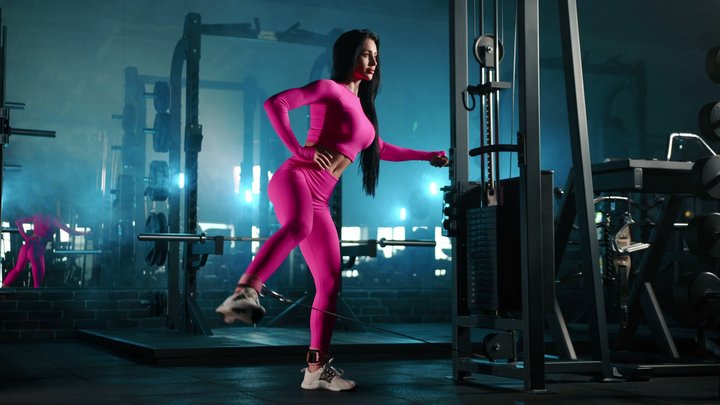
A cable kickback delivers constant horizontal resistance with peak glute contraction at terminal hip extension. vadymvdrobot / Envato Elements.
Start with the three glute muscles and force vectors
Training your glutes effectively requires matching exercise selection to muscle anatomy and resistance curves. While the glutes are often discussed as a single muscle, they perform specialized kinematic roles across different planes of movement. [7]
Primary power
Gluteus Maximus
The largest muscle in the human body. Its primary action is hip extension (driving the thigh backward), external rotation, and transverse abduction. It bears heavy loads in squats, deadlifts, and hip thrusts. [1]
Key movements: barbell hip thrust, Romanian deadlift, squat, back extension.
Lateral stability
Gluteus Medius & Minimus
Located on the upper lateral aspect of the pelvis. They abduct the thigh and prevent the opposite side of the pelvis from dropping during single-leg stance, walking, and running. [2] Explore dedicated gluteus medius exercises.
Key movements: cable kickback, Bulgarian split squat, lateral band walk, step-up.
Shortened position versus lengthened position tension
Different glute exercises apply maximal mechanical tension at different muscle lengths:
Shortened-position loaded movements (peak tension at terminal hip extension): Barbell hip thrusts, glute bridges, 45-degree back extensions, and cable kickbacks place the heaviest resistance exactly where the gluteus maximus can achieve full active shortening.
Lengthened-position loaded movements (peak tension in deep hip flexion): Romanian deadlifts, deep barbell squats, walking lunges, and Bulgarian split squats challenge the gluteus maximus under high eccentric stretch.
Plotkin and colleagues (2023) demonstrated that both hip thrusts and deep squats induce robust gluteus maximus hypertrophy with similar overall gains. Combining both vectors—one horizontal thrust and one vertical hinge or squat—creates a complete hypertrophic stimulus across the entire muscle length. [3]
Curated selection
Eight foundational glute exercises
Filter these top exercises by available equipment. Each option provides a specific mechanical advantage for hip extension or pelvic stabilization.
Showing 8 of 8 exercises
Equipment:
Horizontal hip extension
Barbell hip thrust
The premier exercise for peak gluteus maximus tension at full contraction. Elevated upper back supports heavy horizontal loading with negligible spinal compression. [1]
Maximizes eccentric stretch on the gluteus maximus and hamstrings as hips travel rearward. Can be performed with a barbell or a pair of dumbbells. [2]
Unilateral knee & hip
Bulgarian split squat
Places the working hip through deep flexion while demanding dynamic pelvic stabilization from the gluteus medius and minimus. [3]
Constant tension extension
Cable glute kickback
Maintains smooth, uninterrupted resistance across the entire range of motion, providing targeted isolation for upper glute fibers and gluteus medius. [2]
Floor-based horizontal bridge
Glute bridge
Floor-supported hip extension requiring no apparatus. Teaches posterior pelvic tilt and serves as an effective activation or home exercise foundation. [6]
Horizontal cable hinge
Cable pull-through
Redirects hinge resistance horizontally against the hips rather than vertically against gravity, reinforcing hip extension mechanics without lower back strain. [2]
Shortened-range hinge
45-degree back extension
When performed with slight spinal flexion (rounded upper back) and externally rotated feet, it channels high peak resistance straight into the gluteus maximus lockout. [1]
Dynamic ballistic hinge
Kettlebell swing
Develops explosive horizontal hip drive through a rapid stretch-shortening cycle, building rate of force development in the gluteus maximus. [4]
No exercise matches your filter criteria. Clear the search input or reset filters to display all options.
Complete glute workout: gym and home sessions
This evidence-based glute training session combines both horizontal shortened-range loading and vertical lengthened-range hinges. It directly absorbs the dedicated glute workout routine (glute workout at home and kettlebell swing workout) into a unified curriculum.
Primary Gym Glute Workout (45–50 minutes)
Order
Exercise
Sets
Reps
Rest
RPE
Focus Note
1
Barbell hip thrust
3
8–10
2–3 min
8
Full lockout with posterior pelvic tilt; 1-second pause at top
Deep hip hinge; push hips backward until hamstrings and glutes stretch
3
Bulgarian split squat
3 / leg
10–12
90 sec
8
Slight forward torso lean places higher mechanical load on lead glute
4
Cable glute kickback
3 / leg
12–15
60 sec
9
Slight 30° diagonal abduction outward to engage gluteus medius
Home glute workout alternative
If you train at home without heavy barbells or cable stacks, use single-leg variations and resistance bands to maintain sufficient mechanical tension:
Home Glute Routine (Dumbbells & Bands)
Exercise
Sets
Reps
Rest
Progression Mechanism
Dumbbell single leg hip thrust
3 / leg
10–12
90 sec
Elevate shoulders on sofa or bench; hold dumbbell across hips
Dumbbell Romanian deadlift
3
10–12
90 sec
Controlled 3-second eccentric lower; pause at bottom stretch
Single leg glute bridge
3 / leg
12–15
60 sec
Drive heel into floor; maintain level pelvis at apex
Band glute kickback
3 / leg
15–20
45 sec
Loop mini-band above ankles; squeeze at end range
Weekly volume and frequency guidelines
Current sports science and the ACSM position stand on resistance training recommend 10 to 16 weekly sets per muscle group for hypertrophy in trained individuals, split across 2 to 3 sessions per week. [4] Performing all glute sets in a single session often leads to junk volume in later exercises; distributing volume across two weekly sessions (e.g., Monday and Thursday) maintains higher average force production per set. Pair your glute work with comprehensive leg exercises for balanced lower-body development.
Glute exercises at the gym: heavy compounds and dedicated machines
Training at a commercial fitness center provides access to specialized equipment designed to isolate hip extension and abduction under heavy loads:
Hip thrust machines and plate-loaded glute drives: Provide built-in pelvic padding, an anchored pivot point, and safety catches, eliminating the setup friction of balancing a loaded barbell across the hips.
Cable columns: Unmatched for unilateral isolation movements like standing kickbacks, pull-throughs, and cable abduction. The continuous cable tension prevents the drop-off in resistance typical of free weights at the bottom or top of a range.
45-degree hyperextension bench: Adjust the thigh pad just below the pelvic crest so your hips can flex freely without lumbar rounding. Flaring your toes outward at 45 degrees biases recruitment toward the gluteus maximus and away from the hamstrings.
Seated and standing hip abduction machines: Directly load the gluteus medius and minimus. Adjust seat depth so your knees track naturally against the lateral pads without lumbar hyperextension.
Explore all dedicated gym equipment collections: machine glute exercises, cable glute exercises, and barbell glute exercises.
Glute exercises with dumbbells: unilateral strength at home or gym
Dumbbells offer distinct biomechanical advantages for glute training, particularly for unilateral movements that eliminate bilateral strength discrepancies:
Dumbbell Romanian deadlifts: Holding a dumbbell in each hand allows you to keep the weights closer to your center of gravity or track along the sides of your thighs, reducing lower-back shearing compared to a fixed straight bar.
Dumbbell walking lunges: Dynamic deceleration and hip extension. Taking longer strides biases recruitment toward the glutes and hamstrings, while shorter strides place more demand on the quadriceps.
Dumbbell step-ups: Stepping onto a knee-height bench with a forward torso lean requires forceful hip extension from the lead glute while minimizing assistance from the rear leg.
Dumbbell single-leg hip thrusts: Resting a single dumbbell on the working hip crease challenges rotational pelvic stability while delivering substantial localized overload.
View our complete index of dumbbell glute exercises for structured form instructions.
Glute training for women and men: anatomy, load progression, and goals
The anatomical structure and physiological functions of the gluteal muscles are identical in women and men: the gluteus maximus, medius, and minimus perform the exact same mechanical actions of hip extension, abduction, and rotation regardless of gender. [7]
However, programming emphasis often differs based on aesthetic preferences and athletic goals:
Aesthetic emphasis: Trainees seeking increased gluteal fullness often allocate higher direct volume to hip thrusts, kickbacks, and lateral abduction (12–16 direct sets per week) while moderating quadricep-dominant volume.
Athletic performance: Trainees focused on sprinting speed, jumping verticality, and heavy squat strength emphasize explosive hip extension, heavy barbell hip thrusts, and bilateral hinges that enhance rate of force development.
Progressive overload principles apply universally: Whether the goal is hypertrophy, strength, or athletic power, muscles adapt only when exposed to progressive mechanical tension over time. Light resistance band burnouts alone will not replace progressive load increases with free weights or cables. [4]
Glute exercises with resistance bands: warm-up, burnouts, and travel
Resistance bands deliver variable resistance: tension increases exponentially as the band stretches. While bands cannot match the heavy absolute loading of barbells, they excel in specific training roles:
Pre-workout activation: Mini-band lateral walks, seated band abductions, and banded glute bridges warm up the gluteus medius and minimus, reinforcing proper knee alignment before heavy squats.
Accommodating resistance: Wrapping a loop band around the knees during barbell hip thrusts introduces an active abduction requirement, forcing the gluteus medius to contract simultaneously with the gluteus maximus.
Metabolic stress finishers: High-repetition banded kickbacks (20–30 repetitions) generate deep metabolic accumulation and cell swelling at the end of a workout session.
Portable training: For travel or home training, looped resistance bands provide effective resistance without equipment bulk.
See the complete directory of band glute exercises and bodyweight glute exercises.
Glute exercises that are easy on the knees: hip-dominant hinges and bridges
Individuals experiencing patellofemoral pain or knee irritation during deep squats and lunges can still build powerful glutes by selecting hip-dominant exercises with minimal forward knee travel (tibial translation):
Barbell hip thrust and glute bridge: The shins remain completely vertical (90 degrees to the floor) throughout the movement, producing near-zero shear stress on the patellar tendon.
Romanian deadlift: The knees remain softly unlocked (15–20 degrees of flexion) while all movement occurs via backward hip translation, keeping the patella unloaded.
Cable pull-through: Like the RDL, movement is driven entirely through the hips while the lower legs stay perpendicular to the ground.
45-degree back extension: The knees remain fixed while the hip joint flexes and extends, completely sparing the knee joint.
If you experience joint pain, replace deep knee-flexion squats with these hip-dominant alternatives while consulting a qualified physical therapist. [7]
Glute exercises with weights: barbell, kettlebell, and free-weight loading
Free weights require the lifter to stabilize the load across three dimensions, recruiting synergistic core and stabilizer muscles alongside the prime movers:
Barbell loading: Allows the highest absolute resistance. Movements like the barbell hip thrust and barbell glute bridge allow progressive overload from beginner weights to hundreds of pounds.
Kettlebell ballistic drills: The kettlebell swing and double kettlebell swing emphasize rapid eccentric deceleration and explosive concentric hip extension.
Single-leg barbell & dumbbell work: The barbell single leg hip thrust and dumbbell single leg hip thrust combine heavy localized resistance with intense unilateral stabilization demands.
Hyperextending the lower back at lockout: Arching the lumbar spine to reach higher hip elevation shifts mechanical stress into the facet joints of the lower back. Instead, stop when your hips form a straight line with your torso and knees, squeezing the glutes through a posterior pelvic tilt (tucking the tailbone). [1]
Relying exclusively on light resistance bands: Mini-bands provide useful metabolic burn and lateral activation, but progressive muscle growth requires high mechanical tension from loaded weights or challenging bodyweight progressions.
Neglecting lengthened-position hinges: Doing only hip thrusts, bridges, and kickbacks trains the glutes almost entirely in their shortened range. Including deep Romanian deadlifts or split squats exposes the muscle to high mechanical tension under stretch, driving complementary hypertrophy pathways. [3]
Using excessive momentum on cable kickbacks: Swinging the torso forward and backward turns a targeted glute exercise into a lower back swing. Keep your ribcage down, brace your core, and move only from the hip joint.
Frequently asked questions about glute training
What is the most effective exercise for glutes?
Comparative electromyographic and biomechanical research (Contreras et al., 2015; Neto et al., 2020) demonstrates that the barbell hip thrust produces the highest mean and peak gluteus maximus activation among common strength movements, primarily because tension peaks at full hip extension. However, Romanian deadlifts and deep squats provide superior mechanical tension in the lengthened position. An optimal glute routine combines both: a heavy horizontal hip thrust and a vertical hip hinge. [1][2]
How to fix a flat butt?
A flat appearance is typically caused by underdeveloped gluteal muscle volume combined with prolonged sitting, which leaves hip flexors tight and reduces neuromuscular glute activation. Fixing it requires progressive resistance training focusing on the gluteus maximus for projection (hip thrusts, deadlifts, squats) and the gluteus medius for upper fullness (abductions, kickbacks). Pair this training with adequate dietary protein (1.6–2.2 grams per kilogram of body weight) and a slight caloric surplus or maintenance energy intake to build new muscle tissue.
What are the symptoms of weak glutes?
Weak or underactive gluteal muscles often present through compensatory movement patterns: lower back pain during standing or lifting (due to excessive lumbar extension), anterior knee pain during squats or running (resulting from inward knee collapse, or knee valgus, caused by insufficient gluteus medius hip stabilization), tight hip flexors, and anterior pelvic tilt. Strengthening the glute complex restores proper hip-spine mechanics. [7]
What is the 888 rule for glutes?
The "8-8-8 rule" is a training heuristic popularized for lower-body hypertrophy: performing 8 repetitions per set with challenging progressive resistance, completing 8 total working sets per session (or 8 dedicated glute sets spread across the training week), and committing to an 8-week structured progressive overload cycle before modifying exercise selections. While not a rigid scientific law, it aligns well with proven hypertrophy parameters of moderate repetition ranges and progressive volume accumulation.
Movement comparisons and exercise alternatives
Analyze differences in joint angles, muscle recruitment, and equipment setups before selecting substitutes for your glute training program:
Movement comparisons
Barbell Hip Thrust vs Glute Bridge
Pull Through vs Romanian Deadlift
Kickback vs Side Lying Hip Abduction
Exercise alternatives
Barbell Hip Thrust Alternatives
Glute Bridge Alternatives
Kettlebell Swing Alternatives
Pull Through Alternatives
Complete glute exercise directory by equipment
Browse all 283 exercises in our comprehensive glute library, grouped by equipment setup. Click any exercise title to view detailed execution guides as they become available.
Exercise directory grouped by equipment (283 movements)
Bodyweight (114)
90/90 Hip Crossover
90/90 Hip Stretch
90/90 Piriformis Stretch
Alternating Fire Hydrants
Alternating Leg Bridge
Alternating Power Lunge
Back Kick Kneeling
Back Leg Raise Standing
Bodyweight Feet Elevated Figure Four Glute Bridge
Bodyweight Feet Elevated Single Leg Glute Bridge
Bodyweight Feet Elevated Staggered Glute Bridge
Bodyweight Figure Four Heels Elevated Hip Thrust
Bodyweight Heels Elevated Hip Thrust
Bodyweight Hip Thrust
Bodyweight Hip Thrust Hold
Bodyweight Hip Thruster
Bodyweight Knee Thrust
Bodyweight Seated Hip Rotation to Glute Squeeze
Bodyweight Single Leg Heels Elevated Hip Thrust
Bodyweight Single Leg Stiff Leg Deadlift
Bodyweight Standing Fire Hydrant
Bosu Ball Feet Elevated Glute Bridge
Bosu Ball Hip Thrust
Bosu Ball Plank Glute Kickback
Bosu Ball Single Leg Elevated Glute Bridge
Bosu Ball Single Leg Hip Thrust
Bridge Hold
Bridge Taps
Clam Shell
Clams
Clamshell
Clamshells 1 Side Lying
Clamshells 2 Side Lying
Clamshells 3 Internal External Rotations Side Lying