
The knee bends
A leg curl changes the angle at the knee. Seated and lying curls share that action, while putting the hip in different positions. [4]
Examples: seated curl, lying curl, stability-ball curl.
Give your hamstring training two jobs: bending the knee, as in a leg curl, and extending the hip, as in a Romanian deadlift. The muscles at the back of your thigh help with both actions. Choosing one exercise for each is a practical way to organize your training. [1]
Start with the movement map, compare setups, then use the short example session. The research sections explain what a muscle-growth study and an injury-prevention study can tell you before you choose a favorite exercise.
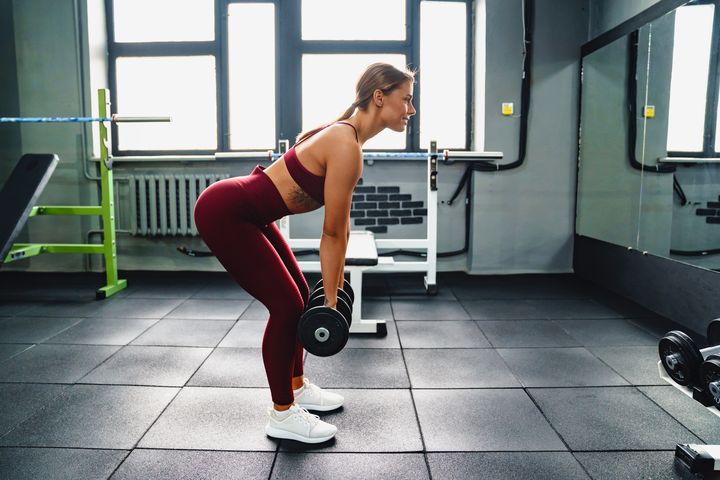
Your hamstrings are the biceps femoris, semitendinosus and semimembranosus. They sit behind the thigh and contribute to knee bending and hip extension. The dedicated hamstring anatomy guide is in preparation. [1]
A leg curl changes the angle at the knee. Seated and lying curls share that action, while putting the hip in different positions. [4]
Examples: seated curl, lying curl, stability-ball curl.
A Romanian deadlift uses a hip hinge: the hips move back and then extend as you stand. ACE describes versions with a barbell or a pair of dumbbells. [7]
Examples: Romanian deadlift, dumbbell Romanian deadlift.
Use these as two slots when selecting exercises. Adding another hinge changes the exercise, but it still leaves you without a knee-curl slot. This is a planning aid, not a requirement to perform every variation in one session.
Each option below has a different setup to consider. These are selection notes; the detailed exercise tutorials are in preparation.
A hinge for the hamstrings and glutes, with a barbell or dumbbells. Read the instructions for your chosen variation before loading it. [7]
A machine curl with the hips flexed. It is the seated option in the muscle-growth comparison below. The machine still needs to be adjusted to you. [11]
A curl performed prone, meaning lying face down. It also increased hamstring muscle volume in the trial discussed below; it is a valid choice to consider if that is the machine available. [4]
ACE describes a version without added weight. Its one-leg setup makes balance part of the choice; a loaded barbell is not its starting requirement. [8]
A leg-curl variation that uses a moving ball support while the hips are held up. Check the ball setup and movement instructions rather than treating it as a machine with less weight. [9]
The body supplies the load, but the exercise needs secure ankle support and an appropriate kneeling setup. Check the full variation and how you will control it. The athlete-prevention evidence is explained below. [10]
Hip position changes the length of the hamstring portions that cross both the hip and knee. The biceps femoris short head crosses the knee only, so the same hip-position argument does not apply to every portion in the same way. [4]
Surface electromyography, or sEMG, records electrical activity during an exercise. A bigger signal in one test does not by itself establish greater muscle growth after months of training. Vigotsky and colleagues' methodological review explains why conclusions about long-term adaptations drawn from these comparisons can be unsupported. [6]
For an exercise choice, consider the task, the setup you can repeat and the outcome a study measured. An MRI growth result, an activation measurement and a sports-injury rate are three different kinds of evidence.
This example is for a healthy adult who already knows the movements. It is a hamstring component of a wider training week, not a complete leg program or injury-recovery routine. Start with manageable resistance; Mayo Clinic describes one set of about 12–15 repetitions as a useful starting point for general strength training. [3]
| Slot | Example choice | Starting work |
|---|---|---|
| Hip extension | Dumbbell Romanian deadlift | 1 controlled set of about 12–15 repetitions |
| Knee flexion | Seated or lying machine curl | 1 controlled set of about 12–15 repetitions |
Recover enough between exercises to keep the next set controlled. Leave a full day before training the same muscle group again, and learn unfamiliar technique with a qualified fitness professional. [3]
Record the resistance and repetitions for each. As a chosen weight becomes easy, increase it gradually while keeping the movement controlled. The curl stack and the dumbbells do not have to change on the same day. [3]
ACSM's 2026 review supports progressive resistance training for healthy adults. For maximal strength, its findings favored heavier loads and at least two sessions weekly; higher weekly volume favored muscle growth. Its finding for growth at ten or more weekly sets per muscle group is about optimizing training outcomes; it is not a starting quota for someone learning two new exercises. Training to momentary muscle failure did not consistently improve outcomes. [2]
The progression guide is in preparation. For the wider plan, use our leg-exercise guide and program guide.
A dumbbell Romanian deadlift gives you a loaded hinge option. ACE also describes learning the standing hinge without weight before adding external resistance. Having the hinge covered still leaves the knee-flexion choice to make. [7]
ACE's unweighted single-leg Romanian deadlift offers a hinge variation, and the ball curl offers knee-flexion work if you have a suitable ball. A Nordic uses bodyweight but still requires its particular support setup; “bodyweight” does not mean that every home space is ready for it.
For a gentler illustration of the knee-bending action, AAOS shows a standing hamstring curl with a chair or wall for balance in its knee-conditioning program. That program is intended to be chosen with a doctor or physical therapist after injury or surgery. Its rehabilitation schedule is not the muscle-building schedule in this article. [12]
Read the instructions for the exact exercise and attachment you intend to use. Use the planned equipment collections to find the right variation as its guide becomes available.
A 2019 systematic review included 15 studies and 8,459 athletes. Programs containing the Nordic hamstring exercise had fewer hamstring injuries than control programs, with a pooled risk ratio of 0.49. That is roughly half the relative risk across the studies, not a promise about one person's next run. [5]
The evidence concerns prevention programs in athletes across different sports and age groups. It does not establish that an unsupervised Nordic session treats a newly pulled hamstring, nor does it tell every recreational runner the same dose to begin with. Your running exposure, current training and any injury history belong in that decision.
If you want to include Nordics, learn a variation and support setup you can control. For pain or a recent injury, get an appropriate rehabilitation plan before importing an athlete-prevention exercise into your routine.
Stop sport or exercise if it brings on hamstring pain. The NHS describes a hamstring injury as sometimes causing sharp pain at the back of the leg, with a snap or pop in more severe cases. Swelling, bruising and difficulty standing or walking can follow. [13]
Seek prompt medical advice for severe or worsening pain, substantial or worsening swelling or bruising, pain when walking or standing, marked stiffness, or symptoms that are not improving. A physiotherapist may be needed if recovery takes longer than expected or you have had previous hamstring injuries. [13]
A group label does not choose the load or balance demands for you. Current resistance-training guidance emphasizes individual goals, abilities and a routine you can maintain. If a health condition or safety concern changes what you can do, discuss the starting plan with a healthcare professional. [14] [3]
Walking uses the hamstrings, but that alone does not give you a progression plan for muscle growth. Keep the purpose of your walking and your resistance work clear, then adjust the training challenge to the outcome you want. [1] [2]
Check whether a proposed replacement fills your curl slot or your hinge slot, then look at its equipment and setup. These comparison and alternative guides are in preparation.
The main choices above are explained on this page. The detailed guides in the lists below are still being prepared; their titles become links when the guides are available.
Written with AI assistance by the Fitness Instructor AI Editorial Team. Updated . A qualified trainer review has not yet been recorded. Read our editorial policy.