Sculpt rotational power, lateral stability, and waistline control
Oblique Exercises
The lateral abdominal wall is driven by the external and internal obliques, coordinating trunk rotation, lateral flexion, and anti-rotational spinal stabilization alongside the deeper transverse abdominis. [1] Learn how the obliques work in our comprehensive anatomy guide.
Explore the lateral core anatomical map, filter curated exercises by available equipment, follow our absorbed complete oblique workout routine, and examine peer-reviewed research on isometric anti-rotation, rotational torque transfer, and spine-safe abdominal conditioning.
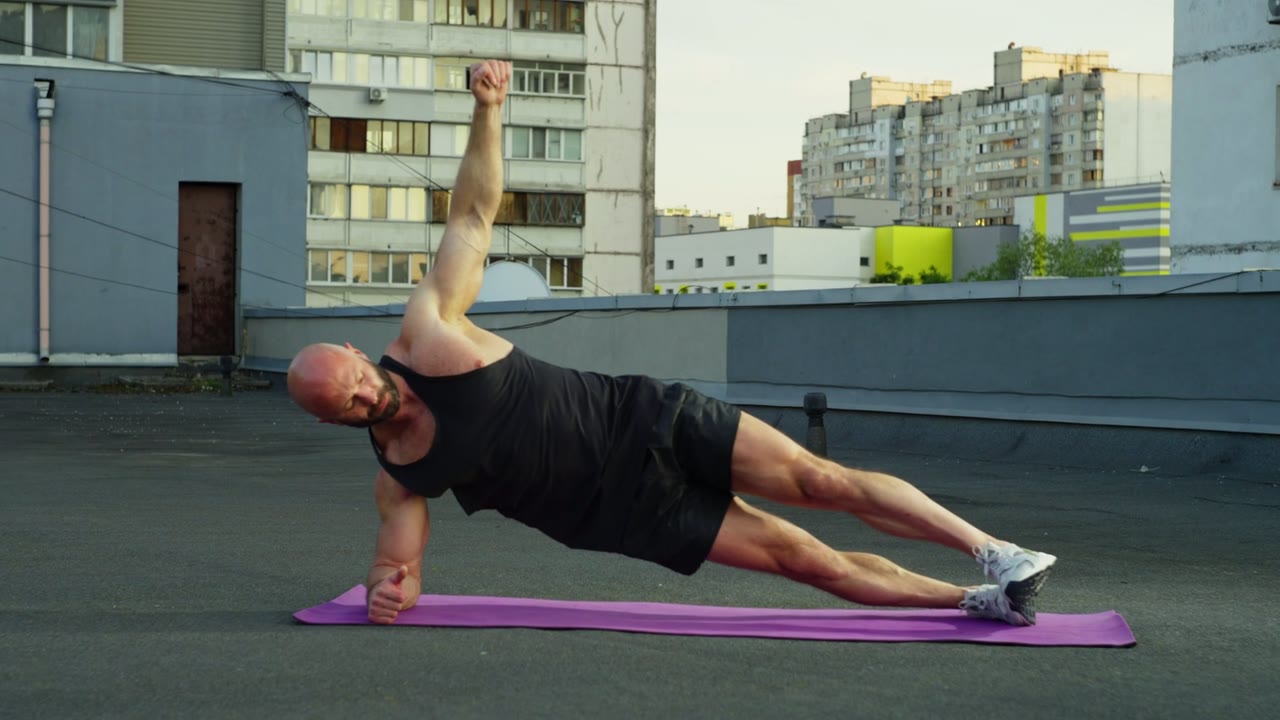
A textbook side plank recruits the external and internal obliques as primary lateral stabilizers, bracing the lumbar spine against gravity with minimal disc compression. Envato Elements.
Anatomy and joint mechanics of the lateral abdominal wall
The human obliques form an interwoven, multilayered muscular corset flanking the rectus abdominis. Unlike simple hinge joints, the lateral abdominal wall controls multidirectional movement across the transverse, frontal, and sagittal planes while serving as the body's primary anti-rotational brake against unwanted torsional shear. [1][7]
The superficial diagonal
External Oblique
Originates from the external surfaces of the lower eight ribs (ribs 5–12) and courses inferomedially ("hands in pockets" fiber orientation) to insert into the iliac crest, pubic crest, and linea alba. Unilaterally, it rotates the trunk to the opposite side (contralateral rotation) and flexes the spine laterally toward the same side. Bilaterally, it assists the rectus abdominis in compressing the abdomen, flexing the vertebral column, and creating a posterior pelvic tilt that stabilizes the pelvis under heavy axial loads. [2]
Key movements: side plank, cable woodchopper, bicycle crunch.
The deep internal corset
Internal Oblique
Situated immediately beneath the external oblique, its fibers course superomedially from the thoracolumbar fascia, anterior two-thirds of the iliac crest, and inguinal ligament, inserting into the cartilage of ribs 10–12 and the linea alba. Unilaterally, it rotates the trunk to the same side (ipsilateral rotation). Working in functional synergy with the contralateral external oblique, it forms the anterior "spiral sling" that transfers rotational torque across the pelvis and thoracic cage. [3]
While anatomically located in the posterior abdominal wall connecting the iliac crest to the lumbar transverse processes and 12th rib, the quadratus lumborum works in direct synergy with the internal and external obliques during lateral flexion and anti-lateral flexion. It acts as the primary muscular anchor preventing pelvic dropping during single-leg stance, walking gait, and suitcase carries. [4]
Dynamic rotation vs anti-rotation: the lumbar spine debate
Decades of biomechanical research led by Dr. Stuart McGill at the University of Waterloo have revolutionized how exercise scientists and strength coaches program oblique training:
Limited lumbar rotational capacity: The human lumbar spine allows only 10° to 13° of total axial rotation across all five vertebrae combined (~1° to 2° per intervertebral segment) due to the sagittal orientation of its facet joints. Forcing repetitive, loaded end-range twisting through the lumbar discs—such as heavy seated barbell twists or aggressive rotary machines—places immense delaminating shear stress on the annulus fibrosus. [1]
The anti-rotation advantage: Biomechanically, the evolutionary role of the obliques is primarily anti-rotation (resisting external twisting forces) and anti-lateral flexion (resisting lateral spine bending). Movements like the Pallof press and side plank challenge the obliques under maximal isometric mechanical tension while maintaining a neutral, non-destabilized spine. [3]
Thoracic and hip rotation mechanics: When performing dynamic rotational movements like cable woodchoppers or medicine ball throws, the rotation should originate through the thoracic spine (which permits ~35° of rotation) and the hips via rear-foot pivoting, leaving the lumbar spine braced as a rigid conduit for force transfer. [5]
Curated selection
Eight foundational oblique exercises
Filter these primary exercises by equipment. Each movement provides a proven biomechanical stimulus for lateral stability, rotational athletic power, or waistline strength.
Showing 8 of 8 exercises
Equipment:
Gold-standard anti-lateral flexion
Side plank
Bracing on one forearm and the lateral edges of your feet creates pure isometric lateral core tension. Elicits high external oblique and quadratus lumborum EMG activity with negligible lumbar spine compression. [3]
Pure horizontal anti-rotation
Pallof press
Pressing a cable handle straight out from your sternum generates a powerful rotational moment arm that forces the deep internal and external obliques to lock down and resist spinal torsion under constant cable tension.
Dynamic rotational power
Cable woodchopper
Channelling force along a high-to-low or low-to-high diagonal path engages the anterior oblique sling across the torso, developing explosive rotational torque driven by hip pivoting and thoracic rotation. [5]
Rotational endurance and control
Russian twist
Holding a V-sit isometric position while rotating a medicine ball or your hands from side to side targets reciprocal oblique contractions and challenges dynamic hip flexor and trunk stabilization.
Lengthened lateral hinge
Kettlebell windmill
Hinging at the hips with a kettlebell locked out overhead places the obliques and hamstrings under intense eccentric loaded stretch, building multiplanar hip mobility and bulletproof lateral core resilience.
Reciprocal bodyweight activation
Bicycle crunch
Alternating opposite elbow-to-knee contact combines sagittal spinal flexion with rotational torque, eliciting the highest surface EMG activation of the external obliques among floor bodyweight exercises. [2]
Targeted lateral flexion
Dumbbell side bend
Holding a single dumbbell provides direct lateral flexion resistance. Performing the movement unilaterally avoids dangerous counterbalancing and allows strict eccentric lengthening of the lateral abdominal wall.
Advanced rotational leverage
Windshield wiper
Rotating your legs through a wide arc while hanging from a pull-up bar or lying supine creates a long lever that places extreme rotational and anti-extension demands across the entire oblique wall.
No exercise matches your filter criteria. Clear the search input or reset filters to display all options.
Complete oblique workout: gym and home routines
This evidence-based oblique routine absorbs our standalone oblique workout programming (WK-0025) into a unified training blueprint. Structured to balance anti-lateral flexion, anti-rotation, and controlled rotational power, it spares the lumbar spine while building extreme lateral core strength.
Primary Gym Oblique Workout (12–15 minutes)
Order
Exercise
Sets
Reps / Duration
Rest
RPE
Focus Note
1
Pallof press
3
10–12 reps / side (2s hold)
60 sec
8
Athletic quarter-squat stance; pause 2 seconds at full arm extension without torso rotation
2
Cable woodchopper
3
10–12 reps / side
60 sec
8.5
High-to-low diagonal; pivot rear foot and rotate from hips and thoracic spine, not lower back
3
Side plank with hip dip
3
12–15 reps / side
45 sec
8.5
Lower hip gently toward mat then drive up to elevate pelvis 2 inches above neutral
4
Hanging oblique knee raise
3
8–10 reps / side
60 sec
9
Underhand or overhand hang; tilt pelvis and drive knees diagonally toward opposite armpit
Home 10-minute oblique workout alternative
If you train at home without access to gym cable stations, this bodyweight and minimal-equipment protocol delivers comprehensive lateral core stimulation:
Home Oblique Routine (Bodyweight & Mat)
Exercise
Sets
Duration / Reps
Rest
Progression Mechanism
Side plank hold
3
30–45 sec / side
45 sec
Raise top leg into a star plank or place feet on an elevated sofa edge
Bicycle crunch
3
15–20 reps / side
45 sec
2-second isometric pause at each cross-body elbow-to-knee contraction
Russian twist (bodyweight or jug)
3
12–16 twists / side
45 sec
Elevate feet off the floor in full V-sit; hold a filled water bottle or small dumbbell
Lying alternating heel touch
3
20 touches / side
30 sec
Keep shoulder blades lifted off floor; squeeze lateral obliques on every reach
Weekly volume and frequency recommendations
The ACSM position stand on resistance training recommends 6 to 12 direct weekly sets for core muscle groups in healthy active adults. [6] Because the obliques work isometrically as stabilizers during heavy compound movements (squats, deadlifts, overhead presses, barbell rows), excessive direct volume is counterproductive. Distributing 3 to 6 targeted sets across two weekly sessions (e.g. at the conclusion of an upper/lower split or push/pull workout) optimizes muscular endurance, stability, and aesthetics while allowing 48 to 72 hours for tissue recovery.
Oblique exercises with weights: progressive overload without spine strain
Training the obliques with external loads—such as dumbbells, cables, kettlebells, and medicine balls—applies progressive overload to stimulate muscle density and core rigidity. However, loading the lateral core requires strict adherence to biomechanical alignment:
Dumbbells vs cables: Performing dumbbell side bends with a weight in each hand is a common beginner mistake: the opposite dumbbell acts as a counterweight, drastically reducing muscular work while doubling axial spine compression. Always perform side bends unilaterally with a single dumbbell, keeping the opposite hand across your chest. Cables provide even smoother tension profiles during standing cable twists and diagonal chops.
Kettlebell windmills and carries: The kettlebell windmill challenges the obliques across a lengthened range of motion under an overhead stability load. Additionally, unilateral suitcase carries (walking with a heavy dumbbell in one hand) force the contralateral obliques and quadratus lumborum into intense isometric anti-lateral flexion to prevent pelvic tilt. [4]
Medicine ball rotational throws: Throwing a 4–8 kg medicine ball explosively against a solid wall trains the stretch-shortening cycle (SSC) of the internal and external oblique slings, converting raw strength into dynamic rotational athletic power.
Oblique exercises for men: athletic power and rotational torque
For male athletes and lifters, oblique training serves as the linchpin between upper-body pressing power and lower-body force generation in sprinting, throwing, swinging, and heavy lifting:
Rotational transfer in sports: Whether throwing a punch, swinging a bat, or swinging a golf club, rotational torque is initiated in the hips and channeled through the oblique sling (connecting the rear hip to the opposite shoulder). Movements like the cable woodchopper and landmine rotations build explosive athletic power along this kinetic chain. [5]
Building the "V-cut" / Apollo's belt: The visible iliac furrow (often called the V-cut or Apollo's belt) is the lower anatomical border where the external oblique aponeurosis inserts into the inguinal ligament and iliac crest. Developing the lower fibers through hanging knee raises with a twist, combined with low body fat, sharpens this masculine aesthetic hallmark.
Heavy axial stabilization: A dense, strong oblique wall braces the intra-abdominal pressure (IAP) cavity during maximal squat and deadlift attempts, preventing lateral spinal buckle under heavy barbell loads.
Oblique exercises for women: sculpting the waist without thickening
A frequent concern among female lifters is whether oblique training will "widen" or "thicken" the waistline. Understanding the difference between hypertrophic loading and functional stability clarifies the ideal approach for female physique goals:
Avoiding heavy weighted side bends: Performing heavy dumbbell side bends (e.g., using 20+ kg dumbbells) can induce muscular hypertrophy of the lateral abdominal wall, which may slightly widen the waist silhouette. Women seeking an hourglass or tapered aesthetic should avoid heavy lateral loading.
Prioritizing anti-rotation and isometric planks: Exercises like the side plank, Pallof press, and bicycle crunch build high muscular density, neuromuscular tone, and postural support without promoting excessive lateral muscle bulk. They act like an internal girdle, pulling the abdominal wall inward. [3]
Pelvic alignment and posture: Strong obliques counterbalance anterior pelvic tilt by pulling the anterior pelvis upward, which flattens the appearance of the lower belly and relieves chronic lumbar lordosis.
Oblique exercises with gym equipment: cables, machines, and landmines
Commercial gyms provide specialized machinery and cable apparatus that allow precise resistance angle adjustments:
Cable stations: The adjustable dual-pulley cable column is the premier tool for oblique training. By setting the pulley at shoulder height, knee height, or overhead, lifters can execute horizontal cable twists, low-to-high reverse woodchops, and high-to-low diagonal chops with constant tension across every degree of arc.
Landmine rotary press: Placing a barbell into a floor landmine pivot and rotating the bar in a controlled semi-circle arc across the hips challenges rotational deceleration and anti-rotation with an exceptionally smooth, natural arc.
Rotary torso machines (with caution): While popular in commercial gyms, seated rotary torso machines lock the pelvis and force pure lumbar rotation. If utilized, select light loads, limit rotational range to 30°, and focus on slow, controlled eccentric deceleration rather than aggressive twisting. [1]
Captains chair and pull-up bar: Performing hanging knee raises with a diagonal rotation to each elbow engages the lower obliques and rectus abdominis against full lower-body gravitational leverage.
Oblique exercises at home and with no equipment
You do not need an expensive gym membership or heavy weights to forge a powerful, defined lateral core. Calisthenic and bodyweight movements leverage gravity and limb length to create formidable resistance:
Side plank progressions: Progress from basic forearm side planks on your knees to straight-leg side planks, then to side planks with leg abduction (star plank), and finally to Copenhagen planks (elevating the top foot on a chair or bench to recruit the adductors and obliques simultaneously).
Reciprocal bicycle crunches: When performed slowly with a 2-second pause at each full contraction—bringing the shoulder blade fully off the mat rather than merely pulling the elbow—bicycle crunches generate superior oblique motor unit recruitment compared to standard machine crunches. [2]
Floor windshield wipers: Lying supine with arms spread wide in a "T" position, raise your straight legs to 90° and lower them slowly from side to side, stopping 2 inches before touching the floor to keep constant isometric tension across the obliques.
Cross-body mountain climbers: In a push-up high plank, drive your right knee toward your left elbow, pausing briefly to squeeze the internal oblique before returning to start.
How to grow underdeveloped obliques: hypertrophy landmarks
If your lateral core lacks muscular definition and thickness despite consistent training, apply these evidence-based bodybuilding principles:
Train through both rotation and lateral flexion: The obliques perform both lateral spine bending and rotational torque. A complete program must pair an anti-lateral flexion or lateral movement (like side planks or moderate side bends) with a rotational movement (like cable woodchoppers or Pallof presses).
Enforce strict eccentric tempo: Most lifters rush through core exercises with rapid, momentum-driven repetitions. Implementing a 3-second eccentric phase forces the oblique fibers to resist stretching under tension, which is the primary driver of myofibrillar hypertrophy.
Target RPE 8–9 on direct sets: Like any other skeletal muscle, the obliques require proximity to failure to recruit higher-threshold Type II motor units. Stop sets 1 to 2 reps before technical breakdown rather than performing endless low-intensity sets of 50 reps. [6]
Common oblique training mistakes to avoid
Holding dumbbells in both hands during side bends: Holding equal weights in each hand creates a seesaw counterbalance where the downward dumbbell pulls you back up, neutralizing lateral muscular work while doubling spinal disc compression. Always perform side bends with a single dumbbell in one hand.
Aggressive lumbar twisting under load: Forcing fast, uncontrolled torso twisting with heavy barbells or machine stacks places severe torsional shear on lumbar discs. Rotate through the thoracic spine and hips, keeping the lower back braced. [1]
Sagging hips in the side plank: Letting the pelvis dip toward the floor places the shoulder joint and spine in vulnerable shear angles while slackening the external oblique. Maintain a rigid, unbroken diagonal line from ankle to ear. [3]
Pulling on the neck during bicycle crunches: Yanking your head forward with interlaced fingers causes cervical spine strain without increasing oblique activation. Rest your fingertips lightly beside your temples and rotate your ribcage toward the knee.
Believing oblique exercises burn "love handles": Doing 500 side bends will not burn localized flank fat. Spot reduction is scientifically disproven; caloric deficit and nutrition drive fat loss to reveal muscular oblique definition. [8]
Frequently asked questions about oblique exercises
What is the most effective oblique exercise?
According to electromyographic and biomechanical research, the two most effective exercises depending on training intent are the side plank (for spine-safe lateral stability and deep quadratus lumborum/oblique recruitment with minimal disc load) and the Pallof press (for pure isometric anti-rotation against constant cable resistance). For dynamic athletic power, the cable woodchopper with hip pivot provides elite rotational recruitment. [1][3]
Do obliques thicken the waist?
Heavy loaded side bends with heavy dumbbells or aggressive rotary machines can cause muscular hypertrophy of the lateral abdominal wall, which may slightly increase waist circumference. However, bodyweight exercises like side planks, bicycle crunches, and cable anti-rotations (Pallof press) strengthen the deep core without adding excessive bulk, acting as an internal corset that tightens the waistline.
What does a strong oblique look like?
A well-developed oblique complex displays visible muscular ridges along the lateral ribcage and a distinct diagonal groove (the iliac furrow or Apollo's belt) leading down toward the pelvis. Functionally, strong obliques present as exceptional trunk rigidity, seamless force transfer during sprinting and throwing, and absence of lateral hip drop during unilateral carries and running.
How do I slim my obliques?
You cannot "slim" or spot-reduce fat from the obliques by doing core exercises alone. Vispute et al. (2011) confirmed that abdominal training does not reduce localized subcutaneous abdominal fat. To reveal your obliques, maintain a moderate caloric deficit through balanced nutrition and cardio to reduce total body fat percentage while performing moderate-volume oblique stability work. [8]
Can you train obliques every day?
While the obliques possess a high percentage of fatigue-resistant Type I muscle fibers designed for postural support, training them with high volume every single day is unnecessary and hinders recovery. Training direct obliques 2 to 3 times per week with 48 hours of recovery between sessions is optimal, especially since they already work during compound squats, deadlifts, and overhead presses.
Alternative exercises and substitutions
If you experience wrist discomfort, lower back strain, or lack access to specific equipment, consult our comprehensive exercise substitution guides:
Russian twist alternative — detailed substitutions and biomechanical alternatives.
Side plank alternative — detailed substitutions and biomechanical alternatives.
Side bend alternative — detailed substitutions and biomechanical alternatives.
Oblique crunch alternative — detailed substitutions and biomechanical alternatives.
Windmill alternative — detailed substitutions and biomechanical alternatives.
Explore oblique exercises by equipment
Explore specialized oblique libraries categorized by your available training implement:
Bodyweight Oblique Exercises
Browse our complete library of bodyweight obliques exercises with form tutorials and progressive overload cues.
Cable Oblique Exercises
Browse our complete library of cable machine obliques exercises with form tutorials and progressive overload cues.
Dumbbell Oblique Exercises
Browse our complete library of dumbbells obliques exercises with form tutorials and progressive overload cues.
Kettlebell Oblique Exercises
Browse our complete library of kettlebells obliques exercises with form tutorials and progressive overload cues.
Resistance Band Oblique Exercises
Browse our complete library of resistance bands obliques exercises with form tutorials and progressive overload cues.
Barbell Oblique Exercises
Browse our complete library of barbell obliques exercises with form tutorials and progressive overload cues.
Browse every exercise in our library that targets the external and internal obliques, categorized by equipment and training modality:
Bodyweight (143 exercises)
Russian Twist()
Side Plank()
Oblique Crunch()
Windshield Wiper()
Seated Twist()
Bicycle Crunch()
Plank Rotations()
Decline Oblique Crunch()
Heel Touch()
Incline Twisting Sit Up()
Push Up to Side Plank()
Reverse Lunge with Rotation()
Reverse Lunge with Twist()
Standing Trunk Rotation()
Wipers()
Alternating Heel Touch Side Kick Squat()
Alternating Pole Rotation()
Alternating Side Bridge on Forearm()
Alternating Side Bridge Straight Arm()
Anti Rotation Reverse Lunge()
Arm Twist()
Back Rotations Kneeling()
Back Twist()
Bench Oblique Crunch()
Bench Rotational Crunch()
Bodyweight 45 Degree Side Bend Hands Behind Head()
Bodyweight Ball Side Bend()
Bodyweight Bent Knee Side Plank()
Bodyweight Double Windmill()
Bodyweight Feet Down Russian Twist()
Bodyweight Hanging Twisting Leg Hip Raise()
Bodyweight Hanging Twisting Leg Raise()
Bodyweight Incline Twisting Crunch()
Bodyweight Side Bend()
Bodyweight Twisting Ball Crunch()
Bodyweight Twisting Crunch()
Bodyweight Twisting Sit Up()
Bodyweight Woodchoppers()
Bosu Ball Wood Chopper()
Bosu High Side Plank()
Bosu Side Plank()
Broomstick Twist()
Cossack Squat Side Twist()
Cross Chops()
Crunch Twist()
Decline Bench Rotational Sit Up()
Decline Twist()
Elbow Side Plank()
Forearm Side Plank Twist()
Forward Lunge with Rotation()
Gate Pose Rounding Spine Looking Up()
Gate Pose Variation Arm Extended on Side()
Half Kneeling Hay Baler()
Half Wipers()
Hand Side Plank()
Hand Side Plank Reach Through()
Heel Touch Crunch()
Heel Touch Lateral Lunge()
High Side Plank()
Hips Rotations()
Isometric Side Bridge on Forearm()
Isometric Side Bridge Straight Arm()
Knee Rotations()
Knee In Twist()
Kneeling Hay Baler()
Kneeling Overhead Oblique Stretch()
Kneeling Upper Back Rotation()
Low Lunge Twist()
Lumbar Rotation 1 Supine Passive()
Lumbar Rotation 2 Supine Active()
Lumbar Rotation 3 Supine Passive Ankle Over Opposite Knee()
Lumbar Rotation 4 Supine Active Crossed Legs()
Lumbar Rotation 5 Active Kick()
Lunge Twist()
Lying Heel Touches()
Oblique Jackknife()
Off Bench Oblique Hold()
Passive Opening Twist()
Pilates Back Rowing Preps Roll Down with Obliques()
Pilates Side Twist Kneeling()
Plank Hip Dip()
Plank Twist()
Pole Rotation()
Quadruped Extension Rotation()
Raised Leg Side Bridge Feet Elevated()
Rotation Push Up()
Rotational Crunch()
Rotational Push Up Knee Tap()
Rotational Step Up()
Rotational Uppercut()
Sage Twist()
Scissor Chops()
Seated Rotation()
Seated Side Bend Pose()
Seated Side Stretch()
Seated Trunk Rotation()
Side Bridge on Forearm Knees Resting on Pad Alternating()
Side Bridge on Forearm Knees Resting on Pad Isometric()
Side Bridge Straight Arm with Alternating Leg Raise()
Side Bridge Straight Arm Elevated Leg Isometric()
Side Chops()
Side Crunch with Leg Lift()
Side Hover()
Side Jackknifes()
Side Plank Abduction()
Side Plank on Chair()
Side Plank Crunch()
Side Plank Dip()
Side Plank Front Kick()
Side Plank Hip Abduction()
Side Plank Hip Adduction()
Side Plank with Hip Dip()
Side Plank Hold()
Side Plank Knee to Elbow()
Side Plank Leg Abduction()
Side Plank Leg Pull()
Side Plank Leg Raise()
Side Plank Modified()
Side Plank Reach Through()
Side Plank Rotations()
Side Plank Row()
Side Plank with Straight Leg()
Side Plank Up Down()
Side Stretch()
Single Leg Heel Touch Squat()
Spinal Twist with a Push Pull Movement()
Spine Twist()
Standing Hay Baler()
Standing Oblique Crunch()
Standing Rotational Chop()
Standing Side Stretch()
Straight Arm Kneeling Side Bridge()
Suitcase Crunch()
Sumo Rotational Squat()
Supine Bicycle Crunch()
Supine Spinal Twist()
Torso Rotation()
Triangle Pose()
Trunk Rotations()
Twist Superman()
V Sit Partner Rotations()
V Twist()
Walking Lunge with Twist()
Cables (64 exercises)
Cable Side Bend()
Pallof Press()
Cable Oblique Crunch()
Pallof Press with Rotation()
Wood Chop()
Cable Twist()
Cable Woodchopper()
Kneeling Wood Chop()
Cable Core Rotation()
Cable Crunch Kneeling Rotation()
Cable Half Kneeling High to Low Wood Chopper()
Cable Kneeling High to Low Wood Chopper()
Cable Kneeling Oblique Crunch()
Cable Kneeling Pallof Press()
Cable Kneeling Pallof Press to Wood Chopper()
Cable Kneeling Wood Chopper()
Cable Lumberjack()
Cable Lumberjack High to Low()
Cable Lumberjack Squat()
Cable Lumberjack Squat High to Low()
Cable Oblique Pushdown()
Cable Oblique Twist()
Cable One Arm Side Bend()
Cable Pallof Circle()
Cable Pallof Twist()
Cable Reverse Wood Chop()
Cable Rope Kneeling Oblique Crunch()
Cable Rotation Stability Ball()
Cable Rotational Crunch Supine()
Cable Russian Twist Stability Ball()
Cable Seated Rotation Stability Ball()
Cable Seated Twist()
Cable Side Crunch()
Cable Standing High to Low Wood Chopper()
Cable Standing Twisting Crunch()
Cable Trunk Rotation()
Cable Upward Chop()
Cable Wood Chops()
Half Kneeling Adductor Pallof Press()
Half Kneeling Cable Chop()
Half Kneeling Cable Lift()
Half Kneeling Cable Lumberjack()
Half Kneeling Cable Lumberjack High to Low()
Half Kneeling Cable Pallof Circle()
Half Kneeling Cable Trunk Rotation()
Half Kneeling Pallof Press()
Half Kneeling Wood Chopper()
Lateral Lunge Wood Chop()
Low Wood Chop()
Lying Pallof Press()
Seated Cable Lumberjack()
Seated Cable Lumberjack High to Low()
Split Stance Cable Chop()
Split Stance Cable Lift()
Split Stance Pallof Press()
Standing Cable Lift()
Standing Oblique Cable Crunch()
Standing Single Leg Cable Rotation()
Standing Wood Chop()
Tall Kneeling Cable Chop()
Tall Kneeling Cable Lift()
Vitruvian Kneeling Wood Chopper()
Wide Stance Cable Anti Rotation()
Wood Chopper()
Dumbbells (27 exercises)
Side Bend()
Dumbbell Incline Fly with a Twist()
Dumbbell Seated Side Bend()
Dumbbell Double Windmill()
Dumbbell Elbow Side Plank()
Dumbbell Feet Down Russian Twist()
Dumbbell Half Kneeling Wood Chopper()
Dumbbell Hand Side Plank()
Dumbbell Kneeling Wood Chopper()
Dumbbell Long Lever Russian Twist()
Dumbbell Lumberjack Squat()
Dumbbell Overhead Side Bend()
Dumbbell Rotational Decline Sit Up()
Dumbbell Side Plank Dip()
Dumbbell Side Plank Row()
Dumbbell Side Plank Up Down()
Dumbbell Single Windmill()
Dumbbell Stability Ball Upper Body Windshield Wiper()
Dumbbell Standing Lumberjack()
Dumbbell Suitcase Crunch()
Dumbbell Trunk Rotation()
Dumbbell Twist Press()
Dumbbell Wood Chop()
Half Kneeling Dumbbell Lumberjack()
Kneeling Side Bend()
Roman Chair Side Bend()
Seated Dumbbell Lumberjack()
Kettlebells (19 exercises)
Windmill()
Kettlebell Double Windmill()
Half Kneeling Single Kettlebell Lumberjack()
High Windmill()
Kettlebell Advanced Windmill()
Kettlebell Around Head Rotation()
Kettlebell Chop and Lift()
Kettlebell Russian Twist()
Kettlebell Side Bend()
Kettlebell Stability Ball Upper Body Windshield Wiper()
Kettlebell Windmill Bottom Hand()
Low Windmill()
Seated Single Kettlebell Lumberjack()
Single Kettlebell Lumberjack Squat()
Single Kettlebell Side Plank Dip()
Single Kettlebell Side Plank Row()
Single Kettlebell Standing Lumberjack()
Single Kettlebell Trunk Rotation()
Wood Chop Kettlebell()
Medicine Ball (19 exercises)
Med Ball Russian Twist()
Half Kneeling Med Ball Lumberjack()
Med Ball Lumberjack Squat()
Med Ball Stability Ball Upper Body Windshield Wiper()
Med Ball Standing Lumberjack()
Med Ball Trunk Rotation()
Medicine Ball Arch Chop()
Medicine Ball Diagonal Chop()
Medicine Ball Front Chop()
Medicine Ball Kneeling Wood Chopper()
Medicine Ball Rotation()
Medicine Ball Seated Twist()
Medicine Ball Standing Twist Self()
Rotational Med Ball Shot Put()
Rotational Med Ball Shuffle Into Shot Put()
Rotational Med Ball Step Behind Shot Put()
Seated Med Ball Lumberjack()
Seated Medicine Ball Trunk Rotations()
Side Bridge Straight Arm on Medicine Ball()
Resistance Bands (16 exercises)
Band Pallof Press()
Band Side Bend()
Band High to Low Pallof Press Wood Chopper()
Band Lumberjack()
Band Lumberjack Squat()
Band Overhead Side Bend()
Band Pallof Circle()
Band Pallof Press to Wood Chopper()
Band Squat Twist()
Band Trunk Rotation()
Band Twist()
Band Wood Chopper()
Half Kneeling Band Lumberjack()
Half Kneeling Band Pallof Circle()
Half Kneeling Band Trunk Rotation()
Seated Band Lumberjack()
Barbell & Machines (19 exercises)
Barbell Side Bend()
Seated Barbell Twist()
45 Degrees Side Bend()
Barbell Floor Wipers()
Floor Barbell Twist()
Lever Kneeling Twist()
Lever Power Twist()
Lever Seated Side Leg Raise Crunch()
Lever Seated Twisting Leg Raise Crunch()
Lever Twist()
Lever Twist Gripless()
Lever Twist Lower()
Rotary Torso Machine()
Sled Side Hip Raise Ab Coaster()
Smith Machine Oblique Crunch()
Smith Machine Side Bend()
Smith Machine Side Plank Up Down()
Stability Ball Barbell Twist()
Standing Barbell Twist()
Other & Functional Implements (56 exercises)
Landmine Rotation()
Stability Ball Side Crunch()
Weighted Twisting Crunch()
Anti Rotation Forward Sled Walk()
Barbell Landmine Side Bend()
Decline Bench Weighted Twist()
Decline Weighted Twist()
Double Rotation Waves()
Hanging Knee Raise Rotation()
Hanging Oblique Knee Tuck()
Hanging Windshield Wiper()
Landmine Alternating Lunge and Twist()
Landmine Kneeling Twist()
Landmine Oblique Twist()
Landmine Rotary()
Landmine Rotational Lift to Press()
Landmine Russian Twist()
Landmine Stationary Twist()
Landmine Twist()
Plate Front Rotation Raise()
Plate Pinch Grip Side Bend()
Plate Reverse Lunge Twist()
Plate Russian Twist()
Plate Standing Twist()
Plate Twist()
Plate Wood Chopper()
Ring Side Bridge Straight Arm()
Russian Twist Weighted()
Single Arm Rotational Press()
Stability Ball Back Extension with Rotation()
Stability Ball Oblique Curl()
Stability Ball Roman Twist()
Stability Ball Side Bend()
Stability Ball Side Stretch()
Stability Ball Trunk Rotation()
Stability Ball Upper Body Windshield Wiper()
Stability Ball Weight Plate Side Bend()
Stability Ball Windshield Wiper()
Stability Ball Wood Chop()
Standing Anti Rotation Press()
Suspended Side Bend()
Suspended Twisting Jackknife()
TRX Forearm Side Plank()
TRX Oblique Crunch()
Twist Knee Thrust()
Weight Plate Rotation()
Weight Plate Russian Twist()
Weighted Decline Rotation()
Weighted Incline Twisting Crunch()
Weighted Incline Twisting Sit Up()
Weighted Side Bend()
Weighted Side Crunch()
Weighted Side Rotation()
Weighted Trunk Rotation()
Weighted Twisting Ball Crunch()
Weighted Twisting Sit Up()
Scientific sources and kinesiology references
McGill, S. M. (2010). Core training: Evidence translating to better performance and injury prevention. Strength and Conditioning Journal, 32(3), 33–46. DOI: 10.1519/SSC.0b013e3181df4521.
Escamilla, R. F., Babb, E., DeWitt, R., et al. (2006). Electromyographic analysis of traditional and non-traditional abdominal exercises: implications for rehabilitation and training. Physical Therapy, 86(5), 656–671. PMID: 16641769.
Youdas, J. W., Coleman, K. C., Holstad, E. E., et al. (2014). Magnitudes of muscle activation of spine stabilizers in healthy adults during side-support exercises on stable and unstable surfaces. Physiotherapy Theory and Practice, 30(3), 214–222. PMID: 24790475.
Behm, D. G., Drinkwater, E. J., Willardson, J. M., & Cowley, P. M. (2010). The use of instability to train the core musculature. Applied Physiology, Nutrition, and Metabolism, 35(1), 91–108. PMID: 20179649.
Escamilla, R. F., Lewis, C., Pecson, A., et al. (2010). Muscle activation among supine, prone, and side-lying exercises with and without a Swiss ball. Journal of Orthopaedic & Sports Physical Therapy, 40(5), 265–276. PMID: 20543886.
Currier, B. S., et al. (2026). Resistance training prescription for healthy adults: ACSM position stand. Medicine and Science in Sports and Exercise. PMID: 41843416.
Vispute, S. S., Smith, J. D., LeCheminant, J. D., & Hurley, K. S. (2011). The effect of abdominal exercise on abdominal fat. Journal of Strength and Conditioning Research, 25(9), 2559–2564. PMID: 21804427.
Editorial and clinical review: Written by the Fitness Instructor AI Editorial Team and audited under our internal TRAINER peer review guidelines. All biomechanical assertions cross-referenced against peer-reviewed kinesiology literature. Free of commercial endorsements, sponsorships, or affiliate recommendations.