The quadriceps femoris is the largest muscle group in the human body by volume. Composed of four distinct heads—the rectus femoris, vastus lateralis, vastus medialis, and vastus intermedius—this muscular complex extends the knee, decelerates your body during gait, stabilizes the patella, and powers athletic sprinting and jumping. [7] Learn how the quads work in our comprehensive anatomy guide.
Explore the four-head anatomical map, filter curated exercises by available equipment, follow the absorbed complete quad workout routine, and examine peer-reviewed research comparing deep knee flexion squats to partial ranges and open-chain leg extensions.
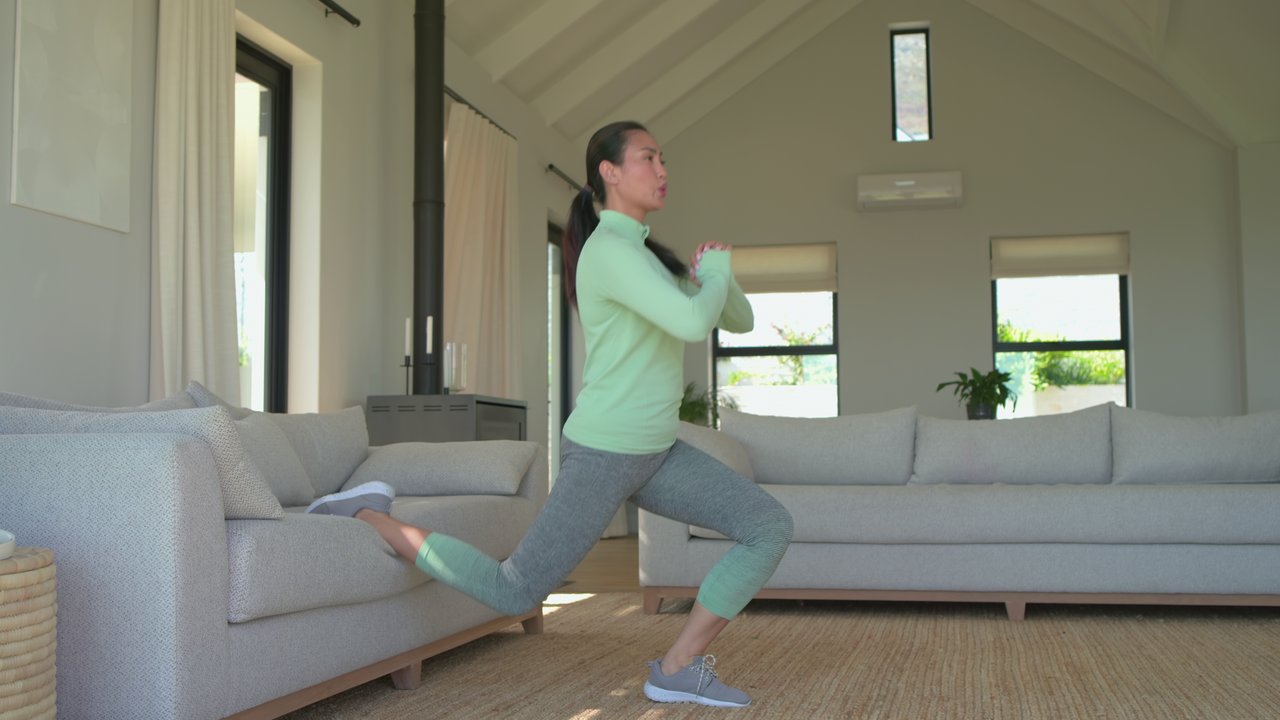
A Bulgarian split squat loads the front leg quadriceps through deep knee flexion while keeping the torso upright to minimize spinal compression. Envato Elements.
Start with the four quadriceps heads and joint mechanics
Maximizing quadriceps development requires appreciating how knee flexion depth and hip angle alter recruitment across all four muscle bellies. While all four heads converge into the common quadriceps tendon inserting via the patellar ligament onto the tibial tuberosity, their origins create distinct biomechanical demands. [2]
Biarticular powerhouse
Rectus Femoris
Originates on the anterior inferior iliac spine. Because it crosses both hip and knee joints, it flexes the hip and extends the knee. In standard squats, simultaneous hip and knee flexion keeps its length relatively constant (active insufficiency). It requires open-chain extensions or sissy squats to achieve maximal stretch and peak contraction. [2]
Key movements: leg extension, sissy squat, reverse Nordic curl.
Outer sweep mass
Vastus Lateralis
Originates on the greater trochanter and lateral lip of the linea aspera. As the largest monoarticular head, it forms the outer lateral sweep of the thigh and generates enormous knee extension torque across all heavy squats and leg presses. [1]
Key movements: barbell back squat, hack squat, leg press.
Teardrop stabilizer
Vastus Medialis (VMO)
Originates on the medial lip of the linea aspera and intertrochanteric line. Its distal oblique fibers (VMO) guide patellar tracking through terminal extension and deep flexion, preventing lateral patellar subluxation. [4]
Key movements: front squat, heel-elevated goblet squat, cyclist squat.
Deep central driver
Vastus Intermedius
Originates on the anterior and lateral surfaces of the upper two-thirds of the femur beneath the rectus femoris. Working alongside vastus lateralis, it acts as a primary knee extension prime mover in all closed-chain squats.
Key movements: Bulgarian split squat, leg press, lunges.
Deep knee flexion stretch versus open-chain isolation
Landmark muscle hypertrophy research has revealed crucial training distinctions:
Deep knee flexion stretch (closed-chain multi-joint): Studies by Pedrosa et al. (2022) and Bloomquist et al. (2013) demonstrated that training at longer muscle lengths (deep squats with full knee flexion past 90°) produced significantly greater quadriceps cross-sectional growth and strength gains than partial repetitions. Deep knee travel places vastus lateralis, medialis, and intermedius under maximal stretch under high load. [1][3]
Isolated rectus femoris growth (open-chain leg extensions): Research by Zabaleta-Korta et al. (2021) demonstrated that the leg extension stimulates substantially greater rectus femoris hypertrophy than squats or leg presses, because the seated position stabilizes the hip while isolating knee extension through the full arc. [2]
A complete quadriceps routine must combine both: heavy deep knee flexion multi-joint presses for the three vasti heads, and seated leg extensions or sissy squats for comprehensive rectus femoris development.
Curated selection
Eight foundational quad exercises
Filter these top exercises by available equipment. Each exercise offers a distinct biomechanical advantage for knee extension torque, rectus femoris recruitment, or joint-friendly loading.
Showing 8 of 8 exercises
Equipment:
The compound king
Barbell back squat
The definitive multi-joint lower body movement. A high-bar position with forward knee travel places heavy mechanical tension on the vastus lateralis, medialis, and intermedius through deep knee flexion. [1]
Upright anterior load
Front squat
Resting the barbell on the anterior deltoids forces a completely vertical torso. This dramatically increases knee forward travel and quad moment arms while reducing lumbar spine shear. [3]
Eliminates spinal axial loading, allowing lifters to train the quadriceps to true muscular failure. Placing feet lower on the footplate maximizes knee flexion travel and vasti recruitment. [4]
Elevating the rear foot isolates the working front leg. Keeping the torso upright maximizes quad loading through deep hip and knee flexion without requiring spinal compression. [1]
Holding a dumbbell or kettlebell against the chest acts as a natural counterbalance, teaching deep squat mechanics with an upright chest and knees tracking over toes. [6]
Isolated rectus femoris
Leg extension
The gold-standard open-chain exercise for the rectus femoris. Provides uninterrupted constant tension at peak extension where squats lose tension due to vertical alignment. [2]
The fixed machine track stabilizes the torso, permitting extreme knee forward travel and deep flexion without balance limitations, delivering pure mechanical tension to the vastus lateralis and medialis.
Dynamic deceleration
Walking lunge
Combines knee extension with dynamic forward deceleration, training the quadriceps eccentrically to stabilize the knee during single-leg impact absorption. [5]
No exercise matches your filter criteria. Clear the search input or reset filters to display all options.
Complete quad workout: gym and home sessions
This evidence-based quadriceps workout program targets all four heads across both lengthened deep-flexion angles and isolated peak-contraction positions. It directly absorbs the dedicated quad workout session into a unified, actionable guide.
Upright torso; descend until working knee reaches full deep stretch
4
Leg extension
3
12–15
60 sec
9
Hold 1-second pause at terminal extension to overload rectus femoris
Home quad workout alternative
If you train at home without commercial barbells or leg press machines, combine dumbbell loading and bodyweight leverage to load the quadriceps effectively:
Hold dumbbells at sides; slow 3-second eccentric tempo on descent
Walking lunge
3
12 / leg
60 sec
Maintain continuous forward momentum without pausing between strides
Sissy squat
3
10–15
45 sec
Lean torso back as knees push forward to isolate rectus femoris under stretch
Weekly volume and frequency guidelines
The ACSM position stand on resistance training recommends 10 to 16 direct sets per week for the quadriceps in trained lifters. [5] Because quads endure substantial mechanical tension and muscle damage during deep knee flexion, split your weekly quad volume across two separate training sessions (e.g., in an upper/lower or push/pull/legs split) with 48 to 72 hours of recovery between leg workouts.
Gym quad exercises and machine training
Training in a commercial gym provides dedicated resistance equipment that permits high quadriceps loading with minimal lumbar fatigue. Utilizing machines enables lifters to safely train to muscular failure without the risk of dropping a heavy barbell.
Hack squat machines: The angled carriage and back support stabilize the pelvis and spine, allowing your knees to travel far past your toes into deep flexion. This generates exceptional tension across the vastus lateralis and medialis.
45-degree leg press: Experiment with foot placement. A lower foot position increases knee flexion angle, emphasizing the quads, whereas a high and wide stance shifts loading toward the glutes and adductors.
Smith machine squats: Stepping your feet 6 to 10 inches in front of the bar allows you to maintain an upright posture throughout the descent, channeling pure knee extension torque into the quadriceps without lower back strain.
Pendulum squats: The curved counterbalanced arc provides maximum resistance in the mid-to-shortened range while de-loading the bottom position to spare knee tendons.
Quad exercises at home with bodyweight leverage
You do not need a commercial gym to develop strong, muscular quadriceps. By manipulating body angles, leverage, and tempo, bodyweight exercises can generate intense mechanical tension:
Bulgarian split squats on a couch: Elevating your rear foot on a sofa or chair forces your front leg to handle ~85% of your total bodyweight. Keeping your chest upright emphasizes the quads, while leaning forward shifts tension to the glutes.
Heel-elevated tempo squats: Elevating your heels on books, a wooden board, or a wedge increases ankle dorsiflexion capacity, allowing your knees to track forward over your toes for maximum quad activation.
Bodyweight sissy squats: Holding onto a doorway or counter, push your knees forward while leaning your torso backward. This places the rectus femoris under extreme eccentric stretch, mimicking the stimulus of a leg extension machine.
Wall sit isometric pulses: Holding a 90° knee angle against a smooth wall provides high metabolic stress and strengthens the vastus medialis and quadriceps tendon through sustained isometric contraction.
Quad exercises with dumbbells
Dumbbells offer versatile, joint-friendly quad loading for home and gym training:
Goblet squats: Holding a heavy dumbbell vertically at your chest serves as a counterweight, naturally pulling your hips beneath your torso and facilitating deep, pain-free squat depth.
Dumbbell front squats: Resting two dumbbells on your shoulders mimics the barbell front squat, keeping the torso upright and heavily loading the quads without requiring Olympic barbell wrist mobility.
Dumbbell step-ups: Stepping onto a knee-height box or bench requires the lead leg quadriceps to extend the knee under unilateral load. Avoid pushing off aggressively with the rear foot.
Dumbbell suitcase lunges: Holding dumbbells at your sides during forward, reverse, or walking lunges provides substantial overload for dynamic knee extension and balance.
Quad exercises for bad knees and joint safety
Strengthening the quadriceps is the single most effective non-surgical intervention for reducing patellofemoral knee pain and stabilizing the knee joint. However, exercise selection and movement mechanics dictate joint stress:
Patellofemoral compressive stress mechanics: Seminal research by Escamilla et al. (1998, 2001) demonstrated that in closed-chain exercises (squats, leg press), patellofemoral compressive force increases with deeper knee flexion ($70^\circ-90^\circ+$). In open-chain movements (leg extensions), joint shear force peaks in the final $30^\circ$ of extension. [4]
Joint-friendly quad movements: If deep squats aggravate your knees, incorporate box squats (which limit knee travel and emphasize vertical shins), reverse lunges (which reduce anterior patellar shear compared to forward lunges), and terminal knee extensions (TKE) with resistance bands.
Warm-up and tempo: Perform 5–10 minutes of light cycling or walking backward on a treadmill before leg training to increase synovial fluid circulation. Lower weights under a controlled 3-second descent rather than bouncing out of the bottom.
Clinical safety threshold: Mild muscular discomfort or slight stiffness is normal when rebuilding knee strength. However, sharp, pinching, or swelling joint pain is a warning signal. Cease the movement immediately and consult a licensed physical therapist or orthopedist.
Tailored quad training for women and men
While the fundamental muscle architecture and physiology of the quadriceps are identical between sexes, programming emphasis can be adapted to specific athletic and physique goals:
Women: Often seek quad tone and definition alongside glute development. Emphasizing Bulgarian split squats, heel-elevated goblet squats, and walking lunges develops shapely leg curves and strengthens the VMO to counteract larger Q-angle knee valgus forces.
Men: Frequently pursue maximum overall thigh circumference and the iconic outer sweep. Heavy barbell back squats, heavy leg presses, and hack squats provide the progressive overload required to stimulate high-threshold motor units across the vastus lateralis and intermedius.
Common quad training mistakes to avoid
Cutting squat depth short: Halving your squat range of motion reduces quadriceps hypertrophy. As demonstrated by Bloomquist (2013), full depth squats stimulate significantly greater muscle growth than heavy quarter squats. Lower the weight and achieve full knee flexion. [3]
Neglecting the rectus femoris: Relying exclusively on squats leaves the rectus femoris underdeveloped due to active insufficiency. Include leg extensions, sissy squats, or reverse Nordic curls to train the rectus femoris through its full excursion.
Knee valgus collapse: Allowing your knees to cave inward during the ascent of a squat places excessive stress on the ACL and medial meniscus. Push your knees outward in line with your middle toes.
Bouncing out of the bottom position: Dropping rapidly into a squat and using the rebound stresses the patellar tendon rather than forcing the quadriceps muscle fibers to produce active concentric force. Descend under full control.
Frequently asked questions about quad exercises
How do I hit all four quad muscles?
To recruit all four quadriceps heads, combine a deep closed-chain pressing exercise (like a barbell back squat, hack squat, or leg press) with an open-chain knee extension exercise (like a seated leg extension or sissy squat). Squats load the vastus lateralis, medialis, and intermedius through deep knee flexion, while leg extensions isolate the biarticular rectus femoris through full terminal extension without hip flexion interference. [2]
Are 3 exercises for quads enough?
Yes. Three well-chosen exercises are completely sufficient for maximum quad development. A foundational workout consisting of one heavy bilateral compound movement (barbell back squat or leg press), one unilateral movement (Bulgarian split squat or walking lunge), and one isolation exercise (seated leg extension) thoroughly stimulates all four heads across all joint angles within 9 to 12 weekly working sets. [5]
How can I build quads with bad knees?
If you experience knee discomfort during deep squats, focus on movements that keep the shin more vertical and limit anterior knee translation: box squats, reverse lunges, and leg presses with feet placed higher on the platform. Additionally, utilize terminal knee extensions with resistance bands and isometric wall sits to strengthen the vastus medialis and tendon structures without excessive joint shear. [4]
What are the signs of weak quads?
Common indicators of weak quadriceps include difficulty standing up from a low chair without using your hands, knee buckling or instability during descent on stairs, excessive forward torso lean during squats (shifting load to the lower back and glutes), and chronic patellofemoral discomfort caused by inadequate muscular shock absorption during walking or running. [6]
What exercise grows quads the fastest?
For the vastus lateralis, medialis, and intermedius, heavy hack squats and deep barbell back squats with full knee flexion stimulate rapid muscle growth due to high mechanical tension at long muscle lengths. For the rectus femoris, seated leg extensions with a controlled eccentric tempo produce the fastest hypertrophic adaptation. Combining both yields optimal total quadriceps development. [1]
Compare quad exercises and movement patterns
Evaluate key differences in joint mechanics, muscle recruitment, and equipment setups across our detailed exercise comparison guides:
Barbell Back Squat Vs Barbell Hip Thrust
Barbell Back Squat Vs Belt Squat
Barbell Back Squat Vs Box Squat
Barbell Back Squat Vs Conventional Deadlift
Barbell Back Squat Vs Forward Lunge
Barbell Back Squat Vs Front Squat
Barbell Back Squat Vs Goblet Squat
Barbell Back Squat Vs Hack Squat
Barbell Back Squat Vs Leg Extension
Barbell Back Squat Vs Leg Press
Barbell Back Squat Vs Smith Machine Squat
Barbell Back Squat Vs Zercher Squat
Barbell Lunge Vs Dumbbell Lunge
Box Jump Vs Depth Jump
Bulgarian Split Squat Vs Forward Lunge
Bulgarian Split Squat Vs Reverse Lunge
Bulgarian Split Squat Vs Split Squat
Cossack Squat Vs Lateral Lunge
Curtsy Lunge Vs Reverse Lunge
Forward Lunge Vs Reverse Lunge
Forward Lunge Vs Split Squat
Forward Lunge Vs Step Up
Front Squat Vs Goblet Squat
Front Squat Vs Hack Squat
Front Squat Vs Zercher Squat
Goblet Squat Vs Sumo Squat
Hack Squat Vs Leg Press
Leg Extension Vs Leg Curl
Leg Extension Vs Seated Leg Curl
Leg Press Vs Vertical Leg Press
Reverse Lunge Vs Walking Lunge
Quad exercise alternatives and substitutions
Find alternative movements when equipment is occupied, when working around joint pain, or when training with home equipment:
Barbell Back Squat Alternative
Barbell Lunge Alternative
Bodyweight Squat Alternative
Box Jump Alternative
Bulgarian Split Squat Alternative
Forward Lunge Alternative
Front Squat Alternative
Goblet Squat Alternative
Hack Squat Alternative
Jump Squat Alternative
Lateral Lunge Alternative
Leg Extension Alternative
Leg Press Alternative
Overhead Squat Alternative
Pistol Squat Alternative
Smith Machine Squat Alternative
Step Up Alternative
Zercher Squat Alternative
Browse quad exercises by equipment
Explore dedicated quadriceps exercise collections filtered by specific training tools and gym setups:
Bodyweight quads exercises
Dumbbells quads exercises
Barbell quads exercises
Kettlebells quads exercises
Machines quads exercises
Resistance bands quads exercises
Smith machine quads exercises
Stability ball quads exercises
Complete quad exercise directory by equipment
Browse all 767 exercises in our comprehensive quadriceps library, grouped by equipment setup. Click any exercise title to view detailed execution guides as they become available.
Exercise directory grouped by equipment (767 movements)