The triceps brachii forms approximately 60% of your upper arm muscle mass. Composed of three distinct heads—the long head, lateral head, and medial head—this muscular powerhouse drives elbow extension, assists shoulder extension, and provides dynamic joint stability during all heavy pressing movements. [7] Learn how the triceps work in our comprehensive anatomy guide.
Explore the three-head anatomical map, filter curated exercises by available equipment, follow the absorbed complete tricep workout routine, and examine peer-reviewed hypertrophy research comparing overhead extensions to neutral pushdowns.
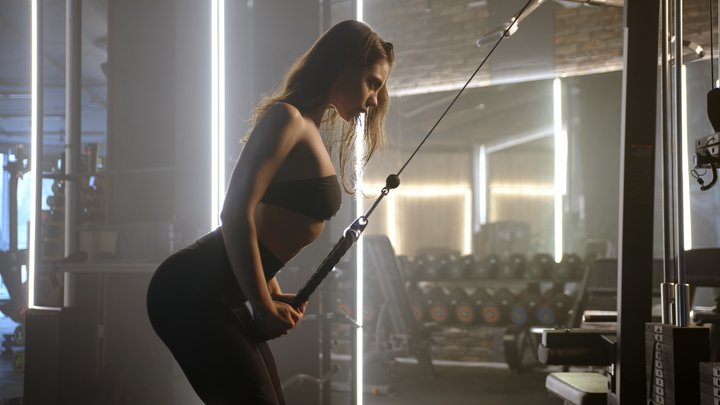
A cable rope pushdown enables full terminal elbow extension with lateral rope flare, producing peak contraction in the lateral and medial heads. Envato Elements.
Start with the three triceps heads and joint angles
Maximizing triceps development requires understanding how elbow and shoulder positioning alter recruitment across all three heads. While all three share a common insertion on the olecranon process of the ulna, their proximal origins dictate distinct biomechanical responses. [3]
Biarticular mass
Long Head
Originates on the infraglenoid tubercle of the scapula. Because it crosses both the shoulder and elbow joints, raising your arm overhead places it under passive stretch, maximizing mechanical tension during elbow extension. [1] Explore dedicated long head tricep exercises.
Originates on the posterior surface of the humerus superior to the radial groove. It creates the iconic visible outer "horseshoe" profile and generates high torque during heavy pushdowns and lockouts. Explore dedicated lateral head tricep exercises.
Originates on the posterior surface of the humerus inferior to the radial groove. The medial head is active during all elbow extension movements regardless of angle, angle speed, or resistance. Explore dedicated medial head tricep exercises.
Key movements: reverse-grip pushdown, JM press, dips.
Overhead stretch versus neutral lockout tension
Sports science has made significant breakthroughs in triceps hypertrophy programming:
Lengthened-position overload (overhead angle): Landmark research by Maeo and colleagues (2023) demonstrated that overhead tricep extensions induced ~1.5-fold greater muscle hypertrophy in the long head compared to traditional neutral pushdowns (28.5% vs 19.6% volume increase), with superior overall triceps volume gains. Placing the long head under eccentric stretch prior to contraction triggers enhanced stretch-mediated hypertrophy. [1]
Shortened-position overload (neutral and extended shoulder angle): Cable pushdowns and kickbacks maximize peak active tension when the forearm reaches full 180° terminal extension against resistance, producing maximal voluntary contraction in the lateral and medial heads.
A comprehensive training curriculum combines both: an overhead movement for lengthened long head stimulus and a heavy pushdown or press for shortened-position torque.
Curated selection
Eight foundational tricep exercises
Filter these top exercises by available equipment. Each option provides a specific mechanical advantage for elbow extension, long head stretch, or compound lockout strength.
Showing 8 of 8 exercises
Equipment:
Constant tension lockout
Tricep pushdown
The staple isolation exercise for the lateral and medial heads. Cable resistance maintains uninterrupted load straight through full elbow lockout. [2]
Elevating your arms overhead places the long head under deep passive stretch, maximizing stretch-mediated hypertrophy during extension. [1]
Heavy compound overload
Close grip bench press
Allows the heaviest absolute loading for elbow extension. Tucking elbows shifts mechanical work from the pecs onto the triceps. [4]
Bodyweight compound
Tricep dip
An exceptional closed-chain multi-joint movement. Keeping the torso upright channels intense mechanical tension into all three heads. [2]
Intermediate angle extension
Skull crusher
Performed with an EZ-bar, barbell, or dumbbells on a flat or incline bench to load the long and medial heads through deep elbow flexion. [3]
Peak bodyweight EMG
Diamond push up
Placing thumbs and index fingers together elicits the highest recorded surface EMG activation among common bodyweight exercises. [2]
Terminal shortened peak
Cable tricep kickback
Maintains continuous resistance where dumbbell kickbacks drop to zero, delivering an intense peak contraction with the humerus extended behind the torso.
Hybrid press-extension
JM press
A powerlifting hybrid combining a close-grip bench and skull crusher, enabling heavy mechanical loading of the medial and lateral heads with reduced elbow shear.
No exercise matches your filter criteria. Clear the search input or reset filters to display all options.
Complete tricep workout: gym and home sessions
This evidence-based tricep training program targets all three heads across both lengthened and shortened joint angles. It directly absorbs the dedicated tricep workout session into a unified, actionable guide.
Primary Gym Tricep Workout (35–45 minutes)
Order
Exercise
Sets
Reps
Rest
RPE
Focus Note
1
Close grip bench press
3
6–8
2–3 min
8
Shoulder-width grip; tuck elbows at 45°; lower smoothly to lower sternum
Cable or dumbbell; maintain full elbow stretch at bottom for long head growth
3
Tricep pushdown
3
10–12
90 sec
8.5
Rope attachment; flare ends outward at lockout with pinned elbows
4
Cable tricep kickback
2 / arm
12–15
60 sec
9
Extend humerus slightly behind back; squeeze 1-second pause at full lockout
Home tricep workout alternative
If you train at home without commercial cables or barbells, utilize bodyweight leverage and dumbbells to target all joint angles:
Home Tricep Routine (Dumbbells & Bodyweight)
Exercise
Sets
Reps
Rest
Progression Mechanism
Diamond push up
3
10–15
90 sec
Elevate feet on bench to increase percentage of bodyweight loaded
Bench dip
3
12–15
90 sec
Elevate feet on opposite chair or place a dumbbell across thighs
One arm tricep extension
3 / arm
10–12
60 sec
Slow 3-second eccentric descent to emphasize lengthened long head tension
Band tricep pushdown
3
15–20
45 sec
Anchor band high on door frame; lock elbows and squeeze lockout
Weekly volume and frequency recommendations
The ACSM position stand on resistance training recommends 10 to 14 direct sets per week for triceps in intermediate to advanced lifters. [4] Because the triceps act as primary synergists in chest presses and overhead presses, every heavy compound pressing set contributes roughly 0.5 sets of indirect triceps stimulus. Distribute direct triceps work across two weekly sessions (e.g., following push days or dedicated arm days) to maximize recovery and myofibrillar protein synthesis.
Tricep exercises with cables: constant tension and versatile angles
Cable columns provide continuous mechanical tension that free weights cannot replicate, particularly at terminal lockout where dumbbells lose their resistance vector:
Tricep rope pushdown: Spreading the rope ends apart at the bottom enables additional internal elbow extension and slight shoulder extension, achieving maximum shortening of the lateral head.
Straight-bar and V-bar pushdowns: Fix your wrists in pronation or semi-pronation, allowing heavier loading without grip fatigue.
Overhead cable extensions: Facing away from the high pulley and extending forward loads the long head under deep stretch with constant resistance throughout the arc.
Cross-body cable extensions: Setting twin pulleys at shoulder height and extending arms across your body aligns cable resistance perfectly with the anatomical fiber angle of each arm without wrist strain.
Explore our complete catalog of cable machine triceps exercises for setup guidelines.
Tricep exercises with dumbbells: unilateral symmetry and free range
Dumbbells enable natural wrist rotation and unilateral independence, preventing a stronger arm from compensating for a weaker one:
Seated and standing dumbbell overhead extension: Grasping a single heavy dumbbell with both hands (or using individual dumbbells) places the long head under profound stretch. Keep ribs tucked to avoid hyperextending your lumbar spine.
Incline dumbbell skull crusher: Setting an adjustable bench to a 30° incline increases shoulder elevation compared to a flat bench, enhancing long head mechanical tension.
Dumbbell Tate press: Lying flat with dumbbells pointed inward across the chest and pressing up and outward emphasizes the medial head and elbow lockout power.
Dumbbell kickbacks: Best used as a metabolic burn exercise with light weight, emphasizing the 1-second peak squeeze when the upper arm is parallel to the torso.
View the full library of dumbbells triceps exercises for detailed technique breakdowns.
Tricep exercises for each head: strategic angle selection
While you cannot completely isolate any single triceps head, joint kinematics alter relative recruitment:
Targeting the Long Head: Select exercises where your elbows are elevated above or in front of your shoulders. Movements like the overhead tricep extension, cable overhead tricep extension, and barbell overhead tricep extension exploit stretch-mediated hypertrophy. [1]
Targeting the Lateral Head: Choose exercises with elbows pinned at your sides under heavy loading. The tricep pushdown, close grip bench press, and diamond push up produce peak lateral head force.
Targeting the Medial Head: Highly active in reverse-grip variations and deep elbow flexion. Movements like the jm press, skull crusher, and reverse-grip cable pushdowns channel consistent tension into this stabilizing head. [3]
Tricep exercises at home: bodyweight and resistance bands
Building dense triceps at home requires no commercial cable stacks when you leverage closed-chain bodyweight exercises and elastic resistance:
Diamond push-ups: Placed at the top of the ACE electromyography rankings, diamond push-ups deliver higher muscle activation than bar dips or pushdowns by concentrating bodyweight directly through the hands. [2]
Bench and chair dips: Supporting your hands behind you on a sturdy chair or coffee table provides convenient vertical extension. Elevate your feet on another chair to increase overload.
Banded pushdowns and overhead extensions: Fasten a resistance loop band to a door anchor or high pull-up bar. The accommodating resistance curve challenges the triceps progressively through lockout.
Close-grip push-ups: Placing hands shoulder-width with elbows skimming the ribs reduces anterior shoulder strain while transferring pushing force onto the triceps.
Review all home equipment variations: bodyweight triceps exercises and resistance bands triceps exercises.
Tricep exercises gym: heavy barbells and dedicated machines
Commercial gym facilities provide the heavy barbell implements and specialized machinery required for maximum mechanical overload:
Barbell close-grip bench press: The king of triceps mass-builders. Grip width should be approximately shoulder-width (roughly 14–16 inches apart); gripping narrower than shoulder-width increases wrist torque without added triceps recruitment.
EZ-bar lying extensions: The angled camber of the EZ-bar relieves wrist pronation strain common with straight bars during skull crushers. Check ez bar triceps exercises and barbell triceps exercises.
Dip stations and weighted belts: Performing parallel bar dips with an upright torso and adding external plate weight builds tremendous pushing strength.
Selectorized triceps extension machines: Fixed-path elbow support pads eliminate shoulder stabilization, allowing trainees to push directly to momentary muscular failure safely. See machines and smith machine triceps exercises, along with kettlebells triceps exercises.
Tricep training for women and men: tone, definition, and strength
The anatomical architecture and neuromuscular recruitment of the triceps brachii are identical across sexes: both men and women possess the exact same three muscular heads performing identical elbow and shoulder extension actions. [7]
However, programming objectives often emphasize distinct priorities:
Arm definition and firming ("tightening saggy arms"): Trainees seeking leaner, firmer upper arms often aim to address laxity on the posterior arm. While spot reduction of fat is a biological impossibility, building triceps muscle density increases underlying firmness and arm silhouette as systemic body fat decreases through nutrition.
Lockout power for athletic strength: Powerlifters and bench press specialists focus heavily on heavy close-grip presses, board presses, and dips to eliminate sticking points midway through pressing movements.
Progressive overload is non-negotiable: Performing endlessly high repetitions with 2-pound dumbbells will not generate sufficient mechanical tension. True toning and strength require working with challenging weights in the 8–15 repetition range within 2–3 repetitions of failure. [4]
Common tricep training mistakes to avoid
Flaring elbows outward during pressing and extensions: Allowing your elbows to flare excessively out shifts mechanical load toward the shoulders and chest while placing high torque on the elbow joint capsule. Keep elbows tucked forward at roughly 30–45° during benching, dips, and pushdowns.
Cutting range of motion short: Stopping short of full lockout during pushdowns skips the crucial shortened position of the lateral and medial heads; conversely, failing to achieve full elbow flexion on overhead extensions eliminates the lengthened stretch of the long head. Use full, controlled range of motion. [1]
Using body momentum and hip swinging: Leaning over the cable stack and bouncing your torso turns a triceps isolation movement into a momentum drill. Lock your torso in place, pin your upper arms against your ribs, and move strictly at the elbow joint.
Neglecting overhead triceps movements: Many trainees perform only pushdowns, close-grip bench, and dips. Because all these movements keep the shoulder neutral or extended, they leave the long head under-stimulated. Always include at least one overhead extension variation.
Frequently asked questions about tricep training
What is the best overall tricep exercise?
Research across electromyography (Boehler et al., ACE study) and long-term muscle hypertrophy (Maeo et al., 2023) indicates that no single exercise is universally superior for all three heads. For pure long head hypertrophy, the overhead tricep extension (cable or dumbbell) is the most effective due to stretch-mediated adaptation. For overall muscle activation and compound overload, the diamond push-up and close-grip bench press produce the highest force outputs. An optimal program pairs an overhead extension with a heavy pushdown or press. [1][2]
How do I target all 3 tricep heads?
To hit all three triceps heads in a single training session, combine exercises across three distinct shoulder positions: (1) an overhead extension (elbows elevated overhead) to maximize stretch on the long head; (2) a cable pushdown or kickback (elbows pinned by your sides) to drive peak terminal contraction in the lateral head; and (3) a compound pressing movement like the close-grip bench press, JM press, or dips to heavily overload the medial and lateral heads simultaneously. [3]
What is the #1 tricep exercise?
In independent electromyographic testing conducted by the American Council on Exercise (ACE), the diamond push-up ranked #1 in overall muscle activation, closely followed by dips and overhead triceps extensions. For loaded gym training, the close-grip bench press is considered the premier movement for moving maximum weight, while the overhead cable extension is the gold standard for long-term hypertrophy. [2]
How to tighten saggy triceps?
Tightening loose or "saggy" posterior arms requires a two-pronged approach: (1) progressive resistance training (8–15 repetitions, 10–14 weekly sets) focusing on overhead extensions, pushdowns, and dips to build and firm the underlying muscle tissue; and (2) a moderate, sustainable caloric deficit if systemic body fat reduction is needed. Spot reduction cannot burn fat exclusively from the arms, but developing muscle volume fills out and firms the upper arm profile as overall body composition improves.
Movement comparisons and exercise alternatives
Evaluate joint mechanics, elbow angles, and equipment trade-offs before swapping triceps exercises in your training split:
Movement comparisons
Close Grip Bench Press vs Tricep Dip
Overhead Tricep Extension vs Skull Crusher
Skull Crusher vs Tricep Pushdown
Close Grip Push Up vs Diamond Push Up
Exercise alternatives
Tricep Kickback Alternative
Overhead Tricep Extension Alternative
Tricep Dip Alternative
Close Grip Bench Press Alternative
Tricep Pushdown Alternative
Bench Dip Alternative
Diamond Push Up Alternative
Skull Crusher Alternative
JM Press Alternative
Complete tricep exercise directory by equipment
Browse all 329 exercises in our comprehensive triceps library, grouped by equipment setup. Click any exercise title to view detailed execution guides as they become available.
Exercise directory grouped by equipment (329 movements)
Cables (85)
Cable Bar Pushdown
Cable Bar Reverse Grip Pushdown
Cable Bar Rolling Pushdown
Cable Bar Skullcrusher
Cable Bent Over Single Arm Overhead Tricep Extension
Cable Bentover Tricep Extension
Cable Bilateral Cross Skullcrusher
Cable Bilateral Cross Tricep Extension
Cable Concentration Tricep Extension
Cable Cross Body Tricep Extension
Cable Cross Pushdown
Cable High Pulley Tricep Extension
Cable Incline Tricep Extension
Cable Leaning Single Arm Skullover
Cable Low Tricep Extension Supine
Cable Lying Tricep Extension
Cable One Arm Tricep Extension
Cable One Arm Tricep Extension Kneeling
Cable One Arm Tricep Kickback
Cable One Arm Tricep Kickback Reverse Grip
Cable One Arm Tricep Pushdown
Cable One Arm Tricep Pushdown Reverse Grip
Cable Overhead Tricep Extension
Cable Overhead Tricep Press
Cable Push Down
Cable Push Down Narrow Overhand Grip
Cable Push Down Narrow Underhand Grip
Cable Push Down Neutral Grip
Cable Push Down Rope Grip
Cable Push Down Shoulder Width Underhand Grip
Cable Push Down Wide Overhand Grip
Cable Push Down Wide Underhand Grip
Cable Pushdown Support
Cable Reverse Grip Tricep Extension
Cable Reverse Push Down
Cable Rope High Pulley Tricep Extension
Cable Rope Incline Tricep Extension
Cable Rope Rolling Pushdown
Cable Rope Skullcrusher
Cable Rope Tricep Extension Supine
Cable Single Arm Cross Pushdown
Cable Single Arm Overhead Tricep Extension
Cable Single Arm Pushdown
Cable Single Arm Rolling Pushdown
Cable Single Arm Rope Pushdown
Cable Single Arm Skullcrusher
Cable Standing Triceps Extension Rope
Cable Tricep Dip
Cable Tricep Extension Kneeling
Cable Tricep Extension With V Bar
Cable Tricep Kickback
Cable Tricep Pushdown V Bar
Cable Underhand Tricep Pushdown
Dual Cable Triceps Extension
Incline Bench Cable Row Rope Extension
Incline Bench Rope Extension
Jackhammer Pushdown
Leaning Overhead Rope Tricep Extension
Lying Cable Pullover Rope Extension
Lying On Floor Tricep Extension Rope Extension
Machine Cable V Bar Push Downs
One Arm Cable Extension
One Arm Cable Underhand Tricep Extension
One Arm Standing Overhead Cable Tricep Extension
Overhead Rope Tricep Extension
Power Push Down
Reverse Grip Cable Tricep Kickback
Reverse Grip One Arm Standing Overhead Cable Tricep Extension