
How to Estimate Portion Sizes Without a Scale
Start with a reference you can identify: a fraction of a labeled package, a measuring cup, or a fill level you have checked in your usual bowl. Hand comparisons can help when those references are unavailable. Keep the result approximate when you have not measured it.
Your portion is the amount you choose to eat. A serving on a label is the amount used for its nutrition information; it is not a personal instruction about how much to eat. [1]
Choose the reference available to you
You do not need to turn every meal into a weighing exercise. You do need to know what your estimate is based on. These three approaches answer slightly different questions.
| What you have | What to do | What remains uncertain |
|---|---|---|
| A package with a stated quantity | Record the fraction you use: half, a third or another share of that same food. | A division made by eye may produce unequal shares. |
| A measuring cup or marked container | Read its volume marking, or use it to learn a fill level in your regular bowl. | Volume alone does not give a universal weight in grams. |
| Only a plate and your hands | Use a familiar shape comparison and describe what you served. | This is a rough visual reference, not a measured gram amount. |
NIDDK explains how package servings relate to the amount eaten. [4] MedlinePlus suggests measuring familiar foods for a few days to practice judging their appearance. Use those ideas to build a reference you can repeat. [2]
Learn the fill level of a bowl you actually use
- Choose a particular food and dish.Use the bowl or container you normally eat from, with the food in the state you will serve it.
- Check a marked amount when you can.Put a measured volume into that dish and notice its fill level. MedlinePlus recommends this kind of practice before relying on visual judgment.
- Keep the description with the reference.“Cooked rice, level half-cup measure, in my small bowl” is a clearer record than “some rice.” Do not assume a different food will weigh the same at that line.
- Reuse the reference deliberately.When the measuring cup is unavailable, compare the same food and dish with that remembered level. Record it as an estimate.
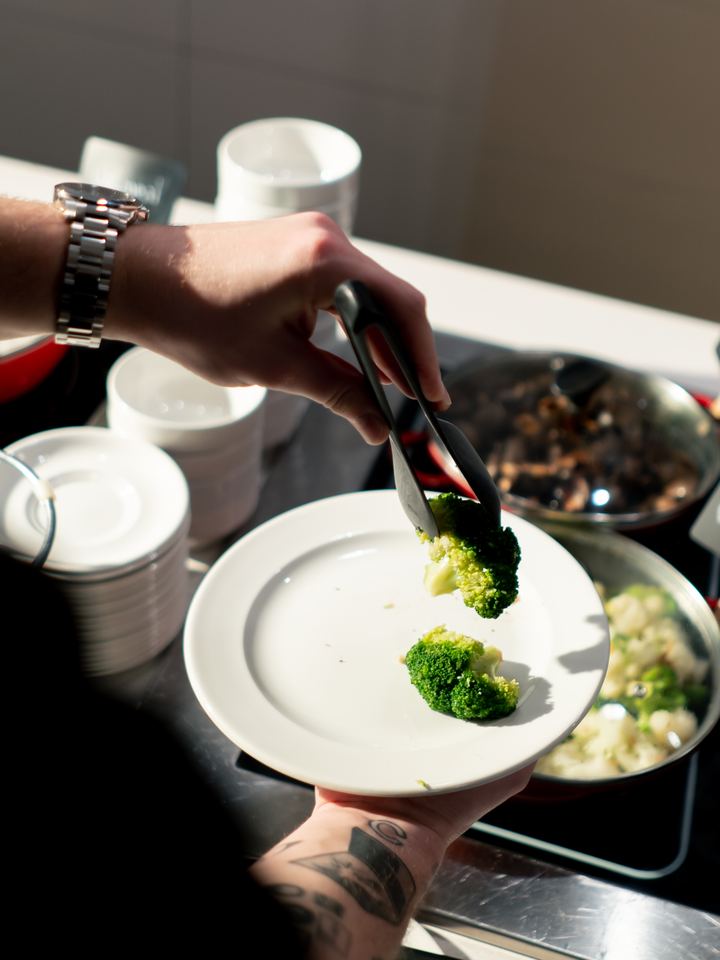
A photo can remind you which bowl and fill level you used. It does not turn an unmeasured meal into known grams or calories. Keep the quantity reference alongside the picture.
Use hand comparisons as shape reminders
MedlinePlus uses a palm or deck of cards for meat or poultry, a rounded handful for cooked rice or pasta, and a fist or baseball for chopped fruit or vegetables. These are visual comparisons. They do not establish that every palm contains the same weight or that every reader needs the pictured amount. [2]
- Palm-shaped food: notice thickness as well as its outline.
- A handful: notice whether the food is loosely held, heaped or compressed.
- A bowlful: keep the bowl and its fill level consistent when comparing it with a previous portion.
At a buffet or restaurant, an honest description such as “about a palm-sized piece” can be more useful than an exact-looking gram number that you never established. For a mixed plate, describe its components separately rather than treating the whole plate as one standard size.
Divide a known amount into equal shares
This calculator handles the arithmetic behind a package fraction. Enter an amount from a reference you have, choose its unit, then divide it into a whole number of equal shares. It keeps the selected unit; it does not convert milliliters into grams.
Keep the assumption visible
Imagine a fictional ready-to-eat tub listing 450 g of food, with nothing added or removed. If you split it into three truly equal shares, the arithmetic is 450 ÷ 3 = 150 g each. Dividing it into six equal shares gives 75 g each.
When you split that tub by eye, the actual shares may differ. Writing “about a third of a 450 g tub” keeps that uncertainty visible. The division calculates an equal share; it does not measure the food in each container.
What if my reference is volume instead?
The same fraction rule applies within that unit: a fictional 600 mL amount divided into four equal shares gives 150 mL each. This does not establish a gram weight. Use a weight reference for that specific food if you need grams.
Match the food before converting its portion
USDA FoodData Central describes food characteristics such as raw or cooked, and provides gram weights for specific food portions. Its weights refer to edible material, with details such as bones or cores treated separately. A database portion is therefore attached to a food description, not to every food that fits in the same cup. [3]
Check the food, preparation state and unit together. Avoid taking a gram value listed for one food and applying it to a different ingredient or to the same ingredient described differently. If the package or a food-specific reference gives you a usable weight, the nutrition-label guide explains how to scale the nutrient amounts.
Keep the estimate useful for the next meal
Record the reference as well as the amount: the package fraction, the marked measure, or the bowl and approximate fill level. That makes a later comparison easier to interpret without pretending the original estimate was precise.
For repeated meals, decide how you will divide and describe the food before filling the containers. The meal-prep guide covers the wider planning task. Estimating what is on the plate and choosing the amount that suits your individual needs are separate decisions.
Portion-estimation questions
Does one palm mean 100 grams?
No fixed gram value is established by a palm comparison alone. Use it as a visual reminder, or check a portion weight for the specific food you are describing.
Can I convert any cup of food to grams?
A cup is a volume reference. You need a gram weight for that particular food and portion to make a food-specific conversion. The USDA documentation keeps those food descriptions and weights together.
Does the serving on the package tell me what I should eat?
No. FDA serving sizes reflect typical consumption and define the amount behind the label's information. They are not personal portion recommendations. [1]
Sources
- FDA: Serving Size on the Nutrition Facts Label — serving information, package quantities and the distinction from a recommendation.
- MedlinePlus: Portion size — practice with measuring cups and qualitative hand or object comparisons.
- USDA FoodData Central: Foundation Foods Documentation — food descriptions and food-specific edible-portion weights.
- NIDDK: Food Portions—Choosing Just Enough for You — portions, label servings and package fractions.
Package amounts and calculator examples on this page are fictional arithmetic examples. The photo and visual comparisons do not provide nutrient measurements.