
The bar drops or rebounds
Slow the descent and choose a lighter load. A bounce makes the bottom of the repetition harder to control; it is not a substitute for pressing strength.
Lie on a flat bench, hold the bar over your chest, lower it under control, then press it back up. Your chest, front shoulders and triceps share the work. A stable setup matters before the first repetition.
This guide covers the standard flat barbell version. Start with a load you can handle without losing your position, and arrange a spotter before you unrack.
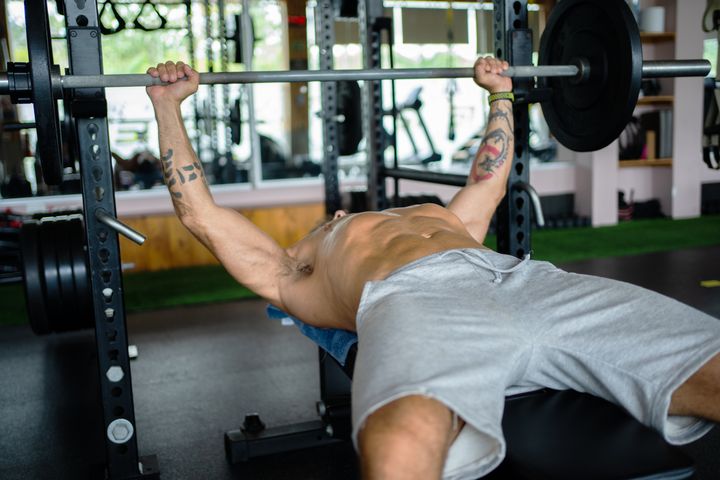
A cue to remember: feet steady, shoulders set, bar controlled. If you have to change all three to finish a repetition, reduce the load before the next set.
The pectoralis major, the large chest muscle, is a main contributor. The anterior deltoids at the front of your shoulders and the triceps at the back of your upper arms also help press the bar. Your trunk muscles help hold your position. This is a shared pressing movement, so feeling your arms work does not mean your chest has switched off. [1] [2]
Slow the descent and choose a lighter load. A bounce makes the bottom of the repetition harder to control; it is not a substitute for pressing strength.
Finish the set with your spotter, then rebuild your base. Keep your feet on the floor and avoid using an increasingly exaggerated back arch to move a load you cannot otherwise manage.
Hand placement needs to work with your body and range of motion. Have a trainer check it instead of forcing a very wide or very narrow grip because it looks stronger.
Rushing, excessive arching and using too much weight are common problems identified in the technique sources. [1] [2]
Use the repetition target in your training plan. Select a weight that lets you complete those repetitions with the same controlled technique. If your position breaks down, lower the weight or do fewer repetitions. Keep breathing through the exercise rather than holding your breath. [3]
For a useful training log, record total bar-and-plate weight, completed repetitions, sets and rest. Keep the bench angle and exercise name consistent. “Bench press” with a flat barbell setup is a different entry from an incline dumbbell press; changing both the exercise and the load makes your next comparison less useful.
Check which movement your plan actually names. This page is for a flat bench and a free barbell. An incline bench, dumbbells and a chest-press machine change the setup and need their own instructions.
With no bench or barbell available, the push-up guide gives you a floor-based pressing movement to learn. It is another exercise to discuss when adapting a plan, rather than a weight-for-weight replacement.
Warm up, use a spotter and get qualified help with unfamiliar equipment. Do not choose your first practice set as a test of your maximum. Stop if the movement causes pain; do not add weight to push through it. [2] [3]
Start around shoulder width or slightly wider. The exact recommendation differs between the technique sources, so treat it as a starting position to check with a trainer, not a measurement every lifter must copy.
Do not force contact. NASM describes lowering just above the chest, while Cleveland Clinic describes lowering to the chest. Follow a coached range you can control without bouncing or losing your setup.
A technique guide cannot give you a useful target from your age or body weight alone. Start with a manageable load and the repetition target in your plan. Keep the movement controlled before making it heavier.