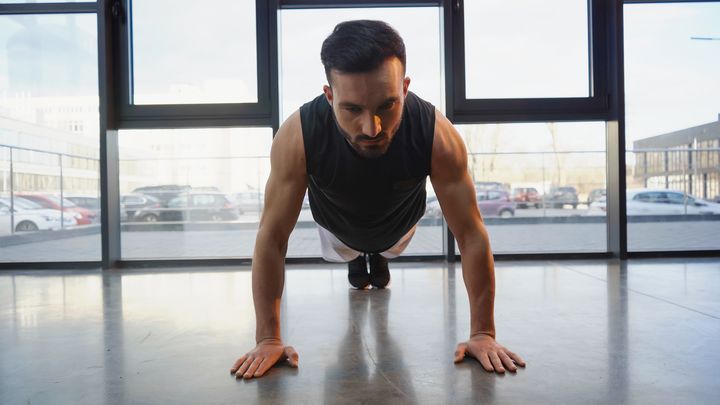
Start in a high plank, bend your elbows to lower your chest toward the floor, then press back up while keeping your body aligned. The push-up works your chest, front shoulders and triceps; your core helps stop your middle from sagging.
The most useful version is one you can control. If the floor version falls apart, raise your hands onto a sturdy surface or practise with your knees down.
Chest · shoulders · tricepsBodyweight · clear floor space
The high-plank starting position. The steps below cover lowering and pressing. LightFieldStudios / Envato.
One controlled repetition
How to do a push-up
Use a clear, stable surface with room to extend your legs. These steps cover the standard palms-on-floor version. [1][2]
Place your hands.Put your palms flat on the floor around shoulder width apart, with your fingers facing forward. Begin with your hands beneath your shoulders.
Make a high plank.Extend your legs behind you and lift your knees. Brace your abdomen and keep your head, trunk and legs aligned. Look toward the floor without jutting your chin forward.
Lower your body together.Bend your elbows and bring your chest toward the floor. Keep your elbows near your sides rather than spreading them straight out. Your hips should travel with your chest.
Press the floor away.Straighten your arms to return to the high plank. Keep your middle supported as you rise; avoid letting your chest lift first while your hips stay behind.
Check before repeating.Can you keep the same alignment on the next repetition? If not, end the set or use one of the easier versions below. A few controlled repetitions give you a clearer starting point than extra ones with a sagging back.
Push-up muscles worked
Your pectoralis major in the chest, anterior deltoids at the front of the shoulders and triceps in the upper arms contribute to the press. Your abdominal and other trunk muscles help maintain the plank position. Think of two tasks happening together: your upper body presses while your middle holds its shape. [1][2]
A muscle-group label is useful for finding the exercise, but the repetition still involves several body areas. This is why losing your trunk position matters even when your goal is chest training.
If a floor push-up is too difficult
You do not have to keep repeating a version you cannot control. NASM and Cleveland Clinic both describe incline and knee-supported options. [1][2]
Hands elevated
Use a sturdy raised surface
Place your hands on a stable counter or other secure elevated surface, with your legs extended behind you. Lower your chest toward the surface and press back while keeping your body aligned. Check that the support cannot slide or tip before starting.
Knees supported
Keep your knees on the floor
Use a padded surface if needed. Keep your trunk aligned with your thighs as you bend your elbows and press back. Your knees change the support point; they are not a cue to leave your hips behind while only your chest moves.
Pick one version and note it in your log. Once you can repeat it with control, gradually work toward a more demanding version. Keep the movement quality as your check instead of treating a particular variation as a badge you must earn.
Three form problems you can spot
Your hips sag
Your middle drops below the line of your body. Reset your brace. If it happens again, use an incline or knee-supported version so you can practise the press with your trunk supported.
Your hips rise first
The repetition turns into a hips-up movement. Reset to an aligned starting position and lower your body together. Reduce the difficulty when you cannot keep that shape.
Your head reaches for the floor
Your chin moves forward while your chest barely lowers. Keep your head in line with your spine and look down; let the elbow bend bring your chest toward the floor.
Loss of trunk alignment and forward head position are common errors described by NASM. [1]
How many push-ups should you do?
Use the repetition target in your plan and a variation that lets you maintain your position. If you cannot finish the target with control, reduce the repetitions or difficulty. There is no useful universal daily number that tells every reader where to start. Mayo Clinic's technique guidance puts form before lifting more or completing more repetitions. [3]
Record variation, support height if relevant, completed repetitions, sets and rest. Ten incline repetitions and ten floor repetitions describe different tasks. Keeping the setup consistent makes your progress easier to interpret.
When to stop and adjust
Keep breathing, move under control and stop if the exercise causes pain. A raised surface must be stable enough to support you. If you are unsure about your technique or a variation is uncomfortable, ask a qualified professional to help you choose an appropriate setup. [2][3]
Push-up questions
Do knee push-ups count?
They are a recognised variation. Record them as knee push-ups so your log describes what you actually did, and keep your trunk and thighs aligned throughout the movement.
Why do my hips sag before my arms get tired?
Holding the plank is part of the exercise. Reset your trunk position and try an easier variation if it keeps happening. This observation alone does not diagnose a weak or injured muscle.
Can I use push-ups instead of bench pressing?
Both are pressing exercises involving the chest, shoulders and triceps, but the equipment and setup differ. Learn each movement separately and adapt your training plan with that difference in mind. See the barbell bench press guide for its bench, rack and spotting requirements.