A barbell can be used for squats, deadlifts, rows, presses and curls. Choose the movement you want to train, then check how you will start and finish it: a bar on the floor is a different setup from a bar supported in a rack above a bench.
Use the choices below to match the exercise to your space and equipment, then work out the whole load before adding plates. The bench-press guide is available now; the other individual guides marked in preparation will become links when they are published.
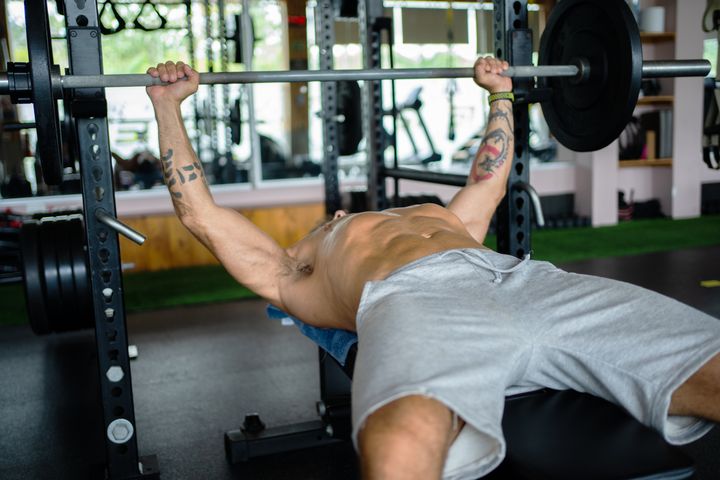
A raised-bar position during a bench press, rather than a complete technique or spotting demonstration.riderfoot / Envato
The same bar, different jobs
Six barbell exercises to build your choices around
These examples cover different movements and equipment requirements. They are options to consider, not a six-exercise workout or a ranking of the best lifts for everyone.
Choose the exercise and the starting position together
A horizontal press for the chest, front of the shoulders and triceps. [3]
A stable bench and rack, correctly positioned supports and a competent spotter.
Bent-over row
A pulling movement for the back, shoulders and arms. [4]
A manageable starting position and room for the bar. You must control the bent-over torso as you row.
Overhead press
A vertical press involving the shoulders and triceps. [5]
The bar's starting support, overhead clearance and the assistance appropriate to the lift.
Barbell curl
Direct work for the biceps at the front of the upper arm. [6]
A load and grip position that feel comfortable; a straight bar need not be the right choice for every wrist or forearm.
For lifts where a free weight is supported on the trunk or moves above the head or face, the NSCA's professional standard pairs appropriate safety equipment with attentive spotting. That matters when choosing a lift, not only when attempting a personal record. [7]
Start from the area you want to train
Barbell exercises by muscle group
A movement can involve several areas. Use the muscle name to narrow your options, then check the exercise's full setup rather than assuming every lift in that section is interchangeable.
Back, chest and arms
For your back, compare a row with a deadlift: the row pulls the bar toward the torso, while the deadlift raises it by extending the hips and knees. They are different jobs, even though both involve the back.
A bench press trains pushing muscles, including the triceps; a curl adds direct biceps work. Choose according to what your session is missing rather than adding another variation of the same movement.
The back squat and conventional deadlift both involve the legs and hips, but they begin and move differently. Choose the version you can set up and perform with control before deciding how much to load.
The overhead press adds an upward pressing direction. It also needs room above you: check the whole path of the loaded bar, not just where you stand.
These collections are planned; the names become links when their pages are ready.
Upper body
Barbell Chest Exercises
Barbell Back Exercises
Barbell Upper Back Exercises
Barbell Lat Exercises
Barbell Shoulder Exercises
Barbell Front Delt Exercises
Barbell Arm Exercises
Barbell Bicep Exercises
Barbell Tricep Exercises
Barbell Forearm Exercises
Legs and hips
Barbell Leg Exercises
Barbell Quad Exercises
Barbell Hamstring Exercises
Barbell Glute Exercises
Barbell Calf Exercises
Trunk and whole body
Barbell Ab Exercises
Barbell Lower Back Exercises
Barbell Oblique Exercises
Barbell Full Body Exercises
Know what you are lifting
What is a barbell?
A barbell is a long metal bar with weights at its ends, used for exercise and weightlifting. [8] With a plate-loaded bar, the discs sit at either end and collars secure them.
The bar itself counts. The IWF's weightlifting equipment specifications use a 20 kg bar for men's competition and a 15 kg bar for women's competition—about 44.1 lb and 33.1 lb respectively. Those are competition specifications, not starting-weight prescriptions or a guarantee of what your gym's bar weighs. Check the actual bar before counting your total. [9]
The IWF setup also includes two collars weighing 2.5 kg (about 5.5 lb) each. Your gym's collars may be different. Use the actual equipment's markings or specifications; do not silently include or leave out a heavy pair of collars when comparing loads.
Count both sides
The number on one plate is not the total load
Add the bar, every plate on both ends and the collars you are using. For a symmetrical load, the plate contribution is twice the amount on one end.
10 kg22.0 lb20 kg bar44.1 lb10 kg22.0 lb
20 kg + 10 kg + 10 kg = 40 kg (about 88.2 lb), before collars. This is an arithmetic example, not a recommended training weight.
Now add a 1.25 kg (about 2.8 lb) plate to each end: the total increases by 2.5 kg, or about 5.5 lb, not 1.25 kg. The same pair of plates takes a 40 kg load up by 6.25%, but a 20 kg load up by 12.5%. A small plate can still create a sizeable step when the starting load is light.
Use one unit system for the calculation and read the labels on your actual plates. The rounded pound equivalents here use NIST's kilogram conversion. [10] The plate calculator can help you work through a loading combination.
Keep the movement recognizable
Progress the exercise you can already control
Choose the load for this exercise today—not the load you can use for a different lift. An empty bar can be too much for a particular movement.
01
Learn the setup first
Include taking the bar from its support, performing the movement and returning it. If you cannot keep the intended technique, reduce the load or choose another exercise. Ask a qualified trainer to help with an unfamiliar lift. [11]
02
Repeat a comparable session
Record the exercise, total load, completed sets and repetitions. Keep the bar and setup identifiable so that a later comparison means something.
03
Make the next step manageable
As you get stronger, raise the resistance gradually while retaining control. Check what your smallest pair of plates actually adds before treating it as a tiny change. [11]
For a general starting point, Mayo Clinic describes a load you can lift with good technique for about 12–15 repetitions and notes that one set can be useful. That is not a requirement to perform every barbell lift in the table, or to keep repeating a lift after technique breaks down.
At home or in the gym
Owning a bar does not provide every setup
Before choosing a lift at home, check the floor, overhead space and the support equipment it needs. The NSCA's equipment guidance says setup should follow the manufacturer's instructions and recommendations. [7]
A squat rack and bench-press station solve different starting and finishing problems. If the required support or spotting is unavailable, choose another exercise rather than improvising a rack or trying to move a loaded bar into an unfamiliar position.
A barbell is one option. The dumbbell collection and bodyweight collection provide other directions to explore. ACSM's review found benefits from several forms of resistance training; the implement's name is not a guarantee of better results.
Is there a different barbell routine for women?
The useful starting questions are the same: which movement, which setup and which load can you control? Competition labels for bar types do not answer those training questions. The ACSM guidance emphasizes individual goals and abilities rather than a single prescription for everyone.
What if the bar or grip does not feel right?
Do not force an uncomfortable position to keep the exercise “barbell only.” ACE specifically discusses switching from barbell curls to dumbbell curls when the forearms are uncomfortable. [6] Stop an exercise that causes pain and get advice if you are unsure how to adapt it. [11]
Open a detailed guide
Browse barbell exercise topics
The bench-press guide is available now, with setup, technique and spotting considerations. Other topics below are in preparation; their names are not active links until the guides exist.
Train the major muscle groups regularly rather than collecting more exercise names. The ACSM's general guidance for healthy adults is at least two resistance-training days per week, with the plan adapted to the person. [12]
These longer programs are in preparation. Until they are available, use this page to understand exercise selection and loading; it is not a substitute for a complete, individualized program.
ACSM: Updated resistance-training guidelines. March 2026. Official explanation of the current position stand for healthy adults, including goal-specific loading and equipment options.