
Bodyweight Exercises
Bodyweight exercises use your own body as resistance. Push-ups, squats, lunges and planks are familiar examples. Choose movements that fit your goal, then adjust the version so you can control it. Some need only floor space; a bodyweight pull-up still needs a suitable bar. [1]
Use this guide to choose a starting session, understand the difference between floor work and supported pulling, and make progress without turning every workout into a repetition contest. Our push-up guide is available now; other individual guides below are in preparation.
Choose a movement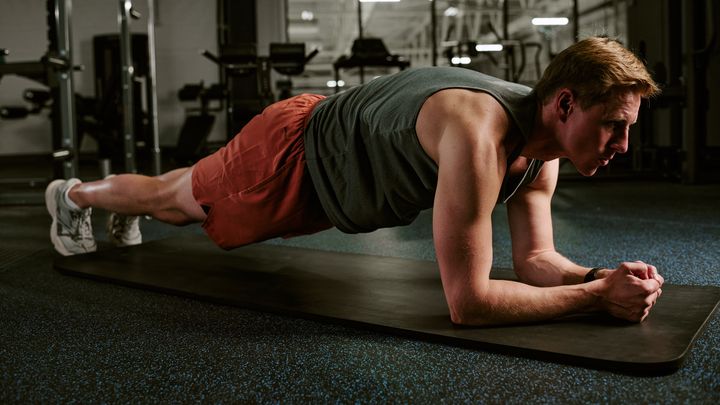
Useful bodyweight movements, by what you want to do
These are options to build a session around. You do not need to do every exercise in the table, and a harder-looking variation is not automatically a better fit.
| Choice | Why consider it? | Setup or adjustment |
|---|---|---|
| Push-up | A pressing movement using bodyweight resistance. | Use a wall or a knee-supported version if that lets you perform controlled repetitions. [2] |
| Squat or sit-to-stand | Train lowering and raising the body through the hips and knees. [4] | A stable chair gives a repeatable sit-to-stand target. The NHS also shows supported mini-squats. [2] |
| Lunge | Another standing bodyweight option for your exercise selection. [1] | Check that you have room for the step and can control the movement before adding repetitions. |
| Bridge | A floor-based hip raise that works several core muscles together. [3] | Keep the movement controlled rather than chasing a higher hip position. |
| Plank | A trunk-control exercise held against bodyweight resistance. [3] | The knee-supported version changes the support points. Keep breathing during the hold. |
| Chin-up | A pulling movement involving the back and biceps. [8] | It requires a suitable bar. Bodyweight describes the resistance, not the absence of equipment. |
| Calf raise | A standing option in the NHS home-strength routine. [2] | Use the back of a stable chair for support while raising and lowering your heels. |
For more detail on one area, use the chest collection for pressing choices. The core collection covers several ways to train trunk control, and the leg collection compares lower-body movement patterns.
Put a short session together
Warm up with a few minutes of walking or another comfortable aerobic activity. Mayo Clinic's general strength guidance uses one set of about 12–15 repetitions as a practical starting frame. Choose a version you can perform with control, and stop sooner if you lose that control. [1]
The following is an editorial example for a generally healthy adult learning these movements. It combines a squat, a press, a hip raise and a trunk hold; it is not the program tested in the research below.
| Movement | Starting amount | Keep in mind |
|---|---|---|
| Squat or supported mini-squat | 1 set, working toward 12–15 comfortable repetitions | Use a range you can control; a support can help you start. |
| Wall or knee-supported push-up | 1 set, working toward 12–15 controlled repetitions | Choose the version first. Repetitions are not a reason to lose body position. |
| Bridge | 1 set, working toward 12–15 repetitions | Mayo describes a controlled raise with a three-breath hold, then a return to the floor. [3] |
| Modified plank | One hold for three deep breaths | Rest on forearms and knees; breathe rather than straining for a long hold. [3] |
Take time between movements to recover your breathing and repeat the setup accurately. Leave a full day between sessions that train the same muscles. General guidance recommends strengthening all major muscle groups at least twice a week; this small example is a starting session, not a complete long-term plan. [1]
If you need a gentler entry point, the NHS routine starts sit-to-stand and mini-squat work at five repetitions and builds gradually. That is a different starting point from trying to complete the table's full range immediately. [2]
To add a pulling component, use an appropriate bar-based exercise after learning its setup. The floor-and-wall version above does not contain a row or chin-up. The workout directory and program guide help place an individual session in a wider week.
How to progress without adding a dumbbell
Bodyweight training still needs an appropriate challenge. When a movement becomes easy, repeat it with a clear change you can track rather than simply making the whole workout faster. The progressive push-up study below used increasingly demanding exercise variations. [5]
1. Keep the version identifiable
Write down the movement, support points, completed repetitions and sets. “Wall push-up, 12 controlled reps” is a useful record; “arms done” does not tell you what to repeat.
2. Change one feature
Add manageable repetitions or choose a different supported variation, then observe the result. Do not assume a new variation is the same exercise with an exact, known percentage added.
3. Reassess the movement
A change in position can change the task. When you move from a knee-supported plank toward the forearm-and-toe version, use the position you can control while continuing to breathe. [3]
These are practical ways to keep a training record, not a promise that every progression gives the same adaptation. If a movement needs more precise loading than your setup allows, compare the dumbbell options instead of forcing an unsuitable bodyweight variation.
Can bodyweight exercises build muscle?
Yes, some programs can—but strength, skill and muscle size are different outcomes. Two small push-up trials show why the distinction matters.
These trials support push-ups as a useful resistance exercise. They do not show that every bodyweight circuit is equivalent to every gym program, or that the same result applies to every muscle, age and training background. ACSM's 2026 guidance recognizes bodyweight, bands and other resistance options while emphasizing a routine you can maintain and individualize. [7]
What about your back, biceps and hamstrings?
A chin-up is bodyweight training, but it is not an equipment-free floor exercise: ACE's entry names a pull-up bar and describes pulling the body upward with the back and biceps involved. A row and a push-up also move in different directions. Choose a genuine pulling setup when that is the task you want to train. [8]
Do not assume an ordinary table, door or chair is an exercise anchor. Use equipment intended for the movement, follow its installation instructions, and learn how to start and finish safely. If you cannot provide that setup, plan a different exercise rather than improvising an uncertain support.
For more focused choices, the back guide explains pulling families. The arm collection separates direct arm work from compound lifts, and the hamstring collection covers that area in more depth.
Bodyweight collections by muscle group
These specialist collections are in preparation. Their titles become links when the pages are available.
Legs and hips
- Legs
- Quads
- Glutes
- Hamstrings
- Calves
- Hip flexors
- Hip abductors
Upper body
- Back
- Chest
- Shoulders
- Arms
- Triceps
- Forearms
- Rotator cuff
- Neck
Trunk and whole body
- Core
- Abs
- Obliques
- Lower back
- Full body
Exercise guides in this collection
The push-up guide is available now, with setup, technique and variations. The following guides are in preparation; their inclusion is a directory entry, not a recommendation to attempt every movement.
Lower-body guides in preparation
- Jump squat
- Forward lunge
- Bulgarian split squat
- Glute bridge
- Pistol squat
- Step-up
- Box jump
- Jumping jack
Trunk and upper-body guides in preparation
- Plank
- Sit-up
- Crunch
- Russian twist
- Triceps dip
- Side plank
- Back extension
- Superman
- Lying leg raise
- Reverse crunch
- Oblique crunch
Bodyweight still calls for care
Keep the area clear, use a nonslip surface and choose stable supports. The NHS specifies a solid chair without wheels that cannot slide for its supported exercises. Stop an exercise that causes pain; talk with a healthcare professional about a chronic condition, symptoms or uncertainty before starting. [2] [1]
Back problems, osteoporosis and other health concerns can change which core exercises are suitable. Mayo advises checking with your healthcare professional before trying its core routine in those circumstances. [3] A general exercise directory cannot provide an injury assessment.
Sources and review
- Mayo Clinic. Strength training: getting started and exercise options (June 2026).
- NHS. Home strength exercises: supported squats, sit-to-stand, calf raises and wall presses.
- Mayo Clinic. Exercises to improve your core strength (2023): bridge, modified plank and breathing.
- American Council on Exercise. Bodyweight squat.
- Kotarsky et al. Progressive calisthenic push-up training (2018). Abstract: 23 moderately trained men, four weeks.
- Kikuchi and Nakazato. Low-load bench press and push-up training (2017). Abstract: 18 young men, eight weeks.
- American College of Sports Medicine. 2026 resistance-training guidance.
- American Council on Exercise. Chin-ups: equipment and movement.
Written with AI assistance by the Fitness Instructor AI Editorial Team. A qualified trainer has not yet reviewed this page. Read our editorial policy.