
Horizontal push
Push-ups and chest presses. The push-up works the chest and triceps, with the trunk holding the body in line. [3]
Start with a press and a row, then consider an overhead press and a pulldown or pull-up. This gives you a useful way to choose exercises for your chest, back, shoulders and arms without filling your session with near-duplicates. The four families below are a planning aid, not a rule that every workout must contain all four.
Here you can compare home and gym options, see what bodyweight training can cover, and put together a small starting session. For more detail on one area, follow the muscle collections below.
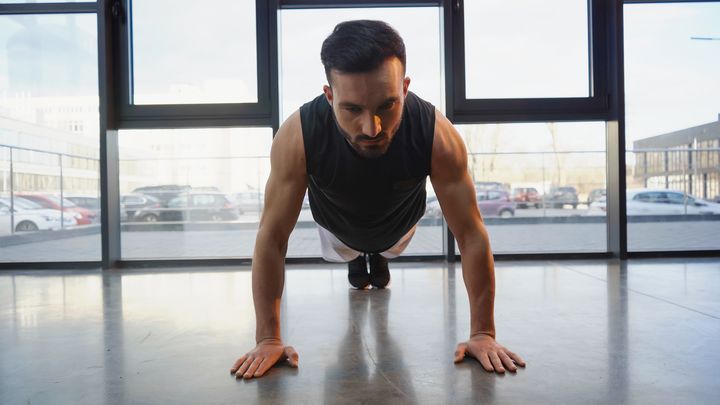
Think about where your hands travel relative to your torso. A horizontal press pushes away from your chest; a row brings resistance toward you. Overhead presses and pulldowns cover different directions. These categories describe exercise selection, not a medically proven push-to-pull ratio.
Push-ups and chest presses. The push-up works the chest and triceps, with the trunk holding the body in line. [3]
Dumbbell rows and seated rows. The row trains the back of the shoulder and upper back; a machine row also involves the arms. [4] [6]
The overhead press. ACE classifies the seated dumbbell version as an exercise for the shoulders and arms. [5]
Lat pulldowns and pull-ups. Lat-pulldown research records activity in the lats, middle trapezius and biceps; it does not make the pulldown a complete upper-body workout. [7]
These are useful candidates for the job shown, rather than a ranking of universally “best” movements. The individual guides have their own setup and technique details.
| Exercise | Why consider it? | What to check |
|---|---|---|
| Push-up | A horizontal push using your body weight. | Choose a wall, knee-supported or floor version you can control. [3] |
| Barbell bench press | A loaded alternative to the push-up for the pressing slot. | The rack, bench and spotting setup in the full guide. |
| Dumbbell row | A row you can do with a dumbbell. | Keep the trunk controlled rather than swinging the weight up. [4] |
| Seated row | A horizontal pulling option at the gym. | A cable station and a chest-supported row machine have different setups; follow the instructions for the equipment you use. [6] |
| Dumbbell shoulder press | An overhead pressing option. | Use a load you can press without leaning back to finish. [5] |
| Lat pulldown | A vertical pull with selectable resistance. | Grip details belong to the exercise guide; a wider grip is not automatically better. [7] |
| Dumbbell curl | Direct arm work when that is part of your goal. | A curl adds elbow-flexion work; it does not replace the row. NHS shows a seated option as well. [9] |
A wall push-up is a practical place to start if the floor version is too demanding. Keep your back straight and move smoothly; both Mayo Clinic and the NHS describe this option. [3] [9] A floor push-up remains a pressing exercise. Doing more variations of it does not create a row or an overhead pull.
Can push-ups build muscle? In a small eight-week trial, 18 men aged 19–22 trained twice weekly using either bench presses at 40% of their one-repetition maximum or push-ups adjusted to a similar load. Both groups increased chest and triceps thickness and bench-press strength, with no significant between-group difference in those changes. This supports push-ups as a useful resistance exercise; it does not prove that any push-up routine equals heavy bench training for every person or goal. [8]
Dumbbells give you rowing and overhead-pressing choices alongside push-ups. Start with a manageable load, then progress while keeping the same controlled technique. You do not have to improvise a pulldown just to fill the fourth box on the map. [2]
Resistance bands are a legitimate way to train, and the ACSM review did not find that one equipment category consistently determined results. Choose according to your space, setup and goals. [1] For a band exercise, use its intended secure setup and the manufacturer's instructions; do not copy a cable-machine setup onto an improvised anchor.
A cable station can provide a row and a pulldown; pressing machines provide another option for the pushing slot. “Machine” is not the movement name: check the equipment's instructions and keep a note of the seat and handle settings you use.
This is an example for a generally healthy adult who is learning the movements, not a rehabilitation plan. Warm up with 5–10 minutes of easy aerobic activity. Mayo Clinic suggests starting with one set of about 12–15 controlled repetitions and increasing the load gradually as you get stronger. [2]
| Slot | Example choice | Starting dose |
|---|---|---|
| Press | Wall or floor push-up | 1 controlled set; choose a version manageable for roughly 12–15 repetitions. |
| Row | Dumbbell row, or a machine row at the gym | 1 × 12–15; do each side if using one arm. |
| Overhead press | Seated dumbbell shoulder press, if comfortable | 1 × 12–15 with a manageable load. |
| Optional vertical pull | Lat pulldown, if you have the equipment | 1 × 12–15; learn the setup first. |
Rest about a minute between exercises, and take longer if needed to regain control of your breathing and technique. Leave a day between sessions for the same muscles. Add lower-body work elsewhere in your week: an upper-body session alone does not cover all major muscle groups. [2]
Write down the variation, resistance, repetitions and sets. For example, “wall push-up, 12 smooth repetitions” is more useful than “chest done.” Repeat a comparable setup so you can see what changed.
The ACSM's 2026 guidance recommends training the major muscle groups at least twice a week. Moving from no resistance training to a routine you maintain matters more than finding a complicated split. [1]
For maximizing strength, its evidence synthesis favored heavier loads, two to three sets, and putting priority exercises early in a session. For muscle growth, higher weekly volumes of at least ten sets per muscle group were associated with better results. Those are findings about optimizing adaptations, not an instruction for a new lifter to begin with ten hard sets for every muscle. [10]
Our starter example is deliberately smaller. Learn the movements, establish a repeatable week, then adjust the load or number of sets toward the result you want. The study population was healthy adults; sport-specific performance and recovery after illness call for a more individual plan.
Women and men: use the same movement map, then choose resistance and variations that fit you. The ACSM guidance emphasizes individual goals and abilities rather than one fixed prescription. “For women” does not tell you what weight to use. [1]
Older adults or anyone returning after a break: the NHS demonstrates wall push-ups and seated curls, with a gradual buildup. These are options to discuss if standing balance or a floor setup is a barrier; age alone does not pick your starting load. [9]
Pain, an injury or recent surgery: stop an exercise that hurts and seek advice if you cannot find a comfortable, controlled version. After a heart attack or heart surgery, get the exercise plan from your doctor or cardiac rehabilitation team before taking up this routine. Recovery differs between people; the timetable in a general lifting guide is not your clearance to train. [2] [11]
Choose one of the detailed collections for anatomy, exercise selection and the limits of the research.
Two detailed exercise guides in this selection are available now. Open one for the setup, technique and variations.
Floor technique, variations and the points to check before making it harder.
Bench and rack setup, pressing technique and spotting considerations.
These topics are planned. They become links when the guides are available.
For now, use the example above to understand how the pieces fit together. The longer sessions below are in preparation.
This guide is general exercise education for adults. A qualified trainer has not yet reviewed this page. Research summaries state the populations studied; the example session is an editorial starting template, not a tested program.